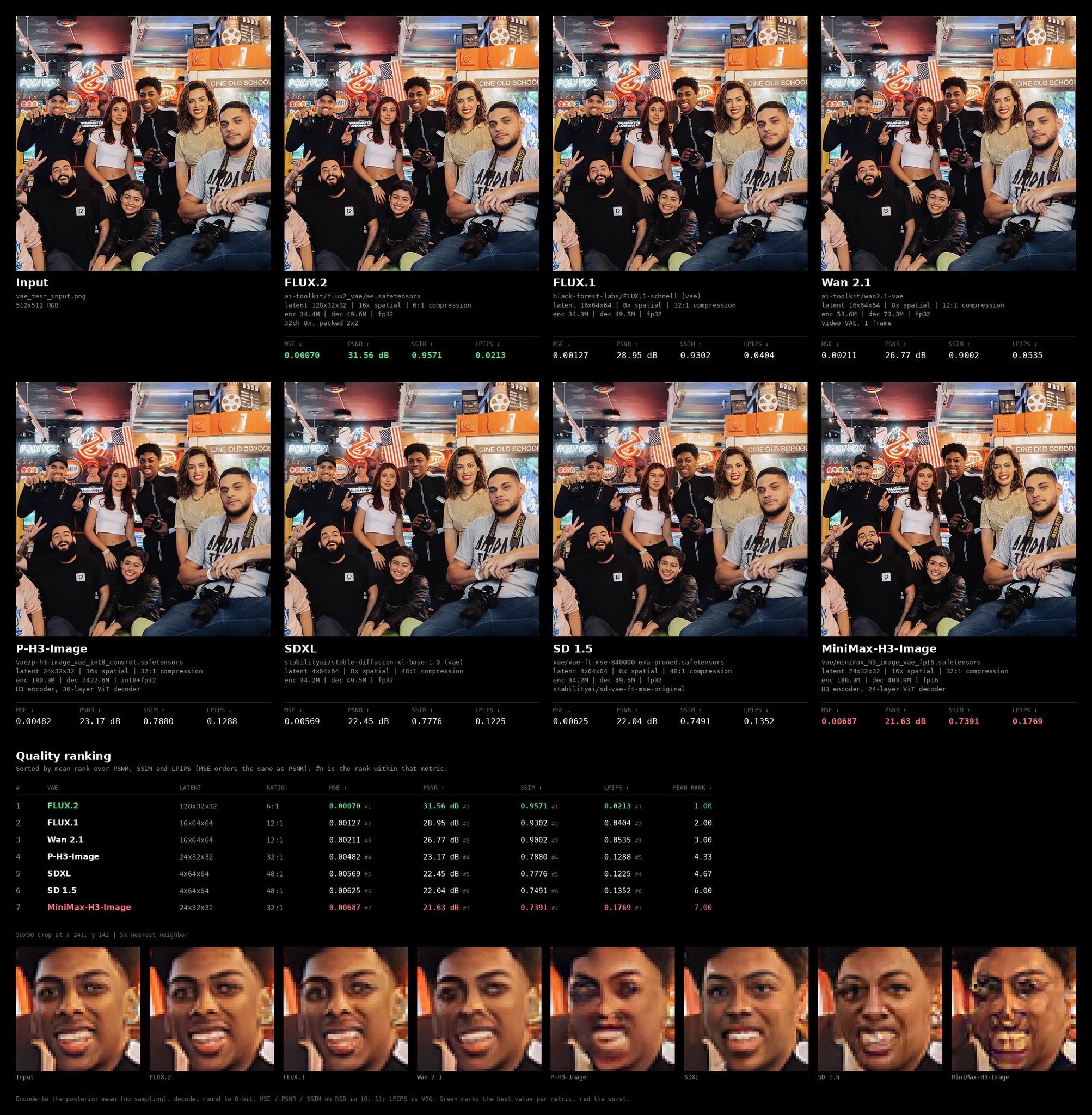
Developer Ostris, author of AI Toolkit, published a round-trip test of popular autoencoders, and the open MiniMax H3-Image model lost on all reconstruction metrics, falling behind even the VAE from SD 1.5. The fault lies not in the build or settings, but in the architecture: for speed, the model inherits a latent space from the H3 video model that is twice as compressed as the Flux class, paying the price in detail at high resolutions. The community responded quickly: a working workaround with a swappable VAE from Pruna already exists, although it only mitigates artifacts rather than eliminating their cause.


What happened
On November 11, 2026, Ostris (@ostrisai, author of AI Toolkit) published a round-trip test of the most popular VAEs: the same images are passed through the encoder and decoder, isolating the quality of the autoencoder from the quality of the diffusion transformer generation. The autoencoder of the open MiniMax H3-Image model, whose announcement and open-weight release took place on November 10, 2026 (a 33.1B parameter DiT transformer, with claimed 4K/16 MP generation in under 10 seconds), lost on all reconstruction metrics, falling behind even the VAE from SD 1.5. Ostris formulated the conclusion directly: “The main reason H3 Image struggles on detail is that it has a highly compressed latent space.” In discussions on r/StableDiffusion, a working workaround quickly appeared: an alternative VAE from the Pruna repository, SA Solver or SGM Uniform samplers, and 16 MP generation with subsequent downscaling to the working size.
Context
MiniMax H3-Image is built on the H3 video model base and inherits its latent space. According to the official MiniMax-AI/MiniMax-H3-Image repository, the Image VAE consists of a CNN encoder with 16x spatial downsampling and a 2×2 patch, resulting in 32×32 pixels per transformer token with 24 latent channels, while a 24-layer 2D ViT decoder handles restoration. Flux-class models have softer compression—16×16 pixels per token. The dense latent reduces the number of tokens, thereby speeding up generation and saving VRAM, but shifts more work to the decoder: the stronger the compression at the input, the more details are irreversibly lost before the generation stage. This is a conscious compromise for speed, not a build defect, and it is precisely this that blurs the line between marketing “16 MP” and actual detail—the resolution figure describes the frame format, not the amount of surviving information.
Why this matters for the industry
For the industry, this case forms a product template: a model as a fast DiT plus a swappable VAE, meaning big-lab release compromises can be fixed without rebuilding the main transformer. The speed of the open ecosystem is notable: the alternative Pruna VAE build garnered approximately 978,000 downloads in about two weeks, the standard VAE architecture has already been dissected in the official repository, and decoder fine-tuning has become a separate direction—Ostris himself is working on it. H3-Image remains suitable for production as a “fast mode”: 4096×4096 generation in under 10 seconds, including on consumer GPUs, with favorable unit economics for compute. Teams should recalibrate model evaluation: speed here is bought with latent capacity (32×32 px per token versus equivalent 16×16 in the Flux class), so “16 MP” promises from announcements cannot be read as a quality metric, and VAE selection, judging by the case dynamics, is becoming a separate layer of inference configuration alongside sampler choice and weight precision.
Why this matters for users
Those using MiniMax H3-Image in ComfyUI should install the VAE from the PrunaAI/P-H3-Image-Comfy repository—the bf16 version p-h3-image_vae_bf16.safetensors (5.56 GB) or the int8 version p-h3-image_vae_int8_convrot.safetensors (3.15 GB), try SA Solver or SGM Uniform samplers, and generate at 16 MP with subsequent downscaling to the desired size: on these configurations, compression artifacts are less noticeable. The cost of the workaround is an additional 3.15–5.56 GB of weights and one or two extra pipeline steps. If small details—textures, faces, small text—still look “soapy,” this is a property of the compressed latent, not an error in your settings: for such tasks, models with less compressed VAEs, such as the Flux class, are currently better suited.
What is still unknown / limitations
The community workaround should be correctly considered a mitigation of artifacts, not a solution: swapping the decoder cannot restore information lost during compression at the encoder stage. The retelling of the round-trip test claims that the H3 VAE loses to the SD 1.5 VAE on all metrics, but the metrics themselves, the test set, and encoding parameters are not named anywhere—the result is reputationally strong but formally non-reproducible. For Pruna builds, their own round-trip metrics have also not been published, so the quality gain is currently confirmed by usage practice rather than numbers. MiniMax’s official reaction to the diagnosis is unknown, and the fine-tuned decoder that Ostris is working on is an expected but not yet released addition.
Sources
- Ostris on X — VAE round-trip test and formulation about H3 Image's compressed latent space
- MiniMax-AI/MiniMax-H3-Image — official model repository with Image VAE description
- PrunaAI/P-H3-Image-Comfy — Hugging Face repository with alternative VAE build for H3-Image
Author
Look at AI, editorial team