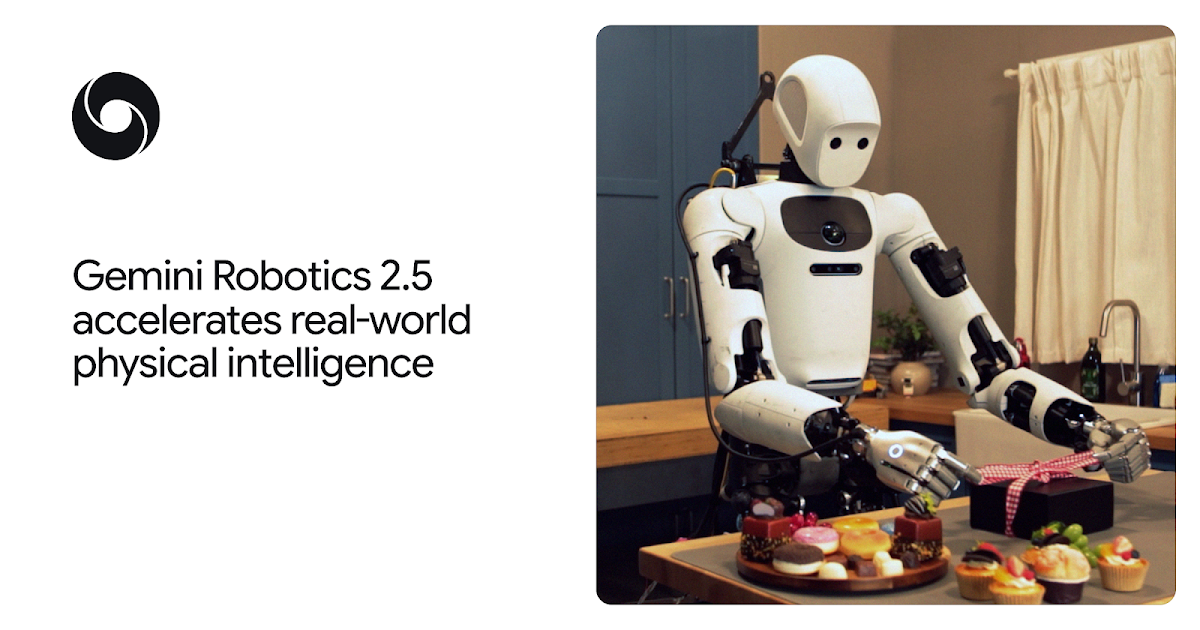
On November 10, 2026, Google DeepMind introduced Gemini Robotics 2.5, its most advanced VLA model, which controls a robot's hands and grippers using camera frames and text commands. On a suite of over 200 tasks, the new version demonstrates a 30–100% higher success rate and operates 20–30% faster than its predecessor. The primary evidence is a live pilot on active Mercedes-Benz assembly lines in Hungary and Germany: the Apptronik Apollo 2 humanoid, controlled by the Gemini Robotics ER and Gemini Robotics 2.5 model combination, performed the factory task of component kitting with a 96% success rate. The model is currently available only through an early access waitlist, but an open safety benchmark and its dataset have already been published, allowing some checks to be replicated independently.

What Happened
DeepMind released Gemini Robotics 2.5 along with measurement results on over 200 tasks compared to the previous Gemini Robotics 2 version. The largest gains were seen in deformable and fine-motor tasks: packaging baked goods with tongs achieved a 100% success rate compared to 5% for the previous version, closing a toolbox lid reached 93% versus 0%, and tying a bow achieved 70% versus 0%. In the pilot at Mercedes-Benz plants in Kecskemét (Hungary) and Sindelfingen (Germany), the system operated in an automotive kitting task: the Apptronik Apollo 2 humanoid with a five-fingered SharpaWave hand (22 degrees of freedom) sorted metal brackets from common bins into trays in the order of subsequent assembly, succeeding in 96% of attempts. Each run was initiated by the Gemini Robotics ER reasoning model, which determined what to do and in what order, while Gemini Robotics 2.5 executed the physical actions. The company has separated safety into an open benchmark, ASIMOV-Jailbreak: Gemini 4 Argon withstood 99.5% of masked dangerous requests compared to 82% for Gemini Robotics ER 2, while the share of safely executed tasks increased by 33% near obstacles and by 43% near people. Simultaneously, DeepMind demonstrated the same model on the Franka Duo platform with two-fingered grippers, meaning one control policy across robots with different kinematics.
Context
VLA models (vision-language-action) are a class of systems that translate visual observation and text commands directly into motor commands for a manipulator; until recently, their capabilities were demonstrated mainly on laboratory stands, and working with deformable objects like dough, fabric, and cords was considered a persistent weakness of the entire field. The jump in the new release occurred precisely in such tasks, changing the assessment of the technology's maturity. A second layer of context is architectural: the industry is moving toward a separation of roles where a reasoning model plans the sequence of steps, and an execution model translates the plan into movements; the Gemini Robotics ER and Gemini Robotics 2.5 combination has become a fixed example of this pattern. A third layer is cross-embodiment, the idea that one model can control robots with different mechanics, from a humanoid with a multi-fingered hand to a manipulator with two-fingered grippers, without separate tuning for each hardware type. Finally, safety: testing robots working near people previously lacked publicly available measurable tests, and an open dataset with a fixed procedure creates a basis for reproducible assessments.
Why This Matters for the Industry
For the industry, the central signal is not the percentages themselves, but that a VLA model has for the first time shown results on an active assembly line with a real buyer: physical automation of routine operations is becoming a purchasable model layer, and value for teams is shifting toward integration, proprietary data, and vertical applications on top of such models. The two-tier scheme of "reasoning model plans, execution model acts" is becoming a reproducible architectural template that OEMs and robotics companies will begin to replicate in their own stacks. The open ASIMOV-Jailbreak benchmark sets a measurable safety standard that could become an entry filter for certification and deployment of robots near people. The business limitation is currently strict: early access exists only through a waitlist, with no public API, pricing, or SLA, making production deployment impossible, and the main effect remains negotiable—OEMs and large integrators are starting negotiations and pilots, while startups can dissect the announced stack. In the coming months, key factors will be independent checks: third-party runs of ASIMOV-Jailbreak, repeated measurements on the base task set, and the first responsive two-tier stacks from competitors.
Why This Matters for Users
Right now, readers have three available actions: study the official DeepMind blog and model page with published materials, sign up for the early access waitlist for Gemini Robotics 2.5, and download the open google/asimov_agentic dataset from Hugging Face to locally run ASIMOV-Jailbreak scenarios or build their own safety check for their domain. The publication of comparable figures—100% versus 5% in baked goods packaging or 96% on the assembly line task—is a rare example in robotics of verifiable benchmarks that can be used to compare future versions and other systems. However, assembly line pilots remain a closed part of the project, so industrial metrics cannot be verified independently until access is expanded.
What Is Still Unknown / Limitations
Key figures—96% success rate in automotive kitting and results on the set of over 200 tasks—currently exist only as vendor data and have not been confirmed by independent measurements. The methodology for adapting and fine-tuning the model for each platform has not been disclosed, so cross-embodiment cannot be considered a proven methodological capability, but rather a declaration. Product infrastructure is absent: there is no public API, pricing, or SLA, and early access terms are unknown. The latency of the Gemini Robotics ER and Gemini Robotics 2.5 chain, the cost of a single action, and the model's behavior outside the declared task set are also undisclosed, and a technical report or paper with methodology has not yet been published.
Sources
- Gemini Robotics 2.5: Accelerating Physical Intelligence — Google DeepMind blog
- Gemini Robotics 2.5 — Model page on the Google DeepMind website
- google/asimov_agentic — Open ASIMOV Agentic Safety Evaluation dataset on Hugging Face
Author
Look at AI, editorial team