On November 11, 2026, Google introduced the Gemini Decisions API — a new endpoint based on the Gemini Decision 1 (gemini-decision-1) model for fast closed decisions: yes or no, choice from 2–255 options, and rubric-based scoring. The model is multimodal — it accepts text, images, audio, video, and PDFs, processes up to 1,000 independent questions in a single pass, and returns probabilities with a confidence score without generating output tokens. The price is $0.10 per 1 million input tokens and $0 for output, which, according to Google, is approximately 5 times cheaper than Gemini 3.5 Flash-Lite with the Interactions API for general tasks; the stated latency is 150–250 milliseconds end-to-end. The API can be tried for free in Google AI Studio, and gemini-decision-1 is already supported on the Vercel AI Gateway.

What happened
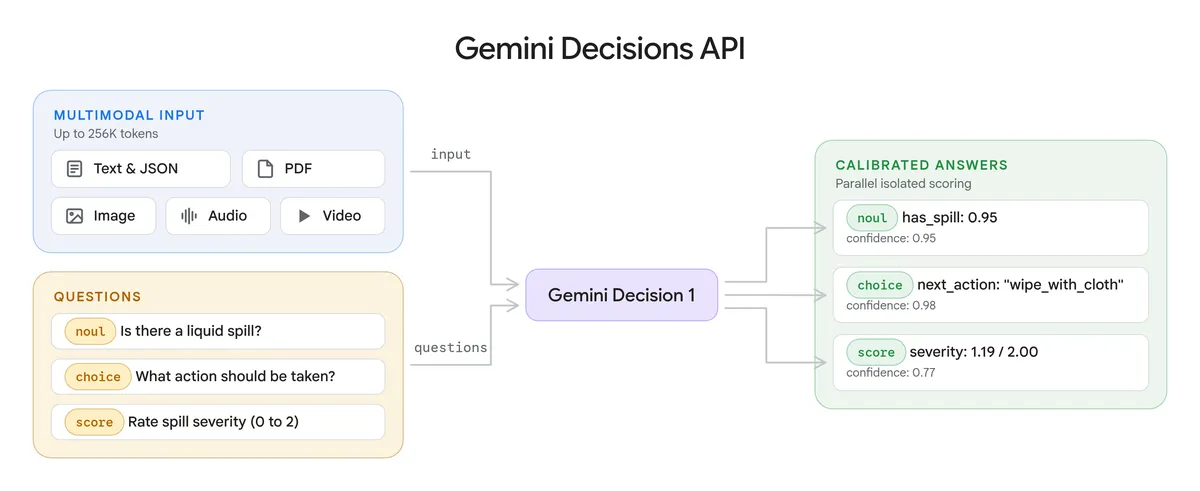
On November 11, 2026, Google announced the launch of the Gemini Decisions API — a dedicated endpoint on the gemini-decision-1 model that returns three types of closed decisions: a binary yes or no answer, a choice of one option from a list of 2 to 255 items, and a score based on a given rubric. The model accepts text, images, audio, video, and PDFs up to 256,000 input tokens, and processes up to 1,000 independent questions in a single pass. Instead of generated text, the endpoint returns probabilities for the options and a confidence score in the range of 0 to 1, with no output tokens generated at all. The rate is $0.10 per 1 million input tokens with zero cost for output; according to Google, for general tasks, this is approximately 5 times cheaper than the Gemini 3.5 Flash-Lite and Interactions API combination. The stated latency is 150–250 milliseconds end-to-end, of which 50–100 milliseconds is the median model computation time. The endpoint is already available in Google AI Studio, where it can be tested for free, and at Vercel, the gemini-decision-1 model is available via the AI Gateway.
Context
The motivation for such a product is the cost structure in agentic systems: a significant portion of large language model calls is spent not on text generation, but on micro-decisions — classification, routing between models, policy checks, and candidate ranking — and each such call has historically been billed as a full generation. Google has allocated a separate control layer for these tasks: due to the absence of sequential token generation, the model immediately calculates probabilities for all options, while the generative LLM remains only for open tasks with free text. The company is already applying this layer in its own products: Gemini Notebook uses the API for dynamic model routing, reducing latency on routine requests by up to 40 percent, and CC from Google Labs uses it to select an emoji reaction from a palette of over 200 options in a fraction of a second. In other words, this is not a research demo, but a control plane around which working product scenarios have already been built.
Why this matters for the industry
For developers and companies, this is a new building block: a dedicated decision layer to which classification, routing, policy checks, and ranking can be offloaded, leaving the generative model only where free text is needed. The economics of mass tasks change the most — moderation, tagging, and real-time ranking, where thousands of small checks are performed in a single pass instead of separate generative calls. Support for gemini-decision-1 on the Vercel AI Gateway lowers the integration barrier: a pilot can be launched through a familiar gateway, without separate infrastructure and contracts. If independent tests confirm the stated price, latency, and probability calibration, the decision layer may become a standard component in agentic stacks alongside the generative one, and competitors will have a direct reason to release similar decision endpoints.
Why this matters for users
For readers who build agents or automate processes, this provides a practical benefit right now: routine “yes or no” and “which option” checks can be moved from a generative model to a dedicated endpoint, reducing both cost and latency, which allows placing them directly in the hot execution path of an application. Since probabilities are calculated directly from the raw input, there is no need to pay separately for transcription and text recognition for audio, images, and PDFs. The endpoint is open for free in Google AI Studio, so calibration, accuracy, and speed should be tested on the same day on your own set of tasks and compared with the current solution. A reasonable plan for the week: inventory the places where a generative LLM is doing classification, routing, or policy checks, list the ten most frequent such calls, and test them on gemini-decision-1, starting with non-critical scenarios.
What is still unknown / limitations
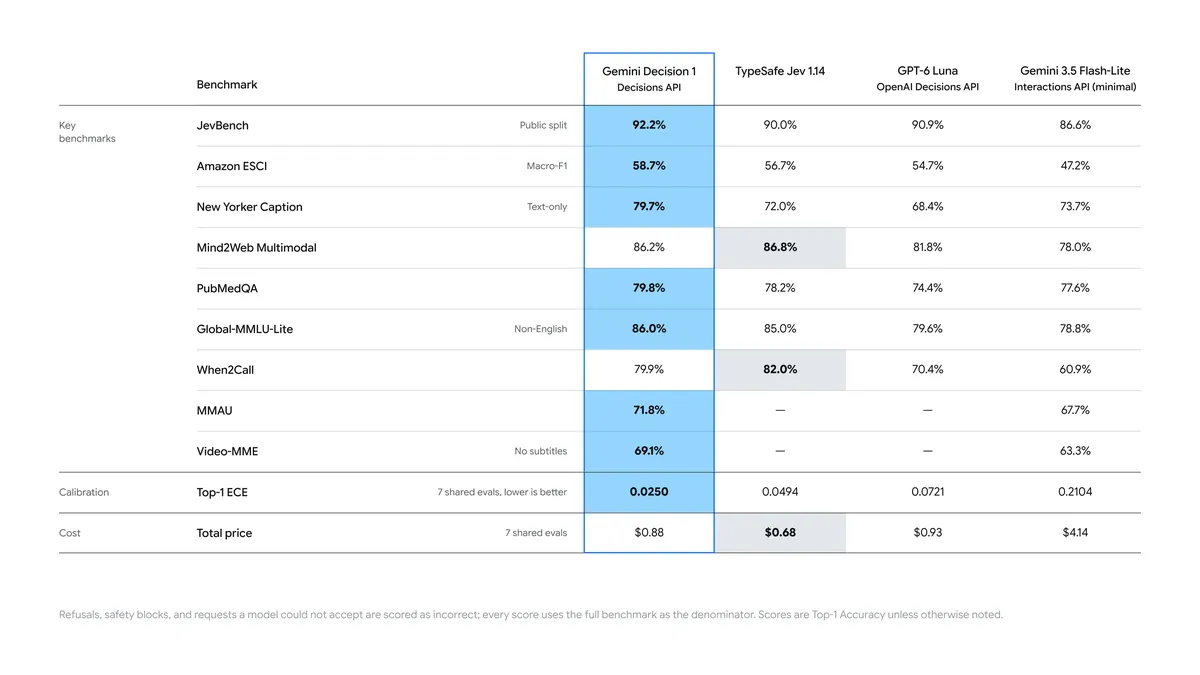
No independent assessment of the accuracy, calibration, or latency of gemini-decision-1 has been published, and calibration is a property that is ultimately verified only on specific user data. The comparison of “approximately 5 times cheaper” should be read as a vendor benchmark: the set of general tasks on which Google calculated the savings is not described in available sources. Architectural details are also not disclosed — how exactly probabilities are calculated and how the stated calibration is ensured. Google’s internal figures, including the 40 percent latency reduction in Gemini Notebook, are also provided by the company and require independent verification.
Sources
- Gemini Decisions API: Fast, calibrated multimodal decisions — The Keyword (Google)
- Google launches Gemini Decisions API for fast multimodal choices — Crypto Briefing
- Gemini Decision 1 now available on AI Gateway — Vercel
Author
Look at AI, editorial team