
Lightricks has published a technical article and an arXiv paper (arXiv:2501.00103) on the LTX-Video model, a transformer-based latent diffusion model for real-time video generation. On an Nvidia H100, it creates 5 seconds of 768x512 video at 24 frames per second in approximately 2 seconds, which is faster than the duration of the video itself. The Video-VAE and denoising transformer in the model are designed as a unified system, and the code and weights are open: the model can be run locally or via the LTX API and LTX Playground.

What happened
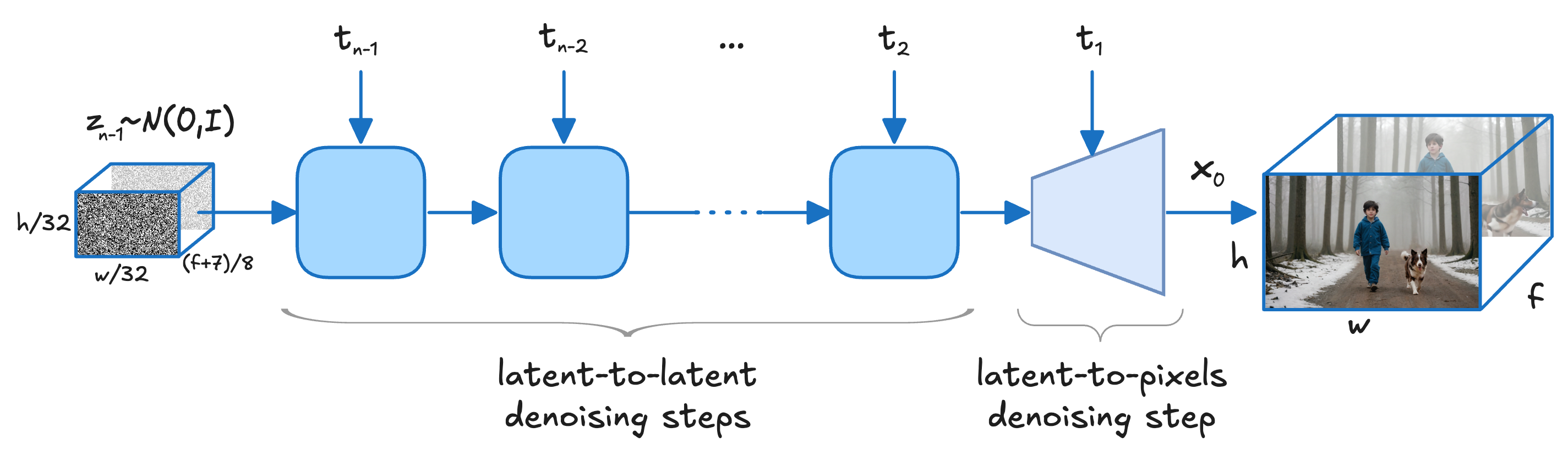
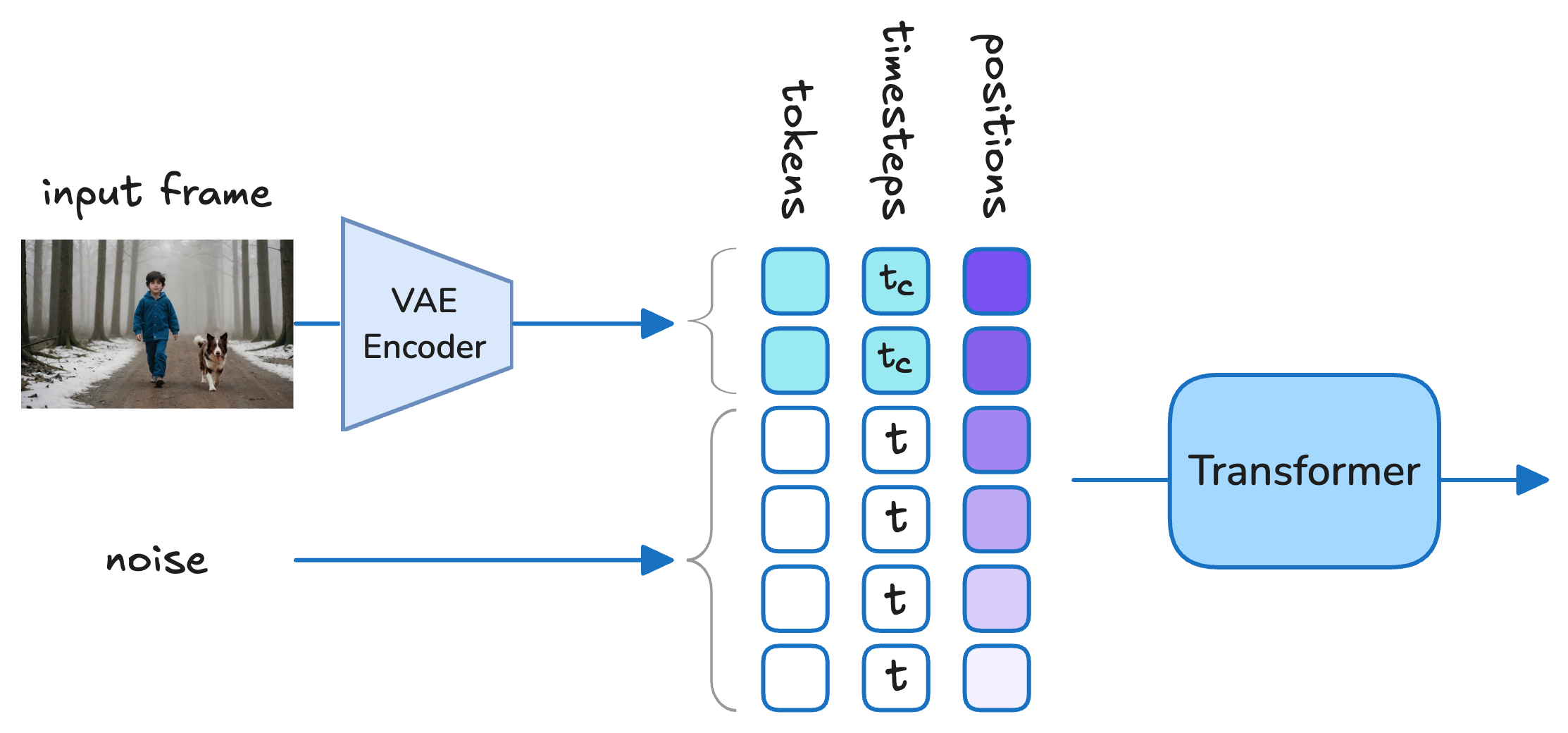
Lightricks released the technical article “LTX-Video: Realtime Video Latent Diffusion” and a companion paper on arXiv (arXiv:2501.00103) describing a transformer-based latent diffusion model for video generation. The key decision in the publication: the Video-VAE and denoising transformer were designed as a unified system rather than as independent components. The VAE compresses video at a 1:192 ratio, meaning one token corresponds to a 32x32x8 pixel block, allowing the transformer to perform full spatiotemporal self-attention and keeping frames consistent over time. The VAE decoder simultaneously reconstructs pixels and performs the final denoising step, so a separate upscaler is not required in the pipeline. The same model is trained on both text-to-video and image-to-video tasks. The authors report that the model outperforms existing models of comparable size, and the code and pretrained weights are available in open access.
Context
LTX-Video is built on latent diffusion: generation occurs not in pixels, but in a compressed representation of the video prepared by the Video-VAE, which the transformer then cleans of noise step by step. The cost of such generation depends directly on the number of tokens the transformer sees, making the VAE compression ratio a central parameter of the entire architecture rather than a technical detail. The focus on aggressive compression makes full spatiotemporal self-attention computationally feasible, where the transformer processes the scene as a whole; from this, motion consistency between frames follows from the architecture itself, rather than being provided by separate motion modules on top of the base model. Joint design of the components also reduces the number of pipeline stages: where the decoder covers two tasks at once, the upscaling stage—which video generators traditionally cannot do without—drops out of the chain, and each extra stage lengthens and increases the cost of generation.
Why this matters for the industry
For the industry, LTX-Video shows that real-time video generation is achievable without compromising on a separate upscaler: joint design of the VAE and denoiser with aggressive latent compression reduces computational cost, while a common model for text-to-video and image-to-video eliminates the need to maintain separate pipeline branches. For interactive applications, live content, and API services where latency is critical, faster-than-real-time generation stops being a demo feature and becomes a product building block, while open code and weights provide two ready paths for implementation—self-hosted and API. If independent measurements confirm the authors' figures, expect pressure on video generation prices and intensified competition in the fast-model segment: speed and access cost cease to be a defensible advantage, shifting to vertical data, distribution, and the product layer, while real-time latency becomes a competitive field among video APIs. In the longer term, if the approach holds up, the combination of “VAE and denoiser co-design plus strong latent compression” may become a standard design template for video diffusion, and faster-than-real-time generation a basic requirement for video models; then competition will shift to detail quality, controllability, and the cost per minute of generation.
Why this matters for users
Users can already download the open weights and reproduce the key speed benchmark on a rented Nvidia H100, or quickly evaluate the model without their own infrastructure via the LTX API or LTX Playground. The hardware benchmark for reproducing the claimed real-time performance is specifically the H100: latency will differ on less powerful machines. The practical window today is scenarios where 768x512 resolution is sufficient: text-based video previews in editors and builders, image animation, and draft videos within agents and automations. For readers, this means that real-time video generation is no longer a hypothesis from a demo: it is a reproducible result that can be verified independently on your own prompts.
What is still unknown / limitations
The claim of superiority over models of comparable size is the authors' formulation: specific benchmarks and comparison methodology are not named in the available materials, so until independent measurements are conducted, it is correct to consider it a claim rather than an established fact. The speed measurement is tied to the Nvidia H100—performance on consumer hardware and other accelerators is not confirmed. The quality of the final video depends on how well the decoder restores details lost during strong compression, which requires visual verification on real prompts. The 768x512 resolution limit restricts applicability in scenarios requiring high resolution. Predictions about price pressure and shifts in competitive fields are estimates, not established events; they should be re-verified as independent reproductions emerge.
Sources
- LTX-Video: Realtime Video Latent Diffusion | LTX Technical Blog
- LTX-Video: Realtime Video Latent Diffusion (arXiv:2501.00103)
Author
Look at AI, editorial team