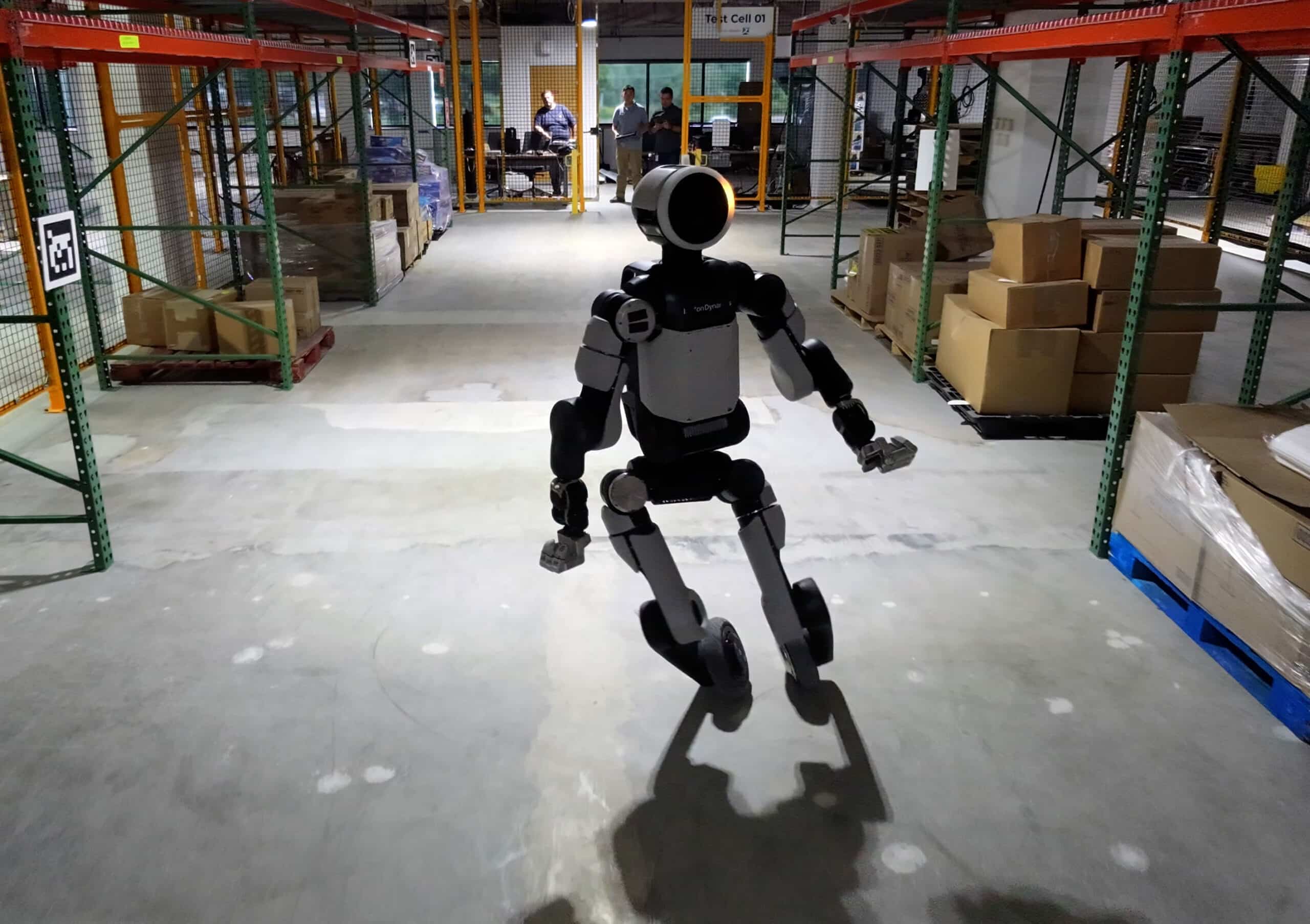
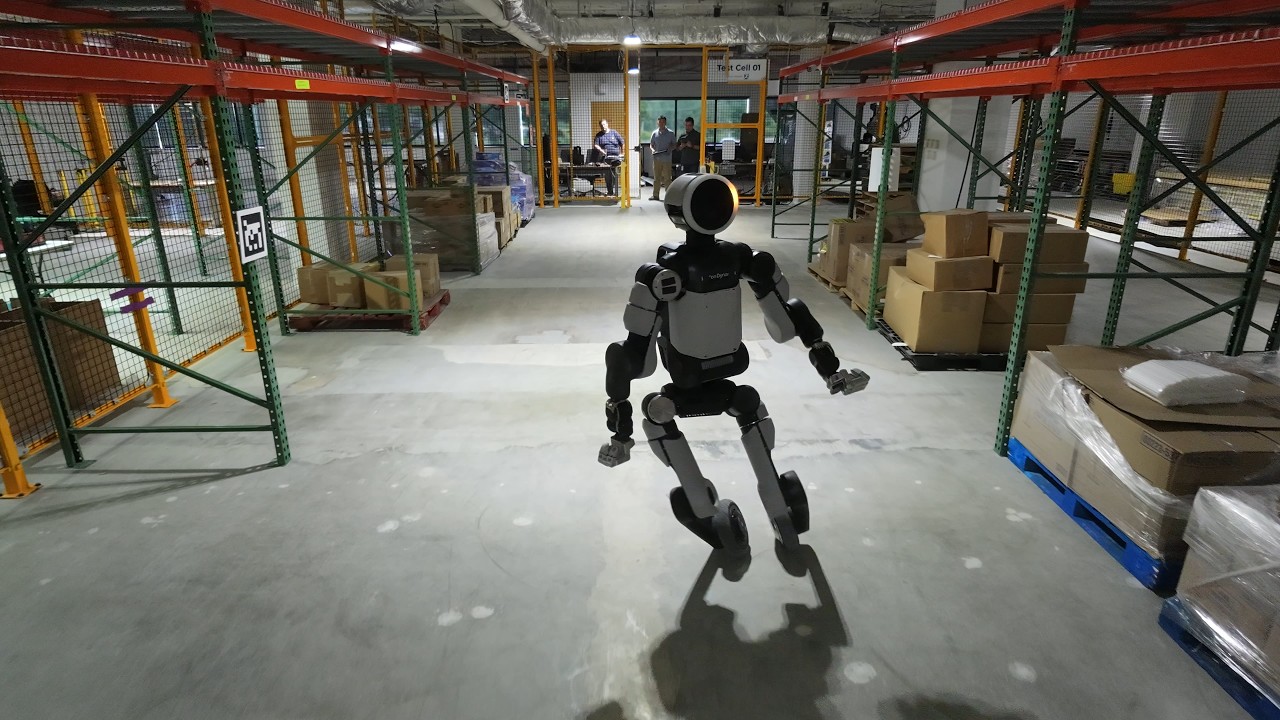
Boston Dynamics replaced the humanoid Atlas's feet with scooter wheels, securing them via a single custom adapter on the existing ankle actuator, without adding new parts. The goal was not a wheeled robot, but pushing actuators to their limits: wheeled driving forces motors to operate continuously across the full range of torque and speed. The whole-body reinforcement learning policy was trained in simulation on millions of virtual episodes and transferred to the physical robot, after which Atlas began using the wheels for lateral movements without explicit programming.
What Happened
The Atlas team removed the humanoid's feet and installed scooter wheels via a single custom adapter fitted over the standard ankle actuator. The robot's behavior is defined by a whole-body reinforcement learning policy: its training took place in simulation on millions of virtual episodes, after which the model was transferred to the physical platform. For the transfer to succeed, the motor model in simulation had to be precisely tuned to real-world measurements, closing the gap between the virtual and physical environments. In demonstrations, the robot independently 'figured out' how to use the wheels from movements in a human motion capture library: it performed lateral lunges with smooth rolling, and executed a 360-degree spin jump on the first attempt. A detailed breakdown of the methodology was prepared by Atlas team engineer Xiaoyu "Andy" Wu.
Context
Wheels in this project are a load testing tool, not transportation: walking movements leave pauses and unloading for motors, whereas wheeled driving keeps actuators under continuous load across the full range of torque and speed. Stress testing is built into the standard pipeline for modern robotics: first, behavior is tested in simulation, where millions of episodes can be run without risking expensive hardware, then transferred to the physical robot. The weak point of this route is called sim-to-real: a policy trained on 'idealized' motors learns movements that the real actuator cannot perform. Therefore, the decisive stage was low-level hardware identification: characterization experiments and tuning motor model parameters based on real measurements. The publication title — Atlas On a Roll: Bridging Classical Motor Controls and Whole-Body RL — directly indicates that the team was connecting classical actuator control with reinforcement learning.
Why This Matters for the Industry
For the industry, the main takeaway here is methodological rather than spectacular: the bottleneck for transferring whole-body RL to hardware was not the policy architecture, but the accuracy of the low-level motor model, and this shifts value in robotics toward the discipline of hardware identification. The practical recipe of the case — characterization experiments with simulation tuning based on real measurements before policy training — can be directly transferred by teams to their own platforms and pipelines. Material of this kind appears infrequently: details of motor model tuning and adapter construction are usually not published, and the stated order of operations sets a reproducible template — first precise actuator characterization, then simulation, and only then the physical robot. According to the company, data on actuator performance under maximum load will go into the standard bipedal Atlas to improve fault tolerance of actuators, which directly concerns the reliability of industrial humanoids. The project currently has no commercial consequences: the wheeled Atlas remains a research development on Boston Dynamics' closed platform, and no new APIs or SDKs have appeared.
Why This Matters for Users
For readers working with RL and robotics, Xiaoyu "Andy" Wu's article is useful as a rare detailed breakdown of a working sim-to-real cycle: it describes motor model tuning and adapter construction, which usually remain inside the company. This is a practical guide for those transferring trained policies to real platforms: without careful calibration of the motor model in simulation, behavior on hardware may not be reproduced, and the case shows exactly where to look for the cause. For the rest of the audience, the story is valuable because it makes emergent behavior of a trained policy visible: the robot found a way to control its body that no one explicitly programmed. No product emerged from the experiment: it is impossible to buy a wheeled version of Atlas or access it, and the company has not released open models or datasets.
What Is Still Unknown / Limitations
All facts rely on the Boston Dynamics corporate blog and promo video: there are no quantitative metrics, comparison baselines, or ablation studies in them. Therefore, statements like 'figured out how to use wheels on its own' and 'executed the jump on the first attempt' allow for at most a cautious positive assessment at this stage. The details of motor model tuning in numbers, training duration, and the number of physical attempts, if any, before successful demonstrations, are unknown. It is also unclear whether the company will publish the collected data on actuator limit loads and when actuator fault tolerance will reach the standard bipedal version of Atlas.
Sources
- Atlas On a Roll: Bridging Classical Motor Controls and Whole-Body RL — Boston Dynamics Blog
- Atlas on a Roll | Classical Motor Controls and Whole-Body RL | Boston Dynamics (video)
Author
Look at AI, editorial team