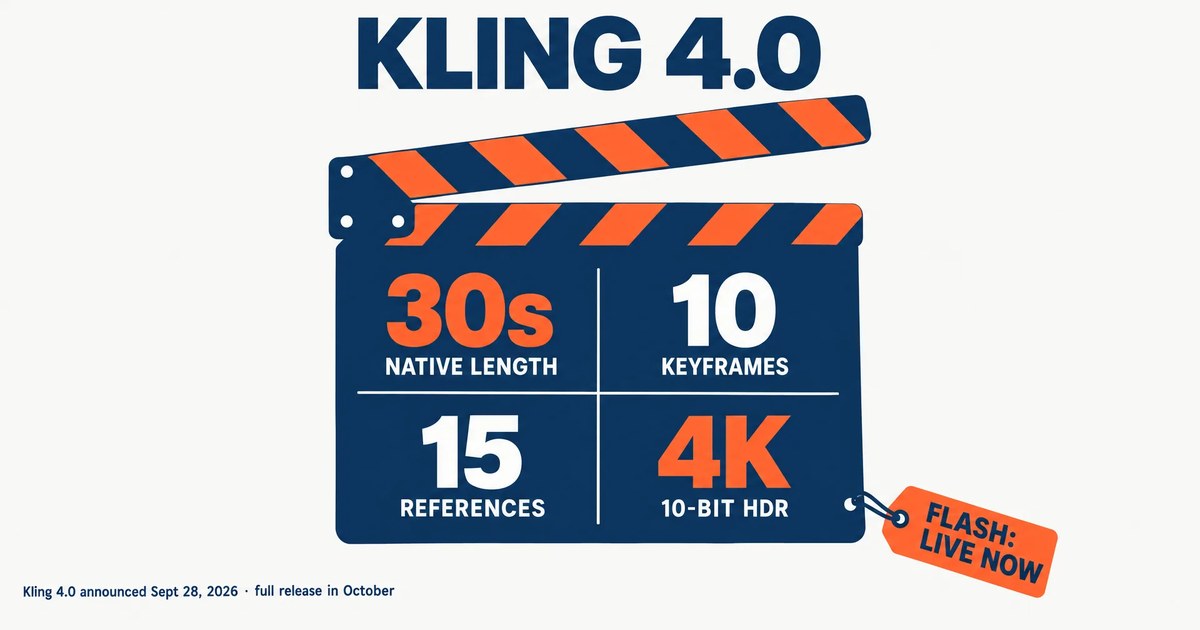
Kuaishou (Kling AI) announced on September 28, 2026, that the Kling 4.0 video model will fully launch in October, while the lightweight Kling 4.0 Flash is already available to Ultra Yearly subscribers. The new generation promises native generation of clips up to 30 seconds in a single pass, output in 4K and 1080p in 10-bit HDR with stereo audio, and scene control through up to 10 keyframes and up to 15 multimodal references. However, the Kling API currently lists only 3.0-generation models, so the October launch will determine everything for production and API products.
What Happened
On September 28, 2026, Kuaishou (Kling AI) officially announced the full October launch of its flagship video model, Kling 4.0; from this day, the lightweight Kling 4.0 Flash is available to Ultra Yearly subscribers. The stated maximum length has increased to 30 seconds in a single pass, whereas Kling 3.0 offered 3–15 seconds. The model outputs video in 4K and 1080p in 10-bit HDR, generates high-quality stereo audio, and promises more precise lip sync. The Omni Reference mode accepts up to 15 multimodal references, and script control allows up to 10 keyframes with built-in video extension and support for languages, accents, and dialects. According to Futu News and Gelonghui, a single task can combine up to 10 images, 5 video clips, and 7 characters.
Context
Kling is Kuaishou's flagship video generator and one of the main competitors to OpenAI Sora and Google Veo. Previous generations were designed for short clips, so complex scenes were assembled in a pipeline: fragments were generated sequentially and stitched together in post-production. Kling 4.0 shifts the focus from pure "text-to-video" to controllable storytelling, where multi-referencing, frame-by-frame script control, and built-in audio are combined in a single model, aligning with the general trend toward unifying video and audio. The rollout logic is also important: Kuaishou first tests the model on a premium subscription tier and only promises full access in October, so the announcement remains a statement about the direction of the race rather than a reproducible result.
Why This Matters for the Industry
For the AI industry, the main shift is production: entire ad spots and scenes can be obtained in a single generation with editing instead of stitching short fragments, and 10-bit HDR 4K and 15 multimodal references raise the bar for quality and control against Sora 2 and Veo. Currently, the impact is limited by the fact that Kling 4.0 is not in the API: as of September 28, the pricing page lists only 3.0-generation models, and the prices and identifiers for the new version have not been published. Real competition with Sora 2 and Veo will unfold in October when full access and the API open, and the deciding factors will be the price per second and the latency of 30-second generation. Teams building products on Kling should already consider migrating to the 30-second format in their roadmap and designing scenarios for frame-by-frame control.
Why This Matters for Users
For readers, the effect is currently asymmetric. Ultra Yearly subscribers can already manually test Kling 4.0 Flash and form their own opinion on quality, although quotas and subscription prices are not fully disclosed; others must wait for the October launch, before which it is impossible to integrate the new model into their product or pipeline. For ML researchers in generative video, the two most interesting open questions are: how 30-second native generation is achieved and whether character identity is maintained across 15 multimodal references. A practical step for teams with a subscription is to test the UX of future products on Flash: the keyframe editor, reference library, and script templates, so that they have ready-made prototypes by the time the API opens.
What Is Still Unknown / Limitations
The announcement remains a product statement without a technical report: there is no architecture, evaluation methodology, or independent comparisons with Kling 3.0, Sora 2, and Veo. Phrases like "more precise lip sync" and "high-quality stereo audio" are not supported by metrics and remain marketing until release. It is not clarified whether 30-second generation is truly a single pass or an internal video extension. Quotas and the price of the Ultra Yearly tier, the exact date of the October launch, and the conditions for opening the API, including prices and model identifiers for 4.0, have not yet been disclosed.
Sources
Author
Look at AI, editorial team