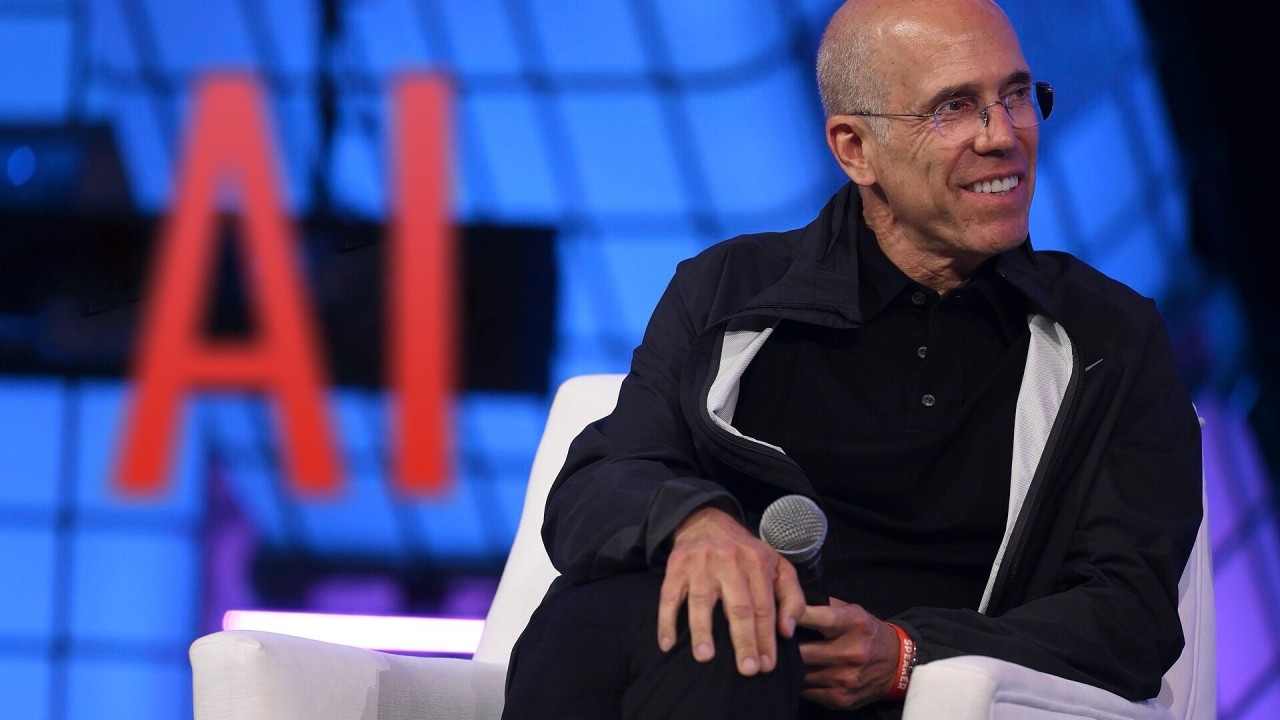
Jeffrey Katzenberg — co-founder of DreamWorks and head of venture firm WndrCo — published the essay 'The World is Changing: AI For Creativity' on X on September 23, 2026, addressed simultaneously to Silicon Valley and Hollywood. In it, he repeats his 2023 forecast: AI tools will reduce the time and cost of producing world-class animation 'by up to 90% within three years.' The author associates this not with a reduction in employment, but with an increase in production volume and a shift in value to authors' taste and the rules for paying their labor. There is no technical data or measurements in the text: this is an insider's position that sets the framework for Hollywood's negotiations with the AI industry.

What happened
In the @jeffreykWNDR account, Katzenberg describes how generative models already output full-fledged animated scenes, and compares this impression to the first showing of Pixar's short film Luxo Jr. in 1986. He draws a line between reasoning — what AI does well today: calculation, evaluation, pattern-matching — and creating, that is, the generation of something new through taste and intuition, and concludes: 'It is statistics, not soul.' He interprets Hollywood's resistance not as a rejection of technology, but as negotiations over terms: 'First, we must all agree that there should be terms.' As a precedent, the author cites the Copyright Act of 1909, which was brought about by John Philip Sousa's campaign against the phonograph, and proposes to develop rules for paying authors' labor on this model. A full text copy of the essay was published as a separate article on LinkedIn, and a discussion thread with three points and zero comments was opened on Hacker News.
Context
The essay is easier to understand through the author's position and the history of technology. WndrCo, under Katzenberg's management, has invested in more than 50 startups, so behind the text stands both studio experience and venture capital. The argument relies on the past of animation: in the 1980s, Disney drew about 125,000 cels per film, then the transition to computer systems like CAPS from Pixar — their trace is visible in 'The Little Mermaid,' 'Beauty and the Beast,' and 'The Lion King' — and the transition of cinema to sound changed not the amount of work, but its structure: production volume and the number of 'seats at the table' grew. The demonstration of the short film Luxo Jr. in 1986 historically worked as an early signal of the maturity of 3D animation, and it is on this impression that the author relies when describing today's generative scenes.
Why this matters for the industry
For the AI industry, the essay is a signal of direction, not a technology launch. Its substantive part is the fixation of the shift in value in creative production: generation is getting cheaper and turning into workflow orchestration, and taste, curation, and rules for paying authors become the bottleneck. For teams working on video generation, the text fixes market demand for manageability and character consistency, not for raw scene generation. The likely product layer of the coming years is tools for managing such a pipeline: pre-visualization and storyboarding, maintaining unified characters and styles, as well as licensing services and payment infrastructure for authors, which fall into the zone of investors' attention. The key shift in the dispute between Hollywood and AI companies: the bottleneck is declared to be not the capabilities of models, but data, provenance, and payment terms, so products at the intersection of generation and rights should build in advance the accounting of authors' contribution and the origin of materials.
Why this matters for users
For the reader, the most practical element of the essay is the reasoning/creating framework: when working with generative models, it makes sense to give them calculations, variants, and drafts, and leave the points of final choice, where taste and personal expression are needed, to a human. Expectations today should reasonably be held more modest than the headlines: generative video is realistically applicable in draft and auxiliary stages — from mood boards to storyboarding — and not in final production. For authors and content owners, the most important thing is the return of the question of labor payment to the agenda: the rules that the industry develops will determine compensation for works on which models are trained and which they use. If Katzenberg's scenario is realized at least partially, the entry threshold into animation for small teams and independent authors will decrease, and the volume of available content will grow — along with competition for the viewer's attention.
What is still unknown / limitations
The figure 'up to 90%' is not tied to either a basic pipeline or a metric: the share of frames, production stages, or the cost of a finished minute are not specified, so in the current formulation the forecast is unfalsifiable and works as a marketing statement, not as a measurement. The 'three years' deadline set in 2023 expired by September 23, 2026, and there is no report on its fulfillment: repeating the forecast is not its confirmation. The comparison with Luxo Jr. is a rhetorical move, not proof: a demo scene does not answer questions of control, character consistency, and editing, which are critical for production quality. The reasoning/creating dichotomy is substantive, but the formulation 'it is statistics' is vulnerable: modern video models demonstrate generalizations that do not reduce to retelling training data, and the industry does not yet have accepted metrics for such a dispute. The sources do not have a single ready-to-implement artifact: no API, no prices, no latency data, no production case — only a demo level, estimated by eye. Finally, the author is a venture investor with a direct interest in reducing production costs, and public verification of the theses is only beginning: the discussion on Hacker News has not yet gone beyond a single thread.
Sources
- Jeffrey Katzenberg on X: The World is Changing: AI For Creativity (original essay, 23.09.2026)
- Pietro Schito (LinkedIn): Jeffrey Katzenberg — The World Is Changing: AI for Creativity (full text copy of the essay)
- Hacker News: discussion of 'AI for Creativity' (3 points, 0 comments)
Author
Look at AI, editorial team