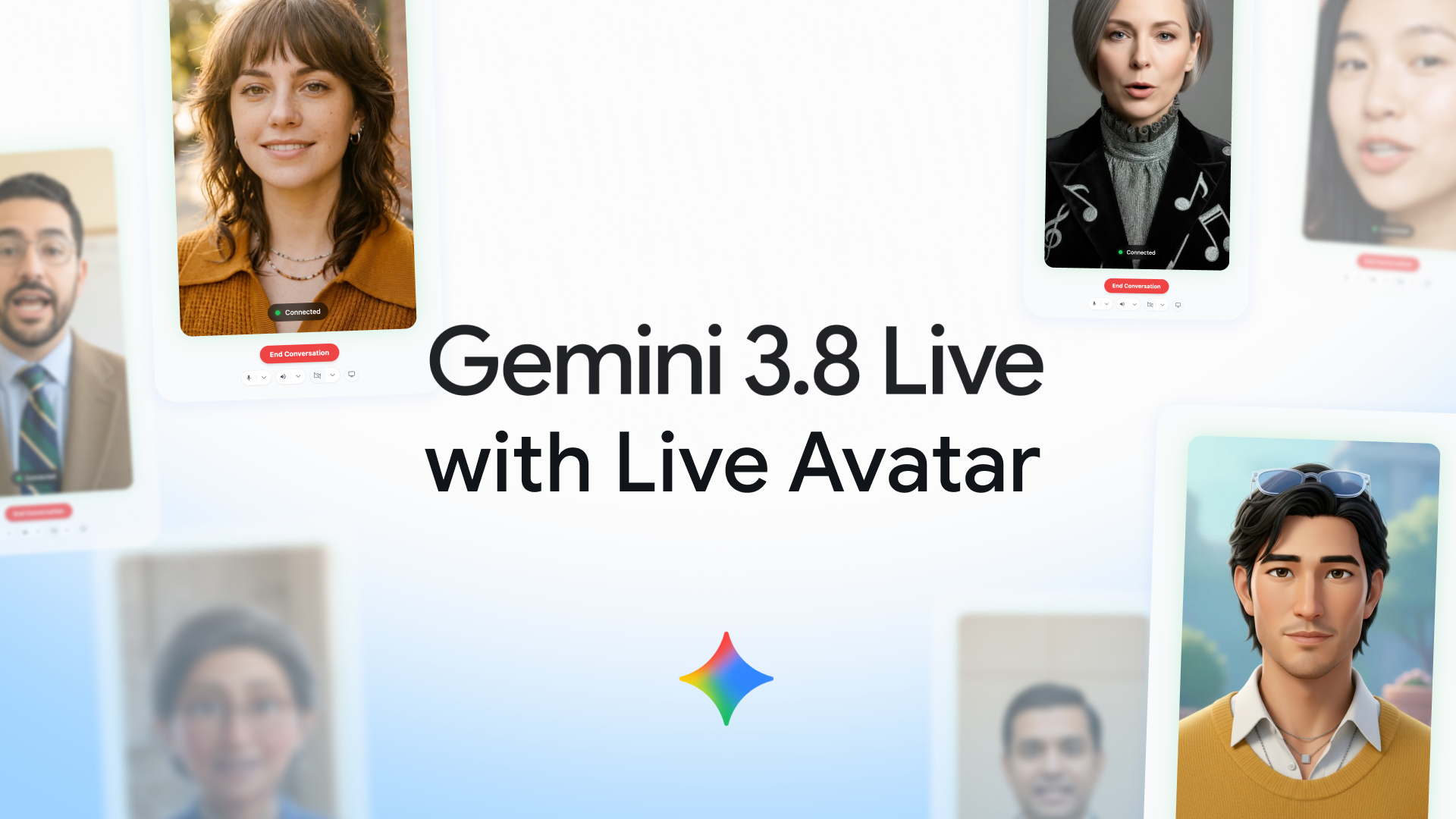
On September 24, 2026, Google released Live Avatar to general availability — an add-on to the Gemini 3.8 Live voice model that generates near real-time video of a talking character: with synchronized lip articulation, natural facial expressions, and smooth transitions between lines. The feature is open to enterprise customers in Gemini Enterprise and via the Gemini Live API with endpoints in the US and EU, a minute of avatar speech costs about 39 cents, and all generated audio and video are marked with an invisible SynthID watermark.

What happened
Live Avatar became a video overlay on top of the Gemini 3.8 Live voice model, which Google announced on September 15, 2026. The add-on generates near real-time video of a talking character: it synchronizes lip articulation with speech, reproduces natural facial expressions, and smoothly passes the turn of lines. In a single stream, the model simultaneously receives video and audio from the user, while calls to external tools are executed in the background without interrupting the conversation; according to the company, lip synchronization and facial expressions adapt to 97 languages, and the image does not degrade when switching languages mid-conversation. The feature has been moved to GA status in Gemini Enterprise and via the Gemini Live API with endpoints in the US and EU: a ready-made set of avatars is open to all enterprise customers, while creating custom characters from a single reference image is currently only possible via an allowlist application. All audio and video output is marked with an invisible SynthID watermark. Billing is tied to output tokens: at a price of $1 per million tokens and a consumption of 6192 tokens per second of video, a minute of avatar speech costs approximately 39 cents, of which about 37 cents goes to video and about 2 cents to audio.
Context
Live Avatar supplemented the Gemini 3.8 Live voice model less than two weeks after the announcement of the model itself. Google describes the architecture as a single stream in which the model immediately receives video and audio and responds with a face, while simultaneously calling external tools — instead of a classic speech-to-text pipeline, then a language model, then speech synthesis, and separate video generation. The economics of the solution are well illustrated by token consumption: 6192 tokens per second of video mean that the main cost is created by video generation, not audio. The public API, GA status, and published pricing make this launch rare for the category of talking video avatars, which until now have more often existed in the form of demos and research previews.
Why this matters for the industry
GA in Gemini Enterprise moves talking video avatars from the demo category to the product environment of customer support and interactive instructions — on the web, in mobile applications, and kiosks, with provisioned throughput and regional endpoints in the US and EU. The first implementations have already been announced: Cox Automotive built an avatar for Autotrader, where car selection is done through conversation; Equal AI processes more than a million live calls a day in nine Indian languages; Salesforce connects the avatar with Agentforce. Mandatory SynthID marking sets an example of how the conversational agent market can mark synthetic video. For startups, the "face" of a conversational agent has become a cheap and rentable component, and the likely trajectory for the coming months is a wave of implementations in support and onboarding following the example of these cases, and the emergence of independent measurements of latency and quality from developers working with the API.
Why this matters for users
This is the first GA-accessible "live" video avatar within a major vendor's voice API: an agent that sees through a camera or screen sharing, hears the interlocutor, speaks with a face, and simultaneously calls your APIs in the background can be built without a homemade video pipeline and without a speech-to-text pipeline. A pilot can be launched immediately: GA status, a ready-made library of avatars without applications, and a clear price with payment only for the character's speaking time make an MVP feasible. You can try it through the Gemini Enterprise console (Agent Platform Studio, Multimodal Live section) and the Gemini Live API documentation.
What is still unknown / limitations
Key capability claims — near real-time generation, adaptation of articulation and facial expressions to 97 languages without image degradation, and maintaining character similarity from a single reference image — are given in Google's words and are not yet supported by methodology, metrics, or independent measurements. Numerical latency, SLA, and limits on simultaneous sessions are not disclosed in the sources, so production capacity under load cannot be calculated. Custom avatars are limited to the allowlist, and the timeline for expanding the list is not named, and endpoints are located exclusively in the US and EU — for other regions, questions of latency and data placement remain open.