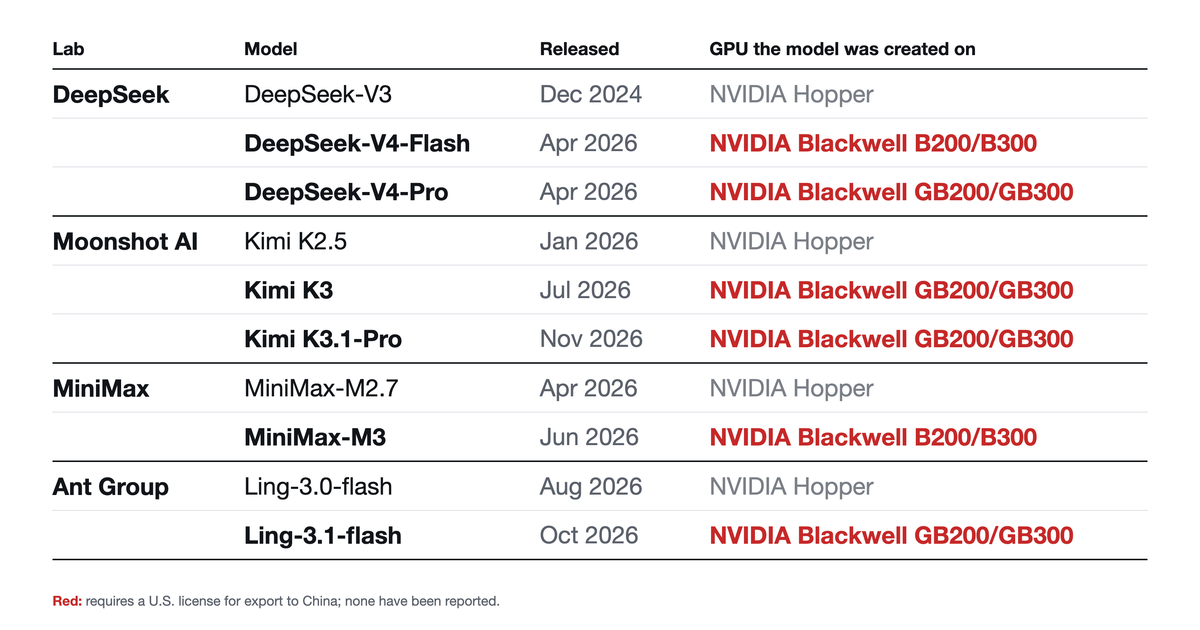
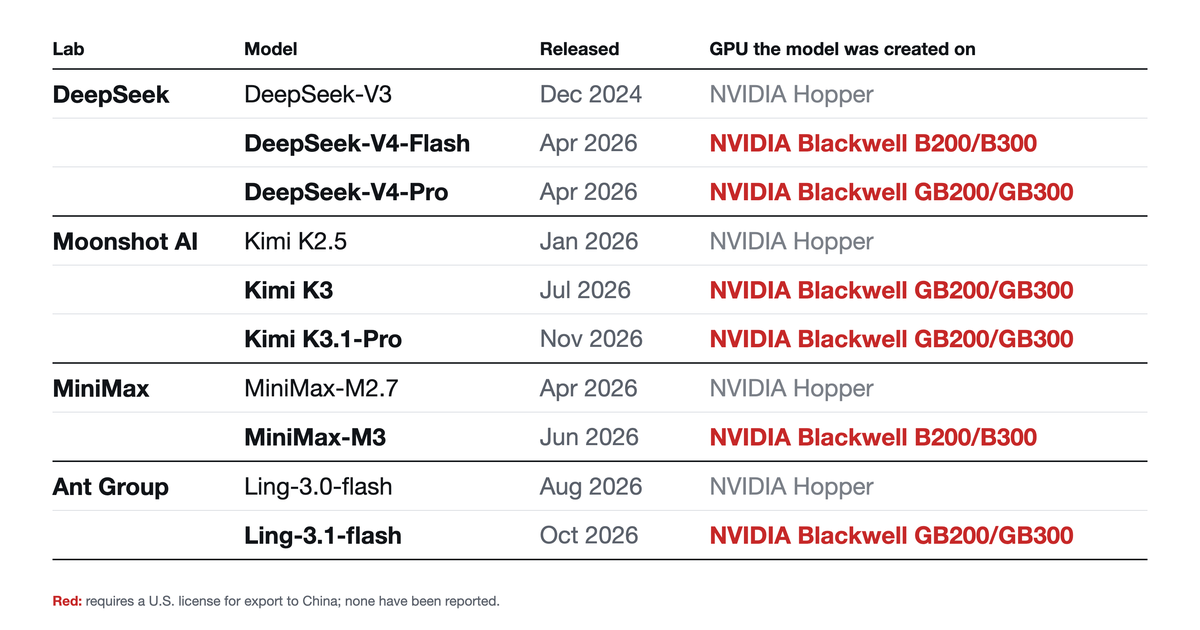
Former OpenAI researcher Will DePue published the Unemployment Labs report 'Top Chinese Frontier AI Models Carry the Fingerprint of Export-Controlled NVIDIA Blackwell GPUs' on November 12, 2026. By analyzing the public weights of six latest models from DeepSeek, Moonshot AI, MiniMax, and Ant Group, he demonstrates that their initialization took place on NVIDIA Blackwell-generation GPUs—chips closed to China by US export restrictions. The work introduces the method of checkpoint-forensics: from open weights, one can determine on what hardware the model began training, and the key conclusion is reproduced on a real graphics card.
What Happened
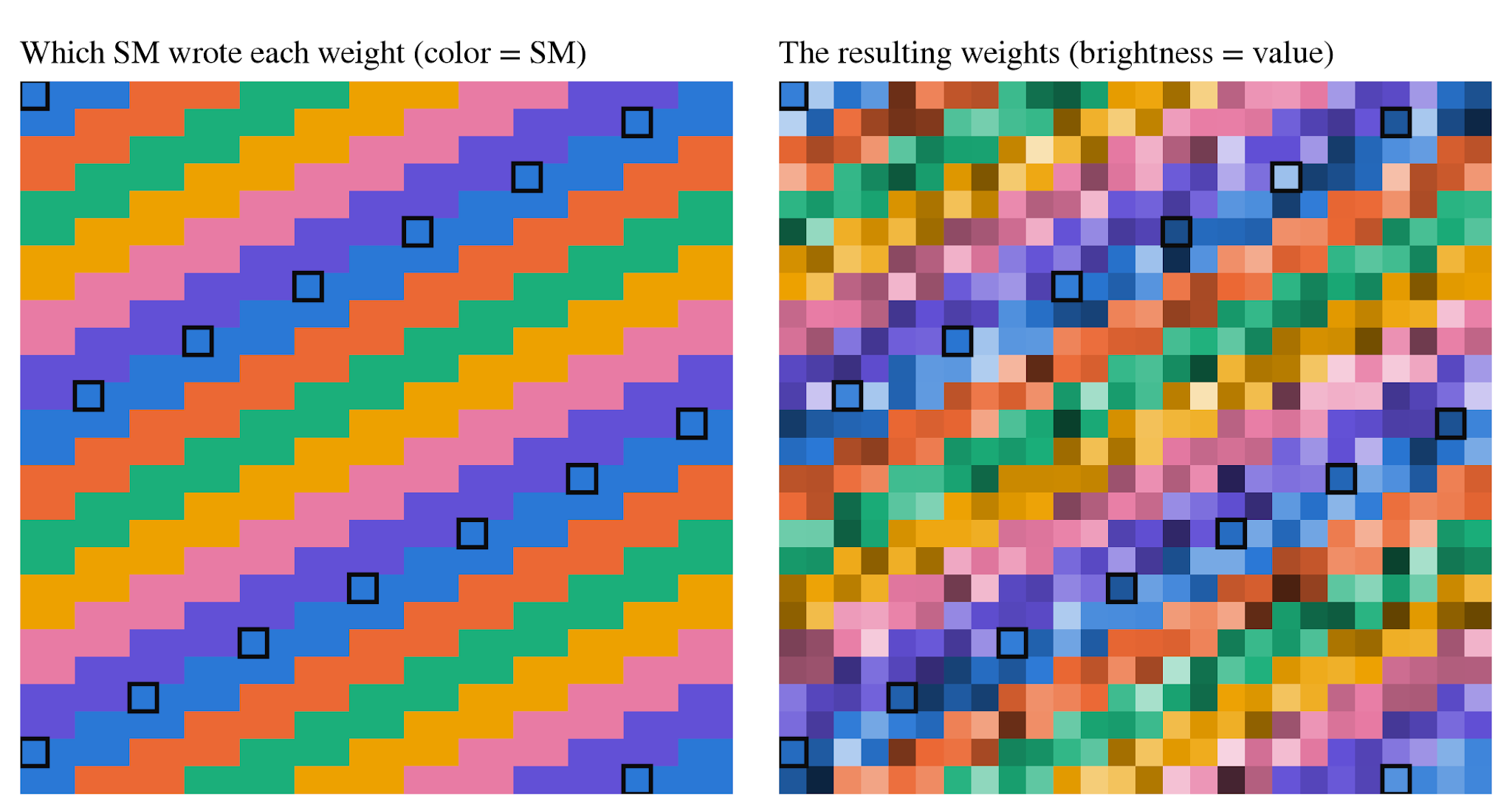
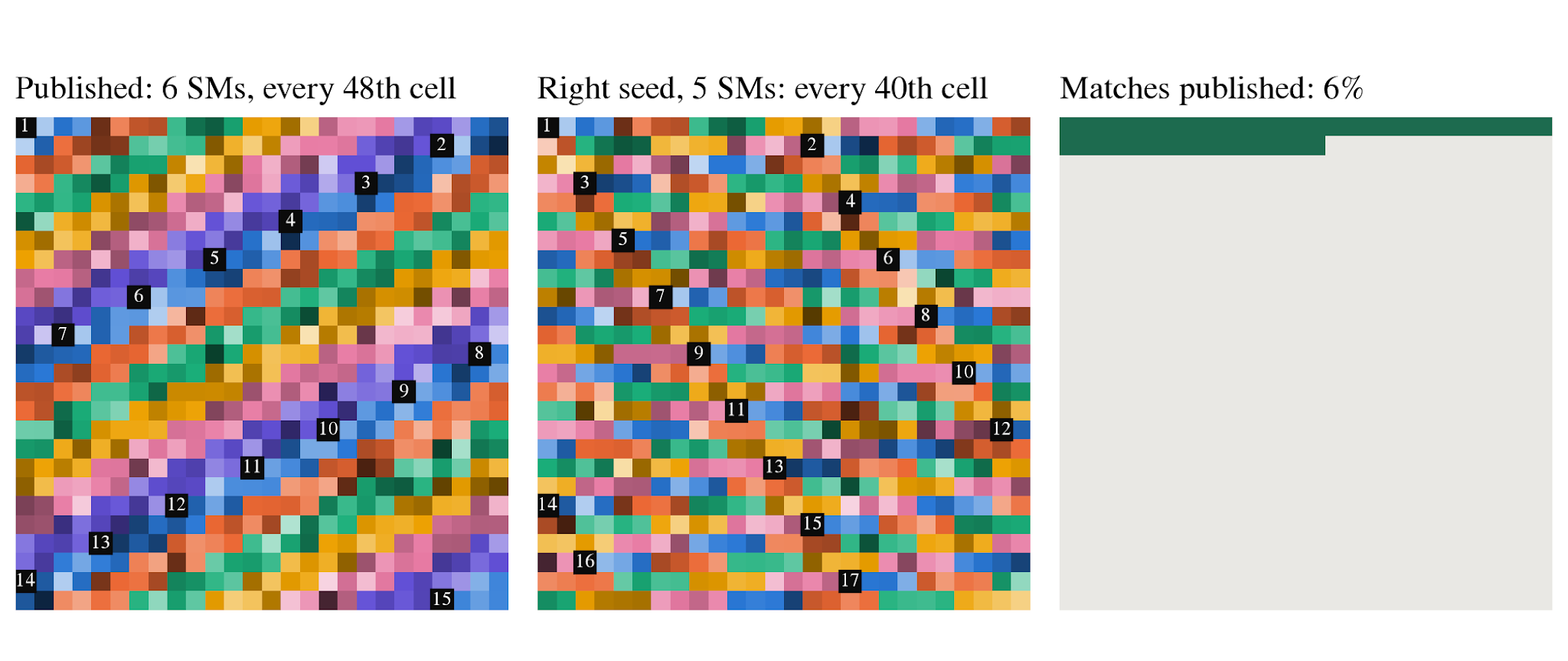
The report's author, Will DePue, who previously worked as a researcher at OpenAI, analyzed the public weights of six models from these labs and restored the seed of the PyTorch random number generator (PRNG Philox) left by the initialization stage. For DeepSeek-V4-Flash, the restored pattern corresponds to a chip with 148 SMs—the B200 and B300 configuration; for DeepSeek-V4-Pro, Kimi K3, Kimi K3.1-Pro, and Ling-3.1-flash—to a chip with 152 SMs, the GB200 and GB300 configuration. To confirm the connection, DePue took 469 selected weight rows of DeepSeek-V4-Flash and reproduced 445 of them bit-for-bit on a real NVIDIA B300; no exact matches were found on H100. The control group consists of earlier models from the same labs—released before V3, K2.5, M2.7, and Ling-3.0-flash: their fingerprint corresponds to the NVIDIA Hopper architecture.
Context
The ability of weights to 'remember' hardware is related to the properties of the framework itself: when initializing tensors, PyTorch distributes the output of the Philox random number generator across GPU streams, and the distribution is uniquely determined by the chip configuration. The pattern that appears at an early stage remains in the published checkpoint regardless of where further training took place. This concerns the NVIDIA Blackwell generation—B200 and B300 chips and GB200 and GB300 server platforms. The industry picture is heterogeneous: according to the report, Alibaba, Zhipu, Tencent, Xiaomi, and StepFun remain on the NVIDIA Hopper generation, while Meituan trains models on its own ASICs—most likely Huawei Ascend. Thus, this is not an isolated case, but a shift of an entire segment of frontier labs to formally unavailable hardware.
Why This Matters for the Industry
For the industry, the report provides technical evidence that Chinese frontier labs have access to export-controlled NVIDIA Blackwell, with an estimate of the scale: five final training runs are equivalent to approximately 12,000 Blackwell-GPUs and 30,000 H100s, the cost of the largest of them (the cluster for Kimi K3) is estimated at $200–300 million, and total costs are over $500 million. These figures strengthen the argument of supporters of strict export controls, but at the same time show that scarce hardware does not work as a moat: the frontier is commoditizing faster, teams at the application layer are winning, and the negotiating position of model buyers is strengthening, as access to frontier quality via API is not narrowing but expanding. Uncertainty increases for everyone who rents or resells GPUs. A new measurable signal also appears: checking the origin of weights may become part of due diligence when choosing a model, and labs publishing raw checkpoints will have to reconsider release practices. A prototype provenance scanner or origin badge in the model catalog can be built now on the open weights of DeepSeek-V4-Flash and other checkpoints, and in the coming months, independent replications and provenance fields in model cards should be expected.
Why This Matters for Users
For working products, only the informational context changes for now: the weights of DeepSeek-V4-Flash, DeepSeek-V4-Pro, and Kimi K3 behave the same as before, and inference latency and cost do not change. If a product depends on open weights and predictable release cycles, it is reasonable to allocate time for an audit of the origin of the checkpoints on which it is built. Anyone can now repeat the analysis independently: the method requires only public weights and a comparable GPU, no closed data is needed. For readers following the AI race, the work provides a new verification technique: lab statements about training infrastructure no longer have to be taken at face value, because such statements can be instrumentally checked against model weights.
What Is Still Unknown / Limitations
The scope of the method is limited to the initialization stage: it is only proven that the weights were created on GPUs with 148 and 152 SM configurations of the Blackwell generation, and whether this hardware was used at other stages of training is not checked by the analysis. The attribution of the found patterns to specific SKUs—B200, B300, GB200, and GB300—is the author's interpretation, as are the total estimates in GPU and dollar equivalents: these are report calculations, not direct measurements. The location of the GPUs, their ownership, and the purchase or rental scheme are not established, so the political conclusion about the failure of US export restrictions remains an interpretation on top of the proven fact. Finally, the proof is asymmetric: the found fingerprint confirms specific hardware, but its absence in future releases will not refute anything—labs can trivially remove the trace by reinitializing weights with a deterministic seed or sanitizing the checkpoint before publication.
Sources
Author
Look at AI, editorial team