On November 12, 2026, Google released Gemini 4 Hydrogen, a mid-tier model in the Gemini 4 lineup adapted from the flagship Gemini 4 Carbon and designed for the rapid execution of agentic tasks and everyday programming. According to Google, the model maintains an intelligence level comparable to the senior members of the lineup, while solving routine agentic tasks faster and significantly cheaper than frontier-class models. Simultaneously, the company is promoting a multi-model orchestration pattern where an expensive model coordinates, and a cheap executor handles routine work. Hydrogen is already available in all major Google services, from the Gemini app and Google Search to AI Studio and the Gemini API.

What happened
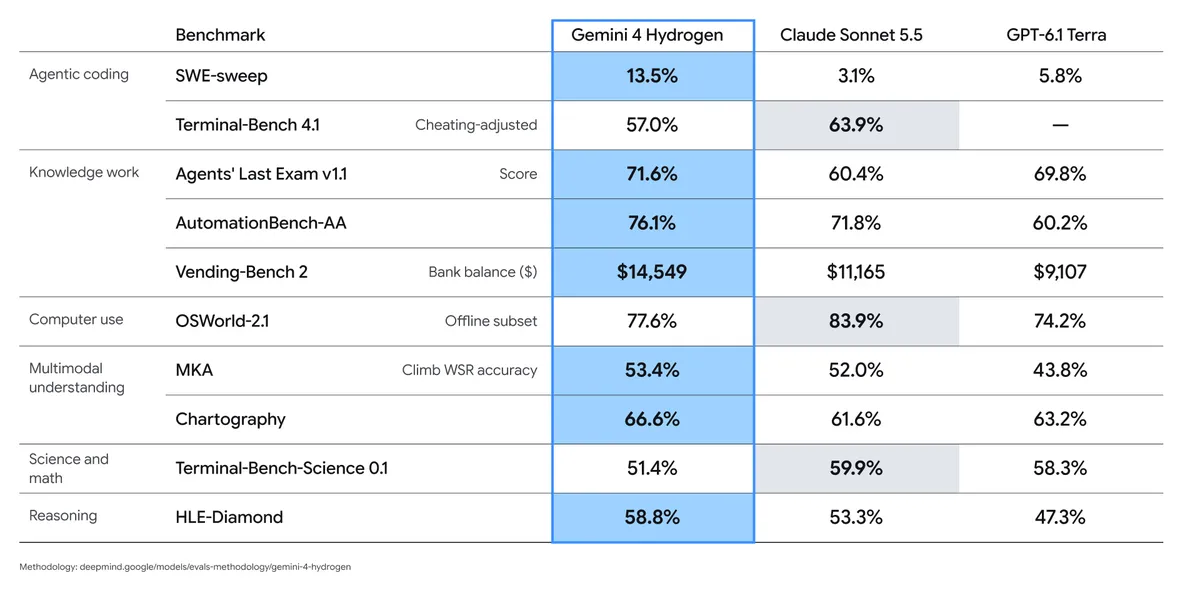
On November 12, 2026, Google released Gemini 4 Hydrogen and opened access to it on the day of release: the model works in the Gemini app, Google AI Studio, Gemini API, Antigravity, and Google Search, and via the API, it is called under the identifier gemini-4-hydrogen. On the aggregated Artificial Analysis Intelligence Index, the model scores 51 points at the high level and 54 at xhigh, compared to 50 for Gemini 4 Argon. On the agentic benchmark Terminal-Bench 4.1, Hydrogen solves 57% of tasks compared to 18.2% for Gemini 3.8 Flash and performs them 2.5 times faster than this predecessor. The context window is 1 million tokens, with API pricing at $1.50 per million input tokens and $7.50 per million output tokens. Along with the model, Google introduced Orchestrator in Antigravity: the system automatically switches between Carbon and Hydrogen and, according to the company, reduced quota consumption by 24% and sped up execution by 19% on Terminal-Bench 4.0 with success rates comparable to Carbon.
Context
The mid-tier class is needed by Google in the lineup not for its own sake, but as part of the architecture of agentic products. Carbon and Argon in the Gemini 4 lineup cover deep reasoning, while Hydrogen takes on the role of a fast executor: in typical agentic pipelines, an expensive frontier model plans and makes complex decisions, while a cheaper one performs routine steps, and without a fast middle tier, such a scheme hits either the price of tokens or quality. Hydrogen itself is adapted from Carbon—a likely path of distillation or adaptive tuning of a frontier model for the mid-tier, meaning a mechanism by which intelligence is filtered into cheaper models within weeks of the flagship's release. The choice of release metrics is also telling: Terminal-Bench checks an agent's work with the terminal, while the Artificial Analysis Intelligence Index aggregates general intelligence, so Google simultaneously covered both key assessments—agentic and intellectual.
Why this matters for the industry
For the industry, the release is primarily a story about the economics of agentic execution, not an intelligence leap. The combination of an "expensive coordinator plus cheap executor" has been shown for the first time by a major vendor with its own measurements: orchestration reduces quota consumption and execution time without losing quality, meaning the unit economics of agentic startups improve without changing model providers. If independent runs confirm the figures, the "router plus executor" pattern will become the expected minimum for agentic products, and competition will shift to the quality of routing and the price of the mid-tier—competitors will likely respond with their own mid-tier models and orchestration. The selection metric is also gradually changing: teams will calculate not the price of a token, but the cost of a solved task. Since the API is open on the day of release, a team can take the first batch of its own measurements on agentic tasks, code, and latency in one working day.
Why this matters for users
In the Gemini app and in Google Search in AI Mode, answers to everyday questions become faster and more accurate: Hydrogen is automatically and freely substituted there, and the user does not need to configure anything. Developers can today open Google AI Studio, select gemini-4-hydrogen, and compare it with their current model on real tasks—run production prompts, work with their own repository, measure latency, and actual token consumption. If the quality on your tasks is comparable to what a more expensive model provides, moving agentic workflows to Hydrogen as an executor reduces the token bill without losing results, and it makes sense to keep the expensive model only for complex pipeline steps.
What is still unknown / limitations
All key release figures are currently confirmed only by Google itself: there are no independent runs for either Terminal-Bench or Orchestrator. The gap from Argon on the Artificial Analysis Intelligence Index is 1–4 points of the aggregated index, which is on the edge of the margin of error, so the phrasing "surpassed in intelligence" is stronger than the numbers themselves—it is more correct to speak of parity with significantly better economics. In the comparison on Terminal-Bench 4.1, only Gemini 3.8 Flash participates: there is no direct comparison of Hydrogen with Carbon or Argon on the same benchmark in the sources, so 57% proves a gap from the predecessor, but not equivalence to the frontier class in agentic tasks. Orchestrator was evaluated on Terminal-Bench 4.0, meaning on a different version of the test. Finally, it remains unknown exactly how Hydrogen is adapted from Carbon: the model card from DeepMind is listed among the sources, but the details of the adaptation method are not disclosed in the open release materials.
Sources
- Introducing Gemini 4 Hydrogen for Agentic Workflows — Google Blog
- Gemini 4 Hydrogen — Model Card, Google DeepMind
- Google announces Gemini 4 Hydrogen, rolling out to Gemini app — 9to5Google
Author
Look at AI, editorial team