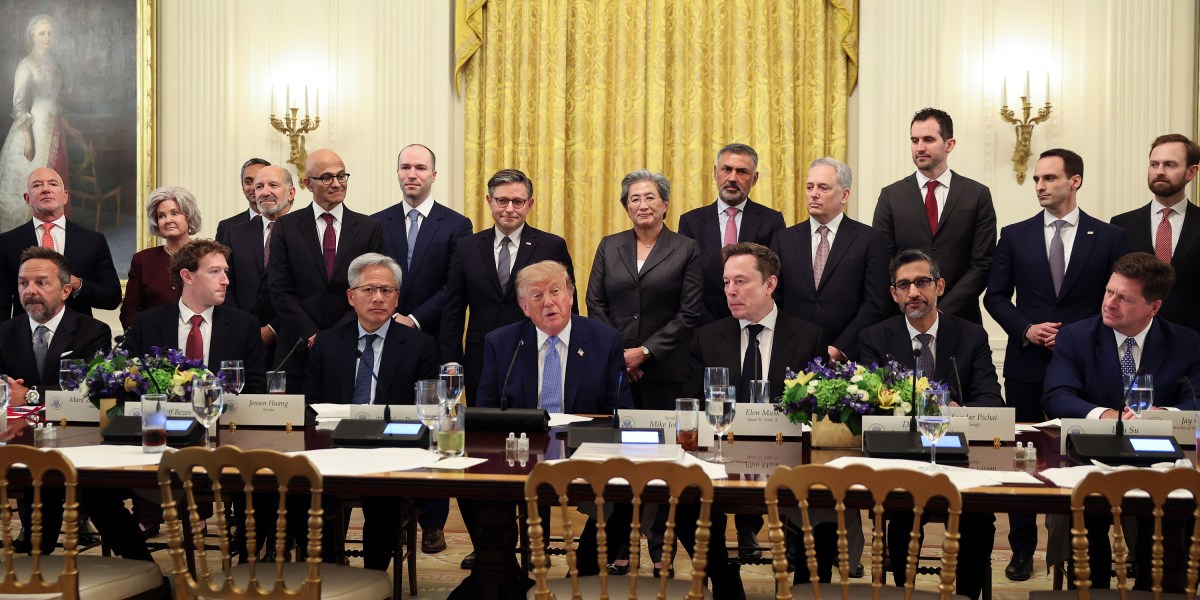
MIT Technology Review publishes an analysis by Aaron Zamost on why Sam Altman, Elon Musk, Mark Zuckerberg, and Greg Brockman misjudged the 2026 midterm elections. Five weeks before the vote, they supported Trump's 'Super Intelligence' initiative at the White House, paying no attention to dozens of pre-election polls. The victorious Democrats, in their victory speeches, attacked AI and Big Tech. The result was a political deadlock: permits for data center construction and grid connections now depend on the goodwill of the new majority, which in turn determines the further scaling of AI infrastructure.

What happened
MIT Technology Review published an article titled "Silicon Valley claims to know the future. So why did it get the midterms so wrong?", dedicated to the failure of political predictions by the leaders of leading AI companies. According to the analysis, five weeks before the 2026 midterm elections, Sam Altman, Elon Musk, Mark Zuckerberg, and Greg Brockman gathered at the White House and supported Trump's 'Super Intelligence' initiative. By this time, dozens of polls showed rising anti-Trump sentiment and bipartisan resistance to AI data centers, but this data was ignored. The Democrats won the elections, and in their victory speeches, they directly attacked AI, data centers, Musk, and Big Tech as a whole. After this, as the publication notes, the industry found itself in a political deadlock: access to energy grids and construction permits now depends on the positions of the new majority.
Context
The background of this story is broader than a single meeting at the White House. According to available materials, the 'Super Intelligence' initiative remained a marketing-level document: there is no technical description, benchmarks, or methodology for it in open sources. However, its support came at a time when polling data confidently indicated a shift in voter sentiment, and resistance to data centers had become a bipartisan issue. Zamost emphasizes the irony: people whose public brand is built on predicting the technological future acted against the discipline of calibration and honest assessment of uncertainty that they themselves demand from their models, simply by ignoring available data and base rates. Simultaneously, Big Tech's bet on one political force turned AI from a neutral technological topic into a marker of cultural-political conflict, and now aggressive public announcements are read as a political signal, not just a scientific statement.
Why this matters for the industry
For the industry, the main signal here is not political, but infrastructural. The growth of computing power, i.e., data centers and grid connections, has come to depend not only on capital but also on political decisions. Therefore, the key bottleneck is shifting from capital and compute to construction permits, and compute expansion is becoming a hostage to the political cycle. There is no direct impact on the production stack yet: contracts, quotas, and inference prices do not change overnight, and site approvals and grid connections belong to long cycles. Therefore, today's effect is more managerial and consists in the fact that capacity expansion plans become less predictable. Teams should fix how many vendors their stack relies on, reduce dependence on a single provider, and plan fallback architecture in advance with multi-provider routing, caching, and inference cost control. If approvals are indeed delayed, competition for existing capacity will intensify, and providers will likely shift priorities toward inference efficiency.
Why this matters for users
For the reader, there is no direct effect yet: the material records a political deadlock, not a technical deficit, so the availability and prices of familiar AI services do not change overnight. The risk lies further ahead: if the deadlock slows down data center construction and energy connections, bottlenecks may eventually manifest in limits, delays, or frontier-API prices, but for now this is a scenario, not a completed fact. There is also a more general lesson: 'vision of the future' in technology does not transfer to politics, and lobbying decisions by top managers can slow down precisely those infrastructure projects on which the affordable operation of AI services depends. Therefore, loud statements by technology leaders about the future should be treated with the same skeptical calibration that they themselves teach their models.
What is still unknown / limitations
There are several uncertainties here. The source records the attacking rhetoric of the winners and the political deadlock, but does not name a single revoked permit or blocked project: for now, these are new expectations and a stress test of plans, not completed blocks. The material relies on the analysis of one publication, and from a single failure in the 2026 midterm elections, one cannot conclude the systematic inadequacy of long-term roadmaps by tech leaders. Regarding the 'Super Intelligence' initiative, only the fact of political support is confirmed, and its scientific content cannot be assessed based on available materials. Finally, scenarios of delayed approvals and a shift in provider priorities remain interpretations, and whether the restrictions will become factual will only be shown by the political process in the coming months and years.
Sources
Author
Look at AI, editorial team