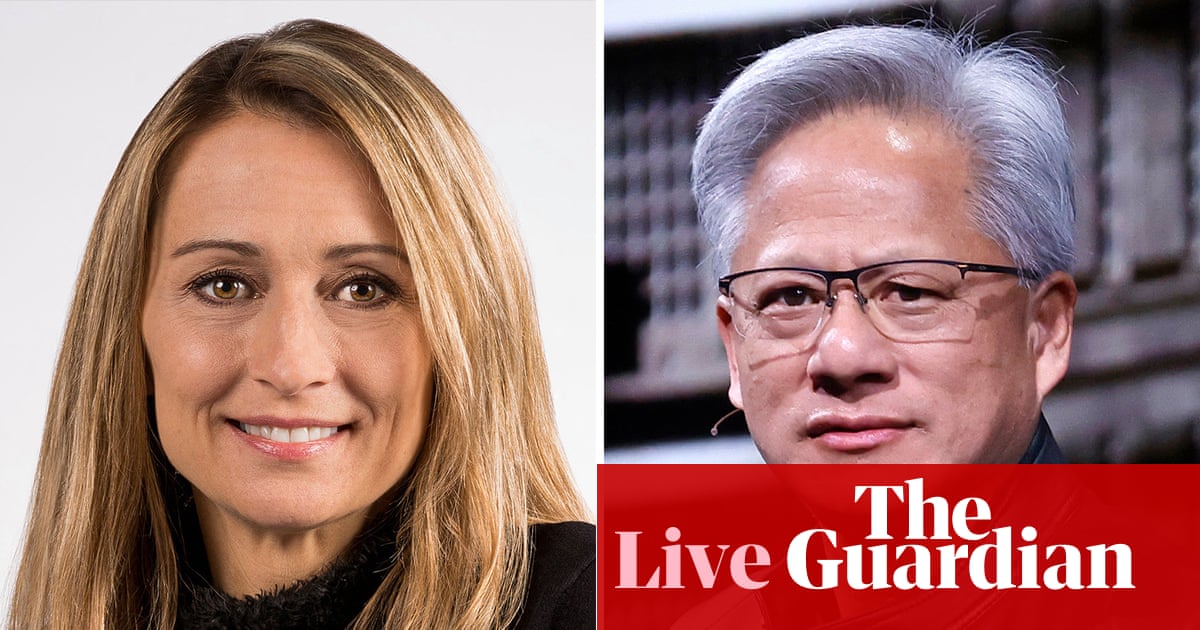
On November 12, 2026, Jensen Huang resigned from his positions as Chief Executive Officer, President, and Board Member of NVIDIA. He cited as the reason an investigation into his relationship with Alice Huang — a top executive at Singapore-based Megaspeed, whom the US suspects of working for Chinese intelligence — and a romance with NVIDIA Vice President Kimberly Powell. Interim leadership of the company was taken over by CFO Colette Kress, while NVIDIA shares dropped approximately 13% at the market open, losing about $320 billion in market capitalization in a single day. Huang agreed to testify before the US Congress before Thanksgiving, and the outcome of the hearings, investigations, and the selection of a permanent CEO will now determine how quickly the AI market stabilizes.


What Happened
Huang stepped down from three positions simultaneously: CEO, President, and Board Member of NVIDIA. The Board of Directors appointed CFO Colette Kress as the interim head of the company and has not yet named a permanent successor. At the same time, several parallel lines of inquiry emerged: an internal board review, FBI involvement, and shareholder lawsuits. The market reaction went beyond the usual fluctuations seen in corporate scandals: a 13% drop at the market open, approximately $320 billion in lost market capitalization in one day, and roughly $888 billion over the week, with the company’s market valuation at about $3.9 trillion. Sources have not reported any technical changes to products, APIs, or capacity availability — the impact was on the company’s management stability, not its product stack.
Context
The sharpness of the reaction is explained not by the scandal itself, but by the structure of the company that the resignation exposed. Even before his departure, on November 9, CNBC described NVIDIA as a classic case of “key man risk” and “no heir”: Huang had 33 direct reports, a flat management structure, and no prepared successor existed. Huang remained the main public face of NVIDIA and a key architect of its strategy, so in such a company architecture, the loss of institutional knowledge transforms from a personal drama into a systemic problem. The situation is compounded by NVIDIA’s position in the industry: it is the largest GPU supplier for AI, and its strategy affects compute supply, infrastructure financing plans, and the price dynamics of the entire AI market. Investors and corporate clients reassessed risks across all these areas simultaneously in a single day, which resulted in the scale of the crash.
Why This Matters for the Industry
For builders and industry companies, this is primarily a signal to manage the risk of dependence on a single infrastructure provider. In the immediate term, nothing broke: GPUs, CUDA, and running inference clusters are being serviced as before, but decisions on purchasing capacity for the next six months are now being made under conditions of management uncertainty. Chinese AI companies are already rushing to book capacity on NVIDIA chips in advance, and queues for smaller customers may lengthen immediately. For capital-intensive startups, a public shock to an infrastructure leader can temporarily complicate funding rounds: investors are revising assumptions about supply and financing. A practical response to such risk is vendor-agnostic architecture, monitoring of GPU capacity prices and availability, and scenario planning: even if the successor maintains supply and the CUDA ecosystem, diversification discipline will become part of the standard AI product stack from this point on.
Why This Matters for Users
For the reader, this is not a story about personal life, but about a change in leadership at a company that determines GPU prices, access to AI power, and the dynamics of the entire AI market. Right now, little changes for users and developers: existing contracts and reserved capacity remain in force, and clouds and the CUDA ecosystem are working as before. Benchmarks should be sought in two points: who NVIDIA will appoint as permanent CEO — Tim Cook, Rene Haas, and Lisa Su have been discussed in the press, but there is no official confirmation — and how the Congressional hearings will proceed. If the supply strategy remains unchanged, the daily work of teams will not change; if it shifts, the first noticeable signals will be prices and access times to GPU capacity, followed by the cost of AI products built on that power.
What Is Currently Unknown / Limitations
The facts are incomplete, and several key outcomes are currently unknown. The confirmed reasons for the departure are limited to what Huang himself stated, while the results of the board review, FBI proceedings, and the outcome of shareholder lawsuits are unclear. Candidates for the permanent CEO position remain media discussions without official confirmation. It is worth separately highlighting the debate around open models: the thesis that Huang was “one of the main proponents of open source AI” exists in publications as a cited opinion, while the conclusion about an impending ban or strict regulation of open neural networks is an expectation not confirmed by sources; there is no data suggesting that any open models or artifacts were affected by the resignation. Comparisons with Jeff Bezos and Bill Gates from social media are methodologically weak: several unstructured cases without accounting for differences do not form a pattern of “coordinated pressure.” Finally, market figures are based on live news broadcasts and may be refined; the provided sources contain no technical or benchmark claims, so the event should be assessed as a corporate and infrastructure risk, not a scientific discovery.
Sources
- Nvidia CEO Jensen Huang resigns over scandal and is replaced by CFO Colette Kress – follow live (The Guardian)
- Jensen Huang's affair highlights Nvidia's key man risk with no heir (CNBC)
- Nvidia CEO Jensen Huang resigns in the wake of multiple controversies (PCWorld)
Author
Look at AI, editorial team