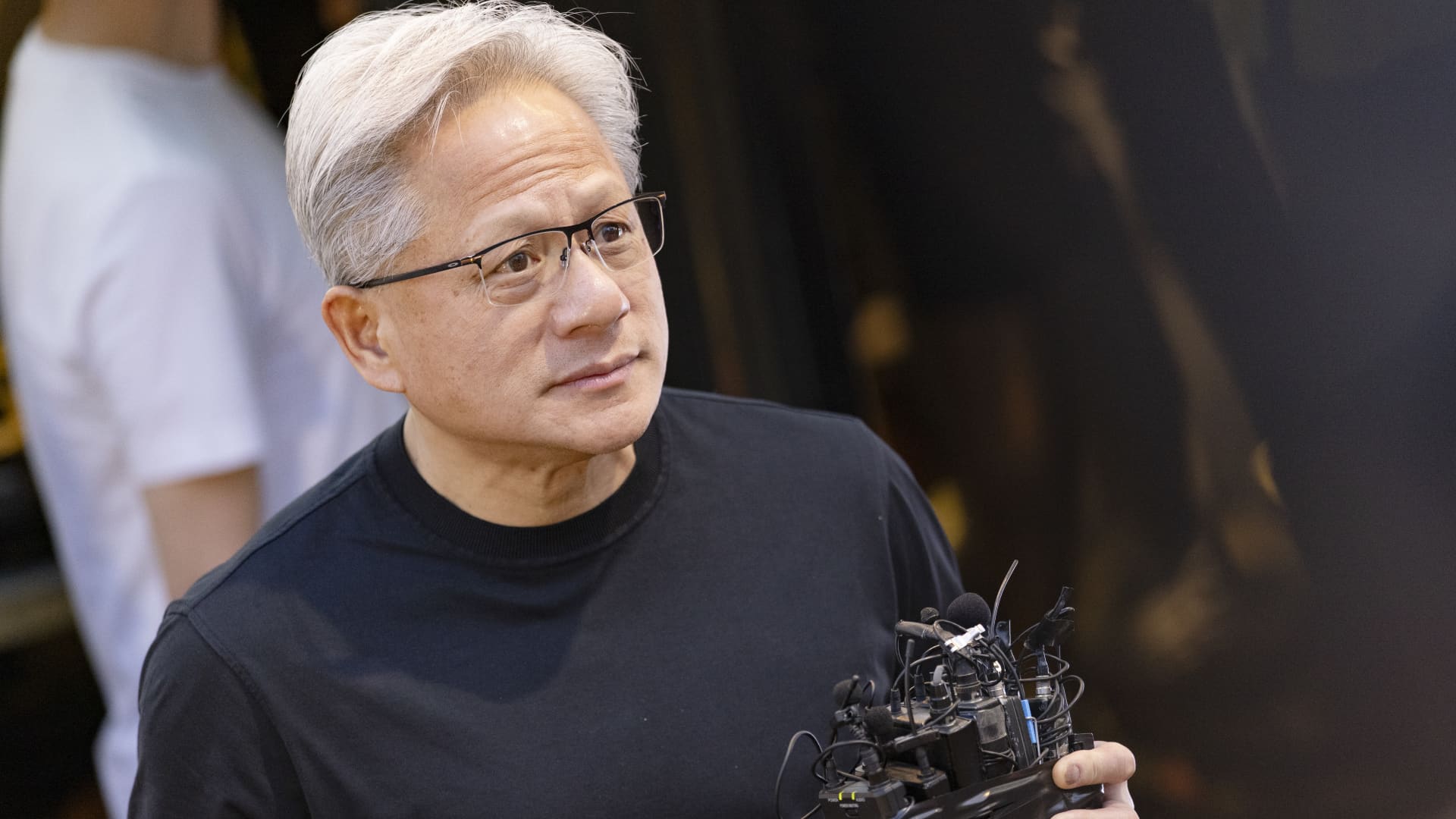
Nvidia co-founder Jensen Huang, who led the company for 33 years, announced his resignation from the CEO and board of directors roles on November 12, 2026. CFO Colette Kress has been appointed interim CEO, and former Synopsys CEO Harvey C. Jones became the first chairman in the company's history. On Thursday, NVDA shares fell 11.33% in pre-market trading, and market capitalization dropped below $4 trillion for the first time since 2025.


What happened
The announcement was preceded by a personal scandal: Huang admitted to a romance with Alice Huang, a top executive at cloud company Megaspeed, whom US intelligence agencies reportedly consider a Chinese spy. The New York Times also published a story about a second affair with Nvidia Vice President Kimberly Powell, who reported directly to him. On November 11, TechCrunch reported that the board was preparing to remove the founder from leadership, and shares had already fallen on that news. On Thursday, November 12, NVDA shares traded at $153.77 in pre-market compared to $173.73, while Bernstein cut its target price in half—from $400 to $200.
Context
Beyond the personal story, the management dimension is significant: at the time of his departure, Nvidia had neither an announced successor nor a succession plan. The CEO had approximately 60 direct reports, and the company entrusted the search for a new leader to an external recruiting consultant. Simultaneously, the scandal overlapped with regulatory vulnerability: suspicions involve circumventing US export restrictions on AI chip supplies to China through a network of companies in Asia, including Megaspeed itself. In its 10-Q report, the company showed $2.7 billion in quarterly revenue, or 15% of the $18 billion that passed through Singapore. The market will be able to assess the scale of the situation on November 17, when the earnings report is released.
Why this matters for the industry
For the AI industry, this is the biggest management shock in recent years, and its essence lies not in the romances but in a demonstrative reassessment of concentration risk: a significant portion of Nvidia's valuation premium was held by a single key figure. Until a successor is named, top-level uncertainty could slow decisions on GPU architectures, CUDA development, and supply schedules—essentially everything that underpins the industry's training and inference plans. For companies building products on Nvidia compute, the event has become a stress test of dependence on a single vendor: compute buyers are seriously discussing infrastructure supplier diversification for the first time, creating a rare window for startups. The next point of tension is the potential increase in regulatory scrutiny of the export line: if investigations confirm the operation of circumvention channels, hardware availability, rental terms, and delivery times could change within a six-month horizon.
Why this matters for users
For those relying on GPU infrastructure in their work, there are no direct changes today: drivers, CUDA, and existing contracts continue to function as before. Caution is needed in planning: compute rental price quotes should be taken with a buffer on validity periods, and large capacity commitments should either be paused or, conversely, use the volatility window to lock in terms if project timelines allow waiting for clarity. Practically, it is worth watching two things: who will become Huang's permanent successor and what the November 17 report will show, including the Singapore revenue channel. A separate caveat concerns the viral version claiming the scandal was orchestrated by Anthropic to influence the AI market: it spread on social media without any confirmation. Neither Nvidia, Anthropic, nor regulators have made any such statements, so it should be treated as a meme rather than news.
What is currently unknown / limitations
It is unknown who will become the permanent CEO and when the external recruiting search will conclude; Nvidia has not disclosed a public succession plan. Suspicions of circumventing US export restrictions remain suspicions: there are no official charges regarding the Singapore channel or the chain of companies in Asia, including Megaspeed. The claim that US intelligence agencies consider Alice Huang a Chinese spy relies on a retelling of sources, not on public agency materials. The original post mentioned "minus 15%", whereas verified data shows 11.33%—numerical claims should be checked against the primary source. Finally, the thesis that part of the market premium will quickly return to the price is an untestable assumption: the valuation premium is based on the company's future technical speed, i.e., architectural decisions, GPU roadmap schedules, and the pace of CUDA and interconnect development.
Sources
- CNBC: Nvidia stock pares morning losses after CEO Jensen Huang announces resignation
- Finbold: Nvidia stock plummets 11% as Jensen Huang resigns as CEO after 33 years
- TechCrunch: Nvidia's stock drops as board reportedly preps to oust CEO Jensen Huang
Author
Look at AI, editorial team