
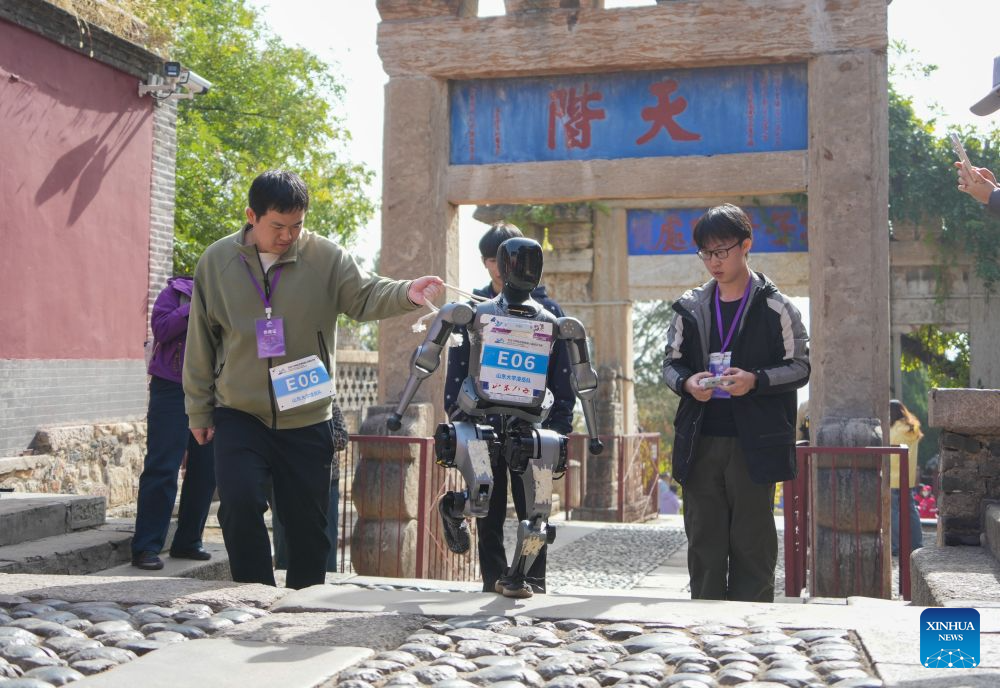
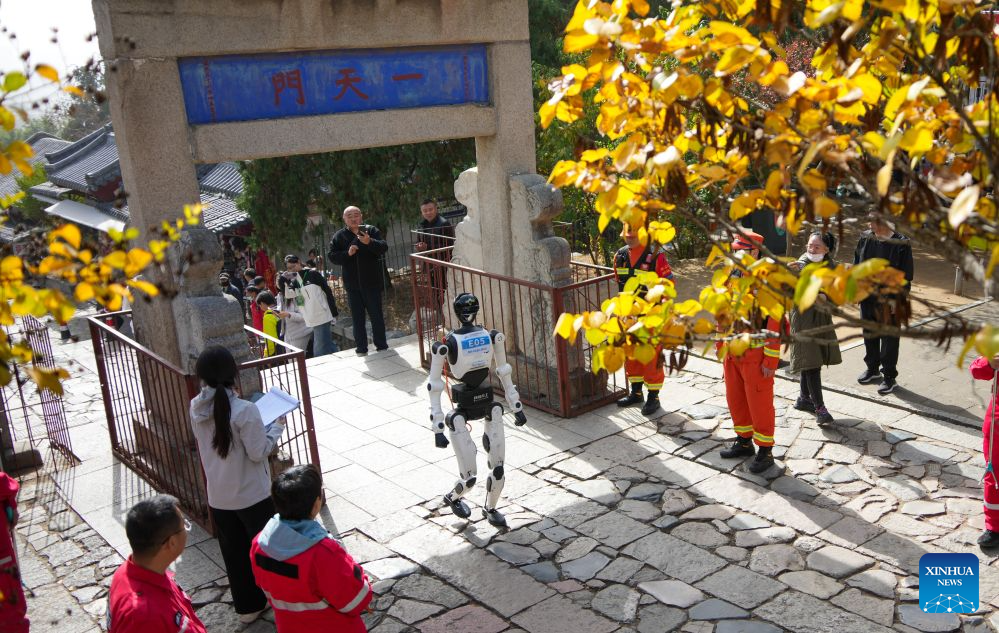
China's state media corporation CMG held the world's first robot Mount Tai climbing competition on November 2, 2026, in Tai'an, Shandong Province, bringing together nearly 90 teams from China. The Unitree A2 from Beijing Lingyi Technology won the quadruped race, completing the historic trail from Hongmen to Zhongtianmen—3.9 kilometers with over 3,100 stone steps—in 43 minutes and 41 seconds. The humanoid race on a shortened 1.6-kilometer segment ended with a victory for the Yinyi NE01 from Genisom AI in 27 minutes and 26 seconds, while the cargo category was closed by the quadruped D50 from LINXAI Robotics. The race served as a rare public field test of robots outside the laboratory and highlighted a gap within the industry: quadruped platforms are already confidently operating on real mountain stairs, while humanoids on long-distance tracks are hitting thermal limitations of their actuators.

What happened
The competition took place on November 2, 2026, in Tai'an, Shandong Province, with nearly 90 teams from China participating. The quadruped race took place on the historic Hongmen — Zhongtianmen trail: 3.9 kilometers with over 3,100 stone steps. It was won by the Unitree A2 from Beijing Lingyi Technology, a subsidiary of Hangzhou-based Unitree Robotics, with a time of 43 minutes and 41 seconds; the Gaoyi Technology team, also competing on Unitree platforms, finished second. Organizers shortened the humanoid category to the Hongmen — Doumu Palace segment, 1.6 kilometers long with over 600 steps, and its winner was the Yinyi NE01 from Genisom AI with a time of 27 minutes and 26 seconds. In the cargo category over 3.3 kilometers with over 2,100 steps, the best result was shown by the quadruped D50 from LINXAI Robotics, which completed the course in 1 hour, 51 minutes, and 29 seconds. The exoskeleton and off-road pathfinding categories had not finished at the time of the summary, and their results were promised to be announced separately. According to a Telegram channel, a dev version of the Unitree G1 humanoid overheated during the climb and was removed from the distance.
Context
The stairs of Mount Tai are a harsh field test for locomotion and autonomous navigation: stone steps of varying height and width, an elevation gain of nearly 600 meters, and the multi-kilometer length of the climb test a robot's endurance under load, so the track has no direct analogs among laboratory demos and standard gait benchmarks. For China, such public displays have long been part of the state agenda: as early as February 2026, humanoid robots at the Spring Festival Gala, according to Global Times materials, demonstrated the country's annual technological leap, and the Mount Tai run continues this line, moving the display from the stage to real terrain. The organization of the event also speaks to its status: this is a competition by a state media corporation, not a standardized benchmark, without open telemetry, a full protocol, or repeat runs, meaning it is a demonstration of industry capabilities. The results, however, reinforce the established landscape of the quadruped segment, where Unitree platforms already dominate, although when evaluating wins, it is correct to separate the merit of the control teams responsible for gait and navigation from the quality of the hardware itself.
Why this matters for the industry
For the industry, the main point of this event is the emergence of public field timings that can be relied upon when assessing the feasibility of inspection and on-site logistics pilots on stairs and rough terrain: the winner's result in the quadruped race reads as an indicator of the product readiness level of Unitree-class platforms, while the humanoids' result on the shortened distance serves only as a basic tracking point for progress, not a basis for market launch. At the same time, the agenda of limitations has been defined: actuator overheating, electronics throttling in humanoids, and gait failure after cargo changes show that the bottleneck for robots on long tracks is currently heat dissipation and motor control, not just AI motion planning, so pressure on thermal design of actuators and power consumption for humanoid platforms will increase. This sets a pragmatic landscape for startups and integrators: quadruped platforms can be moved to near-term commercial pilots, while humanoid projects should be kept within the R&D loop. If the format continues, the industry will receive the closure of the remaining categories and possibly the repetition of mountain competitions as a public field test, and the publication of telemetry by participants would turn such events into a comparable track record of characteristics instead of scattered demos.
Why this matters for users
For the reader, this is a ready-made, honest table of robot reliability outside the stand: the results mentioned above provide a specific reference for which devices are already really walking on long stone stairs with varying step geometry, and allow for sober calibration of expectations after polished marketing videos. The numbers should be perceived as a reference, not a guarantee: there is no telemetry or details of the runs in the publications, so practitioners looking for a platform for inspection, patrolling, or delivery on similar routes should check suitable candidates on their own routes, considering the competition's field timings as the lower bound of the device class's maturity. Further, it is worth watching for the announcement of winners in the exoskeleton and off-road pathfinding categories, where a separate result is promised: for these classes of systems, there have been almost no public field references so far.
What is currently unknown / limitations
Known gaps are significant. There is no run protocol in open materials: payload, battery charge status, number of slips and autonomous gait recoveries, operator intervention, weather conditions, and the presence of repeat attempts are not disclosed, so calling the track a reproducible field test would be an exaggeration. Scoring criteria are not described: reports of 400 points for cargo carrying are given without explanation. The results of the exoskeleton and off-road pathfinding categories have not yet been announced. Data on the winner of the cargo category conflicts in different parts of the source materials: LINXAI Robotics D50 in the summary and Lingsi Intelligent in the text, so the final distribution of places needs to be rechecked against final protocols. Finally, the message about the overheating of the dev version of the Unitree G1 was published by a Telegram channel, and at the time of preparing the material, there was no official confirmation from the organizers or the vendor.
Sources
- Xinhua — First world robot Mount Tai climbing competition held in east China's Shandong
- China Daily (Tai'an subsite) — Robots take on challenging climb at Taishan Mountain
- Global Times — Humanoid robots at Spring Festival Gala grab headlines, showcasing China's tech leap in just one year
Author
Look at AI, editorial team