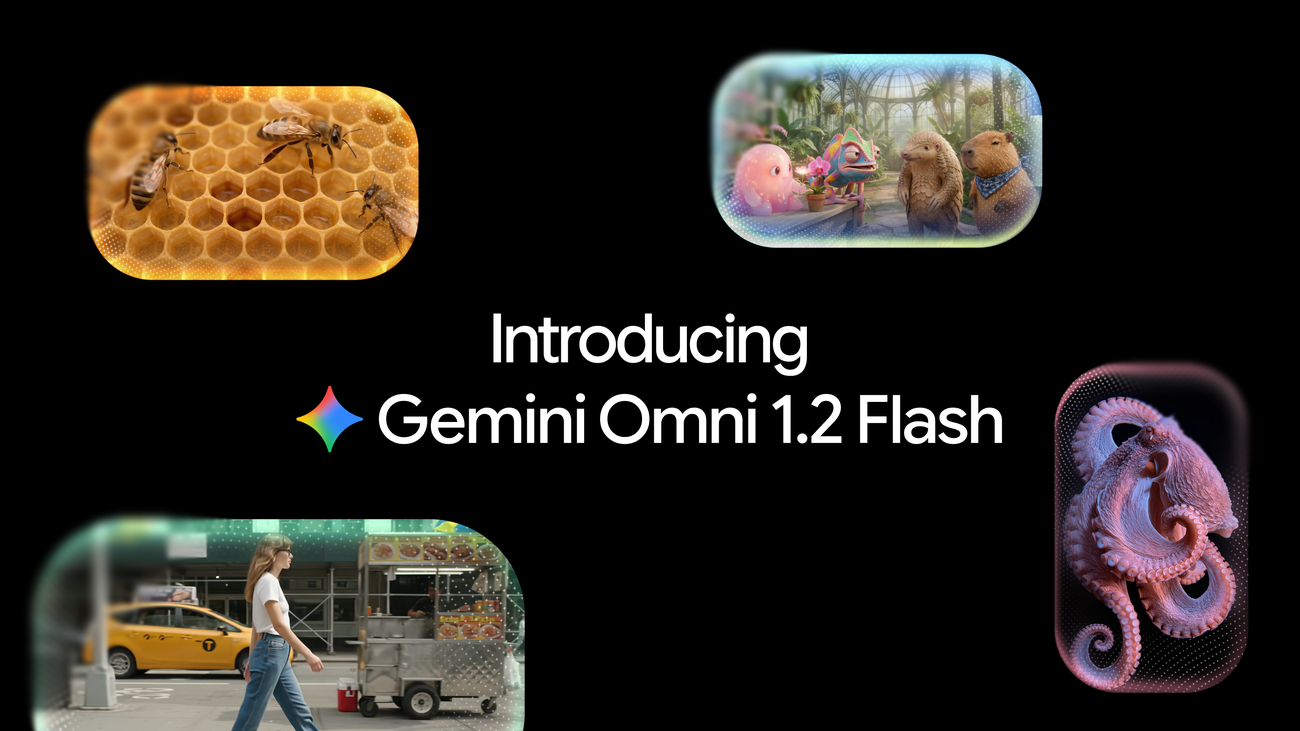
Google DeepMind has moved the Gemini Omni 1.2 Flash video generation and editing model to general availability (GA). It now creates clips up to 15 seconds long instead of 10, with one-second increments, and the price has dropped by 30% compared to Omni 1.1 Flash — to $0.07 per second of 720p video. Drafts can be prepared in 360p or 720p and then upscaled to 1080p or 4K, while the clips themselves can be edited via dialogue without full regeneration.


What happened
Google DeepMind announced the transition of Gemini Omni 1.2 Flash to GA status: the video model has exited the experimental stage and is available for production use. The clip length range is from 3 to 15 seconds with one-second increments. Pricing is $0.07 per second of 720p video, which is 30% lower than the Omni 1.1 Flash level; it supports a workflow involving a cheap draft in 360p or 720p and subsequent upscaling of the selected clip to 1080p or 4K. Quality improvements are claimed: multi-turn dialogue editing of the same clip with changes to background, lighting, and angle without regeneration; stronger adherence to three types of references — images, clips up to 3 seconds, and audio; improved consistency of characters and objects from the first frame to the last; and more natural speech and lip-sync with support for multiple speakers. The model is available in the Gemini API, via Google Cloud in Vertex AI with a Provisioned Throughput option, in Google Vids, Flow, and in the Gemini app for Google AI Ultra subscribers. All generated videos carry a SynthID watermark.
Context
The release fits into a steady trajectory: generative video is ceasing to be a demonstration capability and is becoming a standard production tool. The previous version, Omni 1.1 Flash, produced shorter clips and was more expensive, and the transition to the new version solidifies the movement toward greater duration while reducing the price per second from generation to generation. GA status, a public API, a Provisioned Throughput option with guaranteed throughput, and a mandatory SynthID watermark on all outputs are attributes of a model designed for corporate requirements regarding delivery predictability and content provenance, rather than a research prototype. Simultaneously, partners are integrating the model into their own production pipelines: Adobe Firefly, Runway, Picsart, Photoroom, invideo, and Krea. This means that access to the technology will be available to teams that do not write code themselves and do not work with APIs directly, but interact with it through familiar editors.
Why this matters for the industry
The main industry effect is a change in the economics of iterations. A scheme in which a cheap draft is created in low resolution, refined through dialogue edits of the same clip, and only then upscaled to high resolution allows paying the full generation price once, while performing edits without regeneration. The cost shifts from repeated attempts to pinpoint refinement, and mass scenarios — virtual try-ons, catalog videos, ad spots, CTV advertising — become economically viable in a single run. Provisioned Throughput and SynthID address typical enterprise requirements for reliability and content provenance, lowering the barrier for corporate adoption. The new price benchmark per second of video puts pressure on the economics of competitors and open-weights approaches, whose inference costs are higher, so defensibility for startups shifts from access to the model itself to the UX layer, industry data, and distribution. If multi-turn local editing is confirmed in independent checks, it could become a baseline expectation for video models, and the engineering wrapper over the API will become a new field of competition.
Why this matters for users
Developers can try the model right now in Google AI Studio and build a minimal prototype in days: a reference or text prompt, a clip, dialogue edits — with connection via the Gemini API or Vertex AI, where the budget is calculated in seconds of video, making a pilot on one real scenario cheap. No-code scenarios are available to regular users: generating full-length clips in Google Vids and Flow without extra charges, and for Google AI Ultra subscribers — also in the Gemini app. Multi-turn editing changes the workflow itself: instead of regenerating the video in the hope of an acceptable result, you can change the background, lighting, or angle via dialogue while keeping the rest of the scene. Through partner apps — Adobe Firefly, Runway, Picsart, Photoroom, invideo, and Krea — the model will be available to those who continue working in familiar tools.
What is still unknown / limitations
Key quality claims about the model have not yet been independently confirmed. For multi-turn dialogue editing, neither the methodology nor the quality metrics for background, lighting, and angle edits, nor data on clip degradation after a large number of editing turns, have been published. Limitations of reference adherence — character identity stability, behavior in edge cases — have not been disclosed. The claim of more natural speech and lip-sync with multiple speakers is not accompanied by benchmarks such as recognition accuracy or synchronization metrics, so it is more correct to consider it a hypothesis requiring verification. Numerical parameters — clip length and step, price per second of 720p — are immediately verifiable, however, the best available way to assess the quality of edits today is manual testing in Google AI Studio according to the Gemini API documentation.
Sources
- Gemini Omni 1.2 Flash: 15-second video and lower pricing — Google AI Blog
- Gemini Omni 1.2 Flash now GA: cost-effective video — Google Cloud Blog
- Generate and edit videos with Gemini Omni Flash — Gemini API docs
Author
Look at AI, editorial team