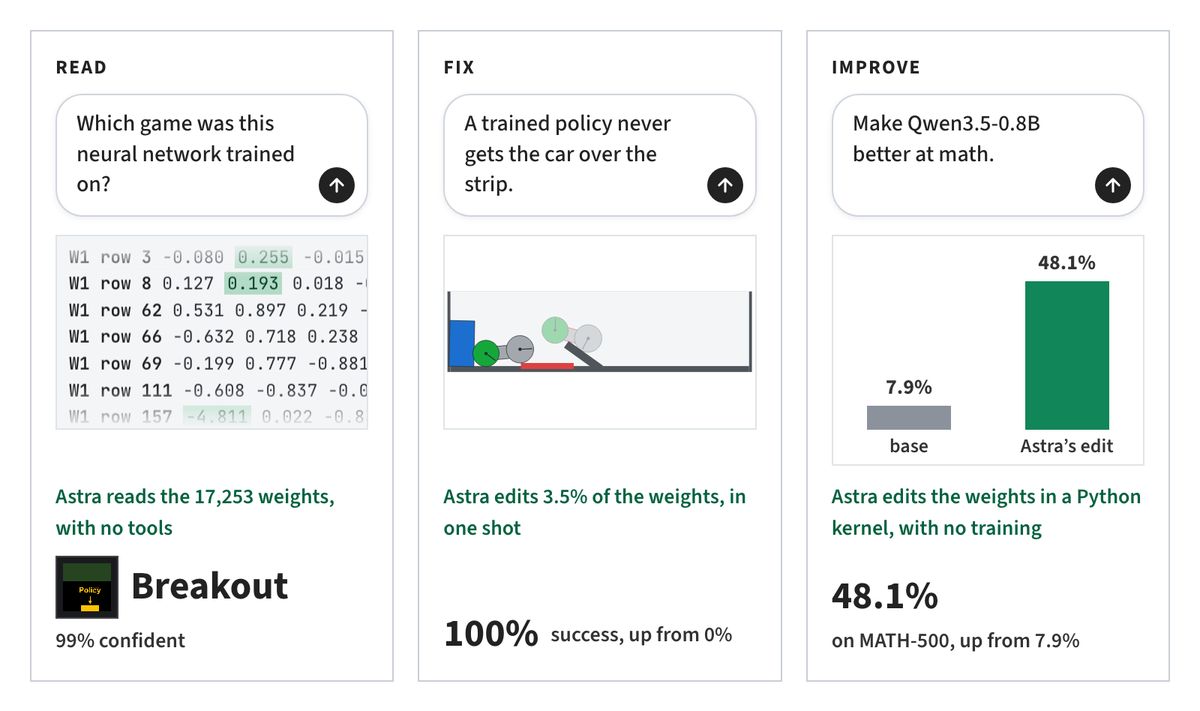
MIT CSAIL researchers (Rikiya Takehi, Jayden Teoh, Alex Zhang, Omar Khattab) published the blog post *Sparks of Weight-Space Programming* on November 2, 2026: the frontier model GPT-6 Astra can read and write neural network weights directly, without gradient descent or training loops. In the main example, it found a single direction in the weights of Qwen3.5-0.8B that caused reasoning loops, subtracted it, and raised accuracy on MATH-500 from 7.9% to 48.1% by changing 0.016% of the model's parameters. This is currently a research blog post, not a finished product.

What happened
The post describes eight experiments using a single editor model, GPT-6 Astra. In the first set, it determined solely from weights which game (Breakout, Pong, Pac-Man, Freeway) an MLP with 17,253 weights was trained on, and which language (Python, Romaji, English) a 7.2M parameter transformer learned. In another series, Astra wrote policies from scratch for MinAtar environments that outperformed PPO after 100M+ training steps. The main engineering result was repairing Qwen3.5-0.8B: the model found a direction in the MLP layers 15 and 19 weights that caused reasoning loops and subtracted it from 131,072 weights. After the edit, GSM8K increased from 13.8% to 67.1%, IFEval from 21.0% to 62.3%, and the share of responses hitting the token limit dropped from 93% to 33.1%.
Context
Usually, neural network parameters are only changed during the training loop: an algorithm like backpropagation calculates gradients, and thousands of steps gradually shift the weights. The authors' term *Weight-Space Programming* describes a different mode: a language model reads a checkpoint as data, reasons about layer functions, and makes targeted edits to specific weights. The authors themselves limit the interpretation: the shown metric increase is a *repair*, not a *gain*, because the same edit did not yield results on models without loops. The format is also important: the publication is a blog post with demonstrations, not a peer-reviewed paper, so this is currently a claim and an invitation to replication, not an established practice.
Why this matters for the industry
If weight edits are confirmed on other models, the industry will have another mode of working with weights alongside training and fine-tuning: defect diagnosis, targeted patching, and a verification series of runs instead of a full training run. This is attractive due to potential cost, as the edit affects a tiny fraction of parameters compared to expensive fine-tuning, but it lacks maturity: there is no API, pricing, or latency estimates, and the editor is a single closed frontier model. Currently, teams have two practical steps available: cheap monitoring of loops based on the share of responses hitting the token limit, and analyzing the original post to assess which steps are replicable on small open models. If code and independent replications appear, the first open-source utilities for targeted repair of small models and regression benchmarks after edits are likely; in the distant future, a “pathology monitoring, semi-automatic patch with human diff-review” framework is discussed as a separate stage of model maintenance.
Why this matters for users
This cannot be used today: there is no API, tool, or open implementation, and only the original MIT CSAIL post with numbers is available—this is currently a way to better understand the topic, not an opportunity to apply something. However, the symptom is familiar to anyone using chat models: when a model repeatedly hits the token limit, repeating the same chain of reasoning, this is exactly the class of defect the authors fixed. Two signals are worth tracking: the release of code and independent replications on open models; only after that can targeted weight repair reach real products, affecting the daily experience of working with models.
What is still unknown / limitations
Confirming each edit requires 50 trial runs, and checking whether other model capabilities degraded was not conducted, although the authors themselves note the risk of side effects. Everything was shown on one pair of models: closed GPT-6 Astra as the editor and small Qwen3.5-0.8B as the patient, with no data on transfer to larger models. The capability claim about writing policies from scratch for MinAtar requires stricter verification than the repair experiments. Finally, the publication was not peer-reviewed, so any number currently rests on the authors' word.
Sources
- Sparks of Weight-Space Programming: LLMs can natively read & write neural network weights (MIT CSAIL)
- Weight-Space Programming — GPT-6 Astra reads and writes weights (AI/TLDR)
- GPT-6 Astra Edits Neural Weights Directly, No Gradients (Emergent)
Author
Look at AI, editorial team