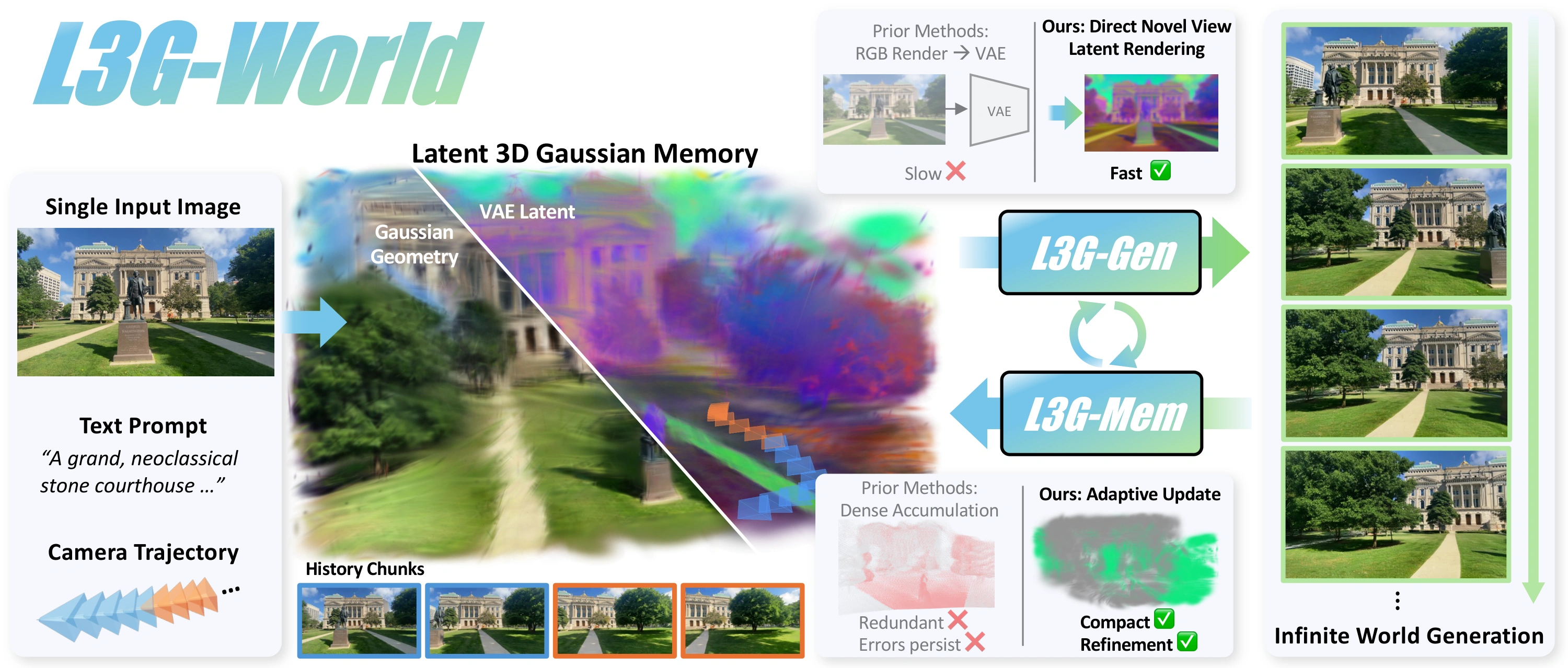
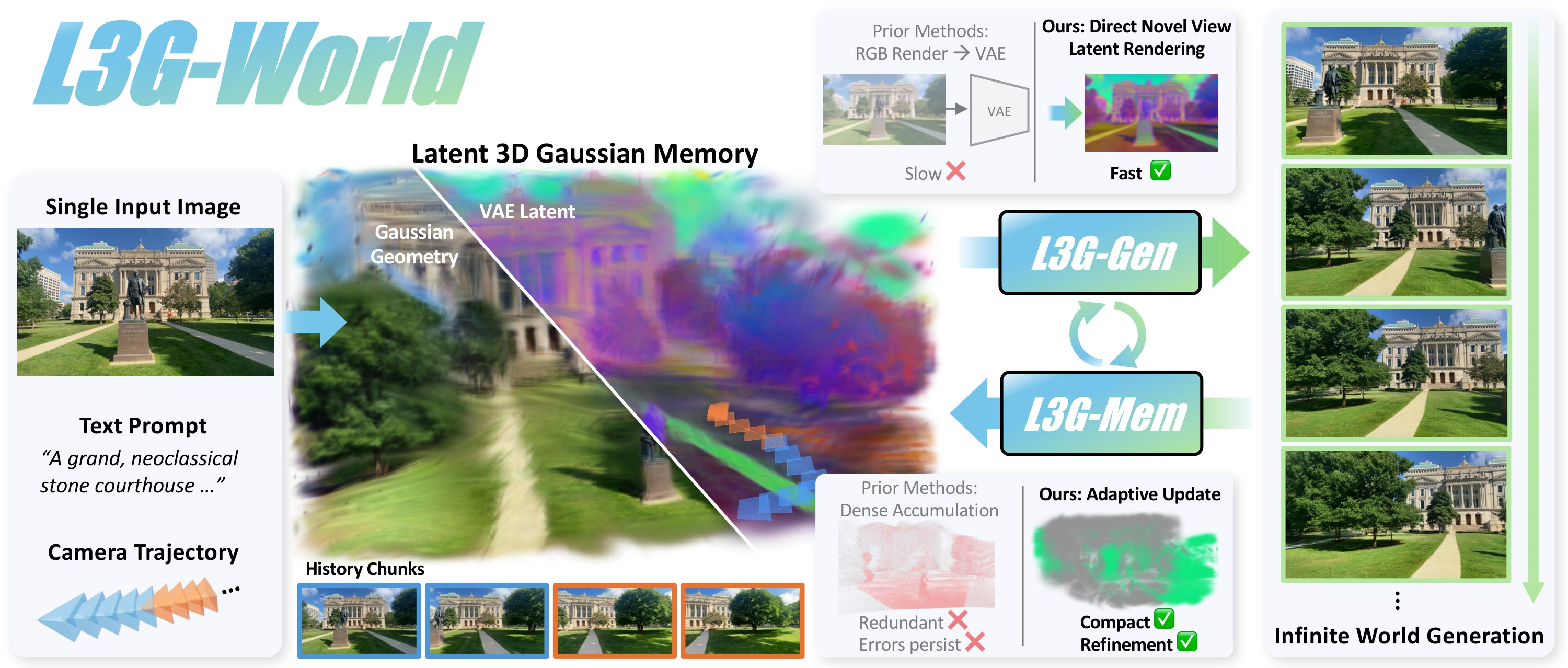
KAIST's Computer Vision Laboratory (Jinhyeok Choi, JoungBin Lee, Seungryong Kim, and co-authors) has introduced L3G-World, a framework that generates infinite 3D worlds in real time from a single image, text, and a camera trajectory. At its core is L3G-Mem, a latent 3D Gaussian memory: the system builds the world on the fly, remembers explored areas, and maintains scene consistency when the camera returns, all while operating in real time on a single NVIDIA A100. Open source code and weights are not yet available: a demo video can be viewed on the project page, and a release is promised in the cvlab-kaist/L3G-World repository.

What Happened
On October 29, 2026, a paper titled L3G-World: Real-Time Infinite World Generation with Latent 3D Gaussian Memory (arXiv:2610.40614) was released on arXiv. The framework consists of two parts. The first is L3G-Mem, a latent 3D Gaussian memory where each Gaussian primitive stores a VAE latent and is rendered directly into the latent space of a video diffusion transformer (DiT) called L3G-Gen, bypassing RGB rendering and VAE re-encoding. The second feature is a memory growth model: it expands as the scene is explored, rather than with the length of the generated stream; new areas receive new Gaussians, while already marked areas are refined upon repeated camera visits. According to the authors' measurements on an A100, memory updates run at 47 FPS, world generation at 9 FPS, and memory reading at 1000+ FPS of VAE rendering. Compared to the most economical 3D-memory baseline, L3G-World uses up to 38.6x fewer primitives (25–33 thousand versus thousands and hundreds of thousands), updates memory 3.2x faster, reads 359x faster, and has 2.56x lower peak memory consumption. The system's base components are NVIDIA Cosmos-Predict2.5 and ZipSplat.
Context
Explicit 3D memory has long seemed a natural way to keep worlds consistent in world models, but the data exchange format was a hindrance: video diffusion models operate in VAE latent space, while 3D memory is more convenient to read geometrically, so existing systems rendered frames to RGB and ran them through the VAE encoder again. This RGB→VAE round-trip consumed real time and prevented world models with explicit 3D memory from operating in real time. The second problem was scaling memory by the length of the generated stream: the longer the generation, the more memory was required, making long sessions expensive regardless of how many places in the frame were actually visited. The idea of tying memory to the size of the explored scene rather than video duration had previously remained more of a design hypothesis—L3G-World became a public attempt to bring it to concrete measurements.
Why This Matters for the Industry
For the industry, the main point of the work is not the FPS figures, but the architectural precedent: latent rendering of 3D Gaussian memory directly into the latent space of a video DiT as a way to eliminate the RGB→VAE round-trip and achieve real-time performance in world models with explicit memory. Teams building their own world-model pipelines can adopt this pattern and reconsider bottlenecks—RGB↔latent exchange and memory growth by stream length. For interactive 3D content, simulations, and game engines, the combination of "memory grows by scene size" makes minute-long consistent worlds practically achievable on a single A100 as an engineering direction. There is nothing to deploy right now: no code, checkpoints, or API. It makes sense to analyze the architecture via arXiv:2610.40614, design UX around camera trajectories, prepare integration scenarios for engines, photo apps, and agent simulators, and monitor the repository: the promised few-step model could significantly shift the stated 9 FPS, and after release, independent reproductions and a wave of follow-up works with direct latent memory rendering are likely.
Why This Matters for Users
For readers, this is one of the first "infinite world" generators from a single photograph that works in real time and maintains scene consistency upon every camera return: you can walk through a location, leave, and return to the same world, not a new version of it. L3G-World cannot be tried yet—only a demo video on the project page is available. The practical step now is one: watch the cvlab-kaist/L3G-World repository, where the authors promise to release inference code, L3G-Mem and L3G-Gen checkpoints, and a few-step model. If results are confirmed after release, such worlds may reach personal applications: personal 3D spaces from photos and interactive content where the world does not "move" under the camera upon repeated visits.
What Is Still Unknown / Limitations
Key figures—47 FPS for memory updates, 9 FPS for generation, and 1000+ FPS for reading—are author measurements on an A100 that third parties cannot yet reproduce: there is no code, weights, or API, and the repository is empty. Memory growth by scene size rather than stream length is currently an author's design claim, not a verified guarantee; it will only gain the status of a guarantee after independent reproduction on released code. Part of the quality is inherited from the base video model NVIDIA Cosmos-Predict2.5, and without ablations from the full paper, the contribution of L3G-Mem cannot be separated from the base's contribution. Behavior on long trajectories, including possible drift, remains an open question, and the license for future code and weights has not been announced.
Sources
- L3G-World: Real-Time Infinite World Generation with Latent 3D Gaussian Memory — scientific paper on arXiv:2610.40614
- L3G-World — official KAIST CV Lab project page
- cvlab-kaist/L3G-World — official implementation repository on GitHub
Author
Look at AI, editorial team