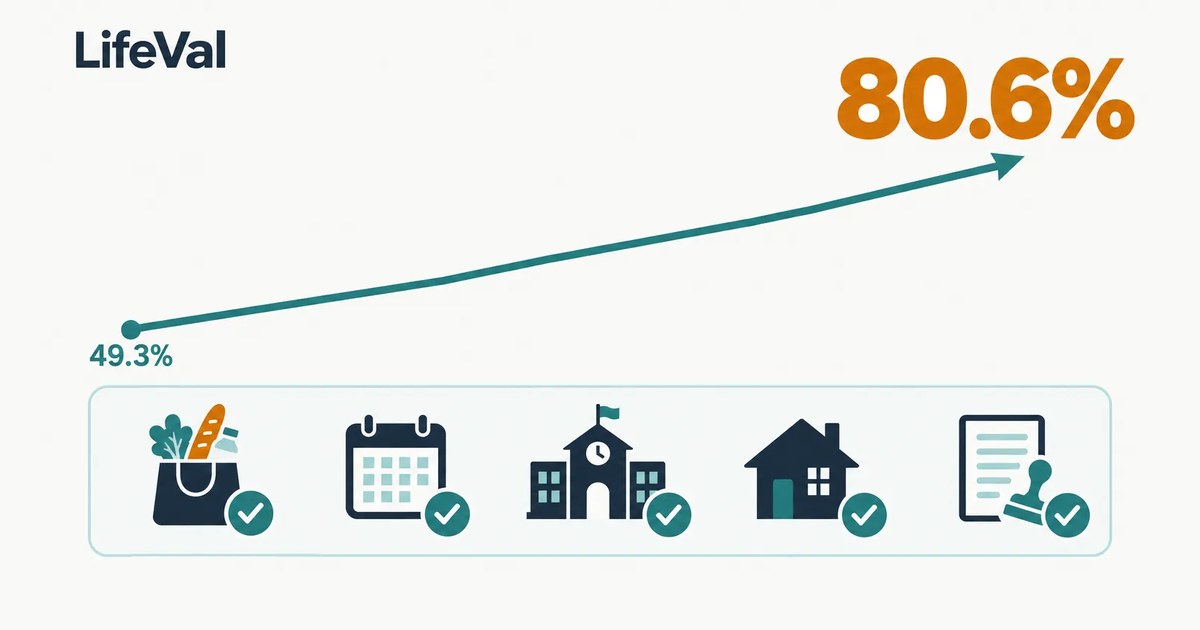
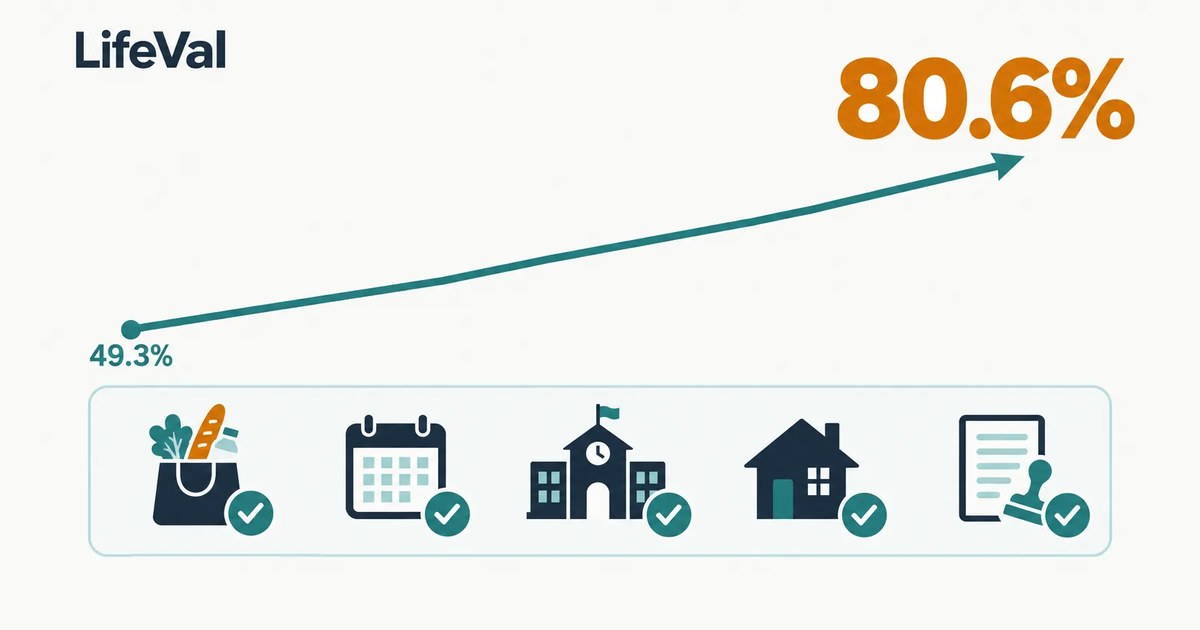
On November 2, 2026, OpenAI released LifeVal, a benchmark used internally for a year to measure the progress of ChatGPT agents on real-world everyday user tasks. The average reward for completed tasks increased by more than 30 percentage points, reaching 80.6% for GPT-6 Astra, although the pace of progress quickly hit a ceiling around 80%. Note that the 80.6% figure is a self-assessment by the developer: the task set and methodology are closed, and independent verification is not yet available.
What happened
OpenAI revealed LifeVal, an internal test that served as a metric for ChatGPT agent progress for a year. The tasks cover seven categories of daily life: caregiving, health, education, household chores, personal finance, shopping, and government services. The scenarios are not synthetic but are built on data from the American Time Use Survey by the BLS, the Multinational Time Use Study, and a survey of 3,995 people. Agents require browser use, computer use, and service connectors, and are evaluated on task completion rather than the quality of advice. According to OpenAI, the average reward rose from 49.3% for GPT-5.2 (December 11, 2025) to 73.0% for GPT-5.4 (March 2026), then to 77.4% for GPT-5.5, 80.0% for GPT-5.6, and 80.6% for GPT-6 Astra (September 2026). The task set, which lists 169 tasks according to the BenchLM tracker, and the evaluation methodology are closed.
Context
LifeVal marks a shift in the logic of agent evaluation: OpenAI explicitly acknowledges that a model "can perform all the necessary clicks and still produce an unsuitable result," so the test looks at the final state of the task, not individual steps. The role of the benchmark within the company is also notable: for a whole year, LifeVal was not just a ruler but a goal, under which models were intentionally improved. The trajectory of results shows a deceleration in pace: the GPT-5.4 release added 23.7 percentage points to GPT-5.2, while the next three releases collectively added only 7.6 points. A point of contrast emerged that same morning: an independent assessment by SemiAnalysis showed that the best of 20 models score only about 12% on expert work, meaning the industry still needs to agree on what counts as a "completed task."
Why this matters for the industry
For builders, the main signal is not the 80.6% figure, which no one can verify, but the shift in the objective function confirmed by OpenAI itself: agents are being optimized for "completed tasks" rather than useful advice. A logical step for teams building agents is to shift the focus of internal quality assessments from answer quality to the proportion of tasks completed, and to add a mandatory human confirmation gate before the final action. Vertical workflows of the form "agent does the rough work entirely, human only confirms" can already be prototyped around the scenarios shown in LifeVal examples, but such workflows should be validated on a proprietary task set compiled from the company's real tasks. Niche assistants in LifeVal categories lose their "we complete tasks" differentiation because everyday routine is quickly becoming a feature of the platform with the largest distribution. Claims like "80.6% on everyday tasks" will begin to circulate as proof points, so the first question in product and investment decisions should be the openness of the task set and methodology. Imitation is expected: vendors will start reporting their own closed "everyday" evals, and the market will be filled with incomparable figures with different definitions of success.
Why this matters for users
A plateau around 80% means that the assistant is already genuinely suitable for routine work that can be delegated entirely. In the best runs, GPT-6 Astra booked a car inspection before a trip at 100%, ordered halal groceries within a set budget with a calculation table, and freed the user from spam emails; in the shown examples, the agent enrolled a child in kindergarten after a move at 93.1% and adjusted the diet of a parent with diabetes at 90.4%. A notable detail from OpenAI's materials: the agent stops before the final step, leaving confirmation to the human. The practical conclusion is that delegating everyday rough work to the assistant—gathering options, calculations, routine communications—is worth doing now, while final decisions and confirmations are best left to the user.
What is still unknown / limitations
The main limitation: 80.6% cannot be independently verified. The task set (169 tasks according to BenchLM—a small sample) and evaluation methodology are closed, all figures were assigned by OpenAI itself, and the execution environment—live sites or test copies—is not specified. The shown cases with car inspection booking, child kindergarten enrollment, and diet adjustment for a parent with diabetes are showcase examples, not statistics: single cases with scores from OpenAI itself do not confirm result stability. The cost and latency of a single agent session have not been published. Since a year of optimization was directed at this benchmark, without independent replication, it is impossible to distinguish real agent growth from overfitting to the task set—a classic Goodhart risk. OpenAI also does not explain what exactly became the ceiling—model capabilities or task construction—and does not compare results with Claude and Gemini.
Sources
Author
Look at AI, editorial team