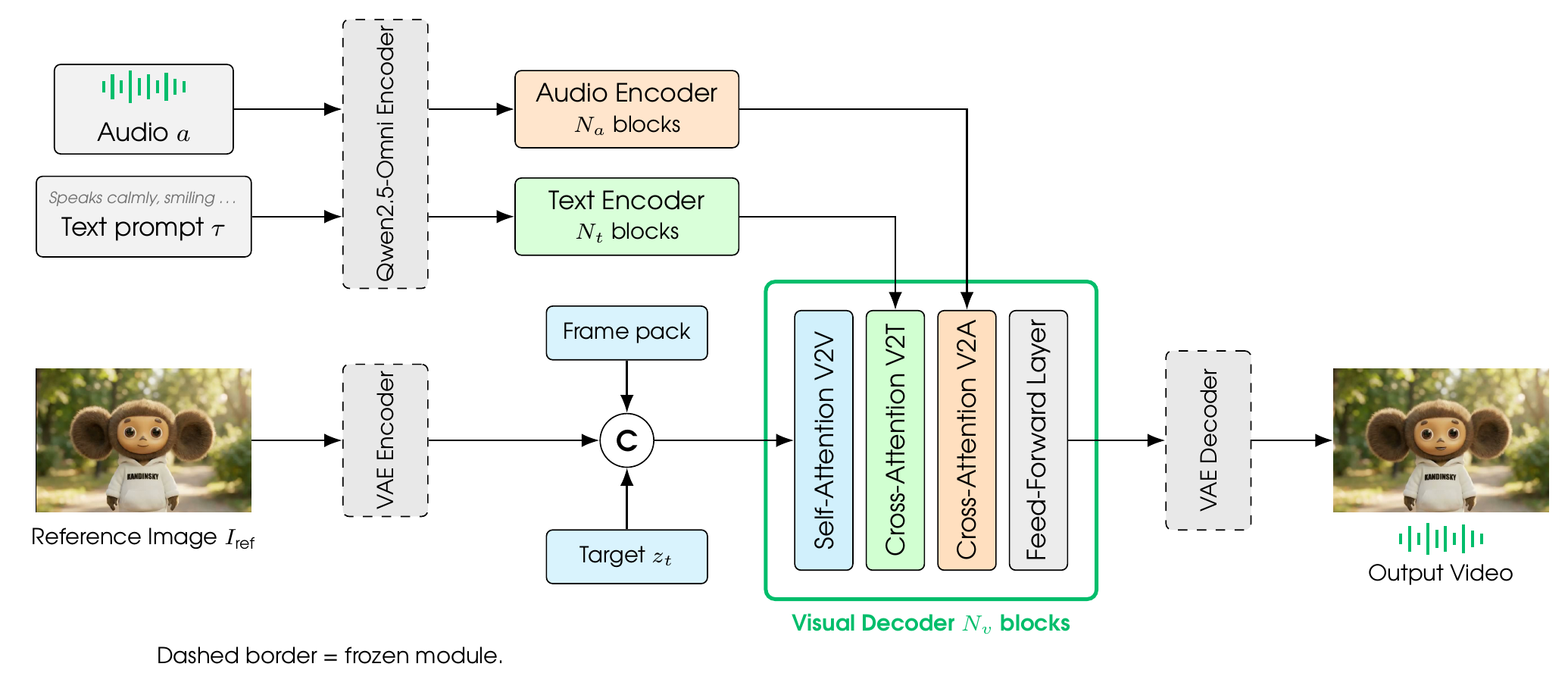
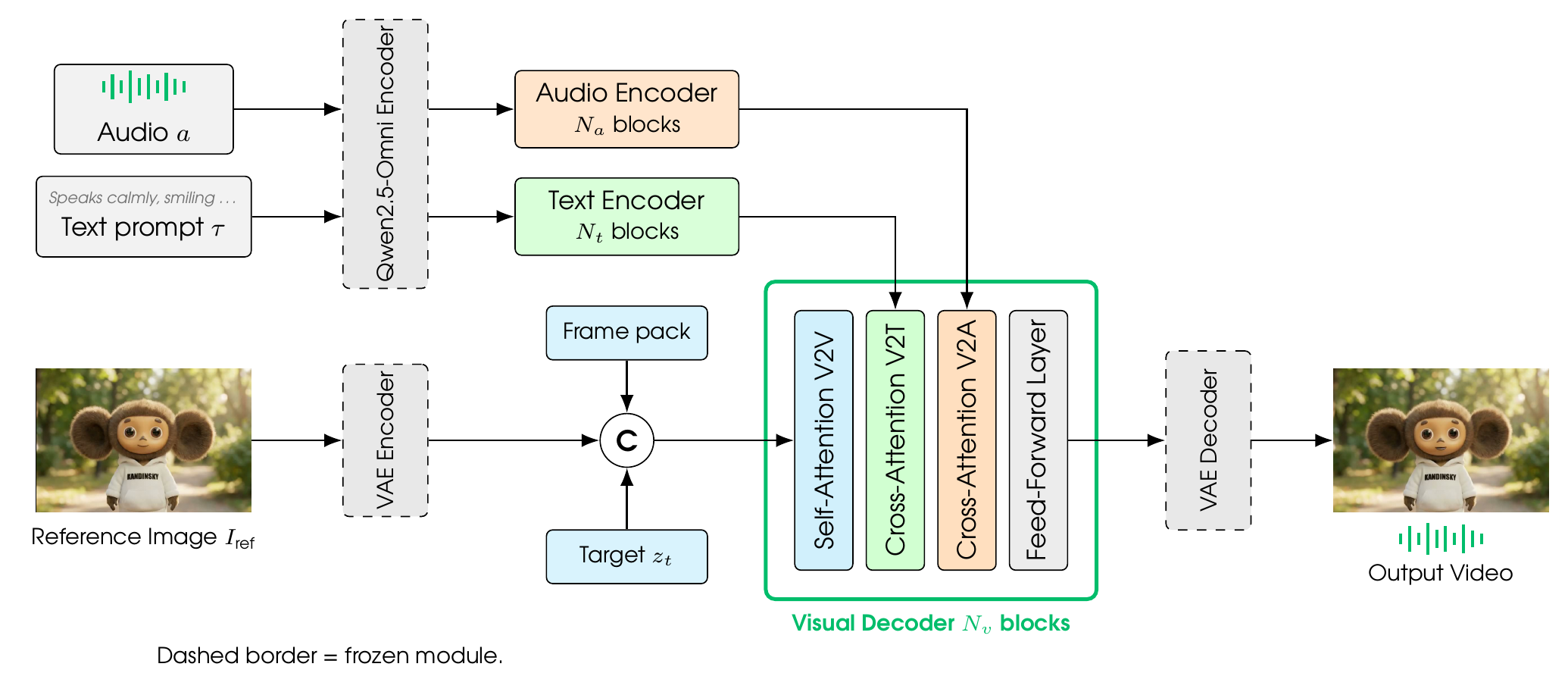
Sber (kandinskylab) has open-sourced the code and weights for the Kandinsky S2V 1.0 family of speech-to-video models: a 2B parameter Lite version, a 21B parameter Pro version, and accelerated π-Flow distilled variants. The models transform a single reference frame, an audio track, and a text prompt into a video of a speaking person, where articulation, facial expressions, and gestures follow the speech. Everything is distributed under the MIT license, which permits commercial use, and generation can be tried in a browser-based demo on Hugging Face without installation. The downside of this openness is high hardware requirements: local deployment requires a server-grade NVIDIA GPU with tens of gigabytes of VRAM. The claimed quality, stated to be on par with commercial services, is currently confirmed only by Sber's own blind tests and awaits independent verification.

What happened
Sber's kandinskylab laboratory released the code and weights for Kandinsky S2V 1.0 in the kandinskylab/kandinsky-s2v GitHub repository under the MIT license, with model cards appearing on Hugging Face in Diffusers format. The family consists of a 2B parameter Lite version, a 21B parameter Pro version, and distilled π-Flow variants that generate video in just 16 inference steps without classifier-free guidance, providing an acceleration of approximately 5.4 times. The system takes a single reference frame, an audio track, and a text prompt as input and outputs a 25 FPS video where articulation, facial expressions, posture, and gestures are synchronized with speech. Long videos—up to 60 seconds according to project data—are assembled from 5-second chunks using a FramePack memory mechanism. Training was conducted on 1.17 million single-speaker clips with English and Russian captions.
Context
Until now, the generation of talking video avatars has been primarily the domain of closed subscription services like HeyGen, where users pay per minute of generation and have no control over the model or data. Open weights change the consumption model itself: the MIT license shifts this type of generation from a SaaS subscription format to self-hosted or rented infrastructure, while the code, model cards, and demo make the open baseline reproducible—it can be studied, fine-tuned, and integrated without licensing restrictions. A separate technical layer is π-Flow distillation: its value lies not in quality ratings but in inference economics, as the cost per minute of generation determines whether embedding avatars into a product is viable. Integration is handled through the standard Diffusers library pipeline, without custom integration code. It remains important to remember that this release is research-grade, and significant engineering work is required to turn it into a finished product.
Why this matters for the industry
The industry now has a free open-source component where previously only paid services existed. The MIT license permits commercial use, allowing companies to integrate the "frame, audio, prompt → video" pipeline into their own perimeter—virtual consultants, training courses, content localization—without paying external vendors for every minute of generation. For closed avatar services, this commoditizes the generation stage itself: the pricing moat disappears once a functionally similar model can be deployed in-house, forcing startups to shift value from model wrappers to vertical scenarios, distribution, and cheap managed inference. Development costs at the entry level decrease: an MVP on rented server GPUs can realistically be built in a matter of weeks, and the main engineering work will shift to controlling consistency in long videos and managing generation, rather than accessing the model itself.
Why this matters for users
The model can be tried immediately without installation: in the Kandinsky-S2V-1.0-Demo Hugging Face Space, generation works directly in the browser. The threshold for local deployment is high: Lite requires an NVIDIA GPU with 48 GB VRAM and more, with peak consumption around 57 GiB, while Pro requires 48 to 80 GB with a peak of approximately 46–55 GiB, with HD generation for Pro requiring the upper memory range; weights are downloaded automatically and take up about 25 GB for Lite and about 65 GB for Pro. Neither version will run on a standard home graphics card, so the realistic path for enthusiasts is renting a cloud GPU. Readers without such hardware still benefit: generation in the demo is free, anyone can compare its results with paid subscriptions, and then use this comparison when choosing a service or negotiating rates.
What is currently unknown / limitations
Key claims about quality remain vendor-provided data: blind comparisons of Pro with two commercial models and its leadership in lip-sync were published without details on the jury composition, sample size, list of baselines, or metrics, so until independent reproductions, they should be read as developer assertions rather than established facts. There is a direct contradiction in the materials regarding training data: the project description mentions 1.17 million single-speaker clips with English and Russian captions, while the post text mentions over a million videos in 95 languages—it is unknown what language coverage is actually supported at inference, which is critical for Russian-language lip-sync. Frame rate data also differs: 25 FPS in the description versus 24 fps in the post text. Consistency of appearance, background, and gestures when stitching long videos from 5-second chunks is an unverified characteristic that should be evaluated on one's own examples rather than selected demo cases. Furthermore, this is a research-grade release without an API, pricing, or latency and throughput data, and lip-sync performance on noisy spontaneous speech, rather than just studio audio, is unconfirmed.
Sources
- Kandinsky S2V 1.0: Audio-Driven Avatar Video Generation — official project page
- kandinskylab/kandinsky-s2v — code repository on GitHub (MIT license, VRAM and speed benchmarks)
- kandinskylab/Kandinsky-S2V-1.0-Pro-distill-Diffusers — model card on Hugging Face
Author
Look at AI, editorial team