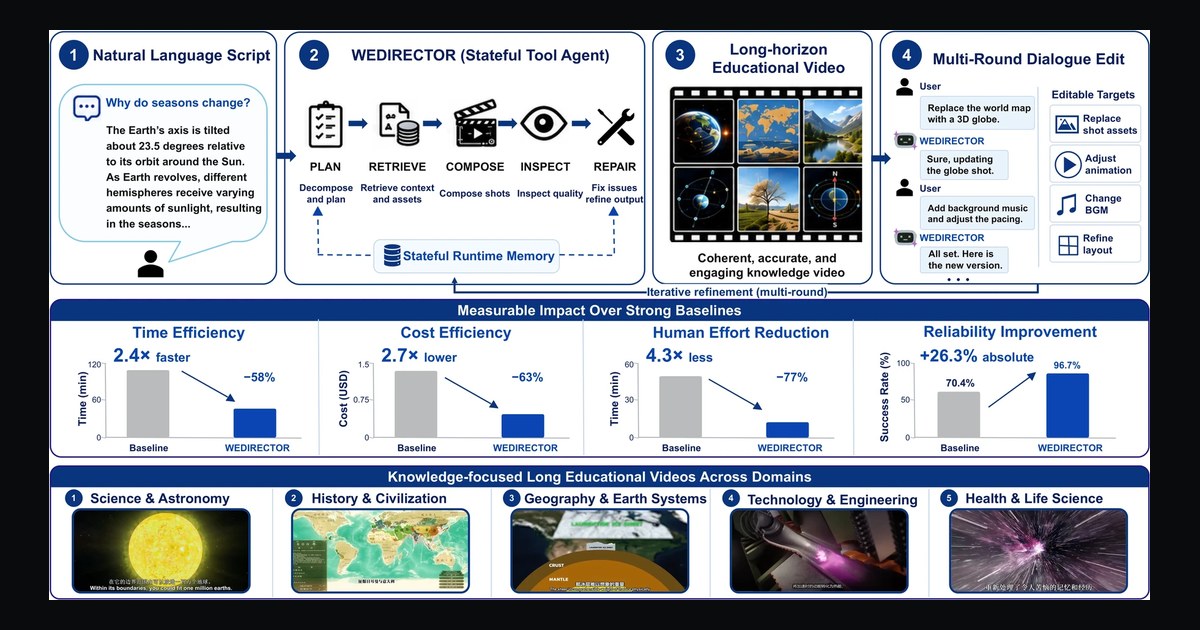
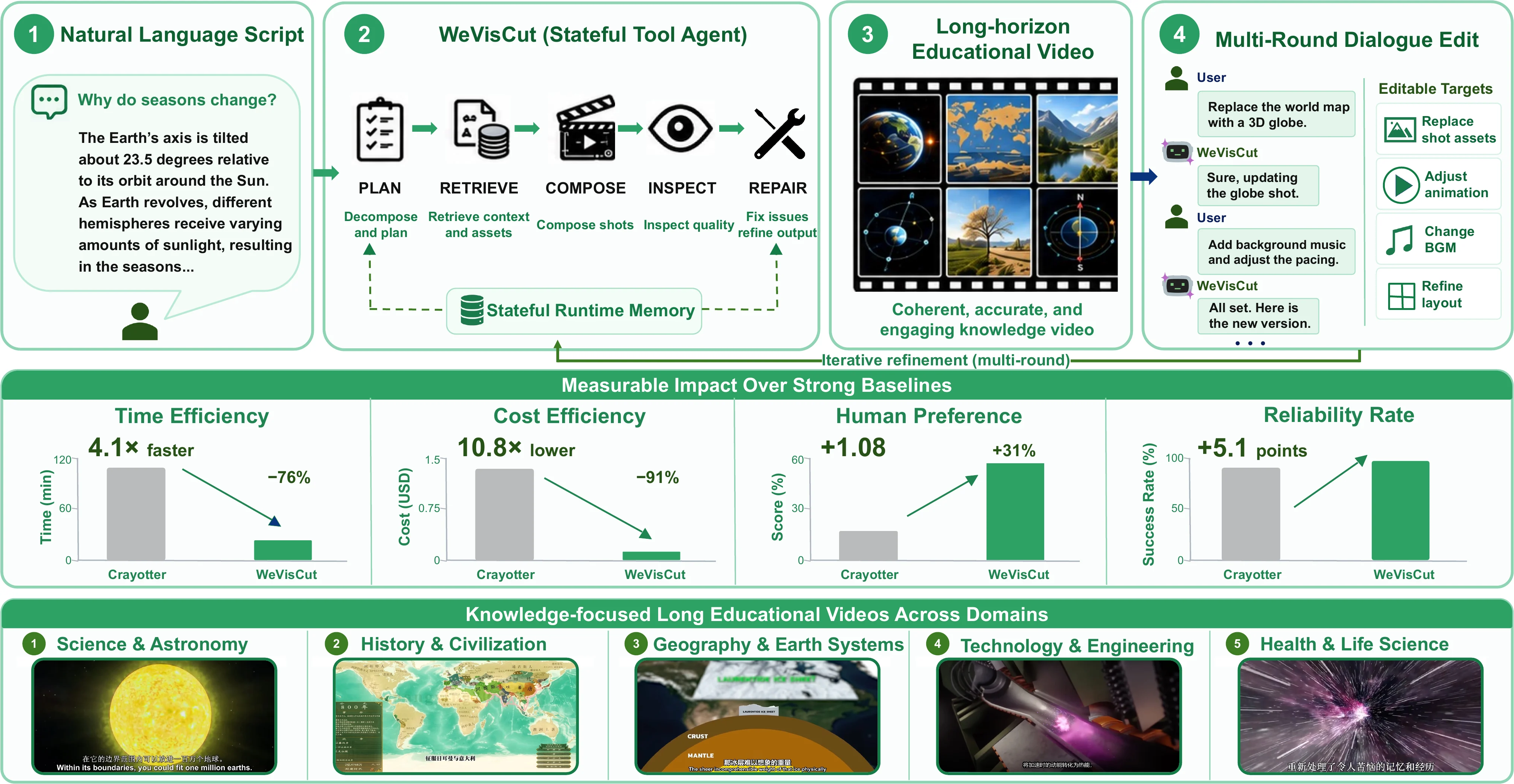
Tencent Research has unveiled WeVisCut (arXiv 2610.38352), an autonomous video editing agent that transforms scripts into finished long-form narrative videos. The process is driven by a single policy model based on Qwen3.5-9B (9 billion parameters): it plans the edit, executes tools, inspects the result, and corrects only failed segments. On a 100-task benchmark, WeVisCut achieves an Overall score of 90.5, surpassing Claude Opus 5 (89.9) and Gemini 3.1 Pro (84.6), while consuming 33 times fewer tokens (2,377 vs. 78,763 per minute of video) and costing 10.8 times less than the Crayotter system. This is currently a research release: the paper is dated October 28, 2026, and the project page makes no claims about the availability of code, weights, or an API.
What Happened
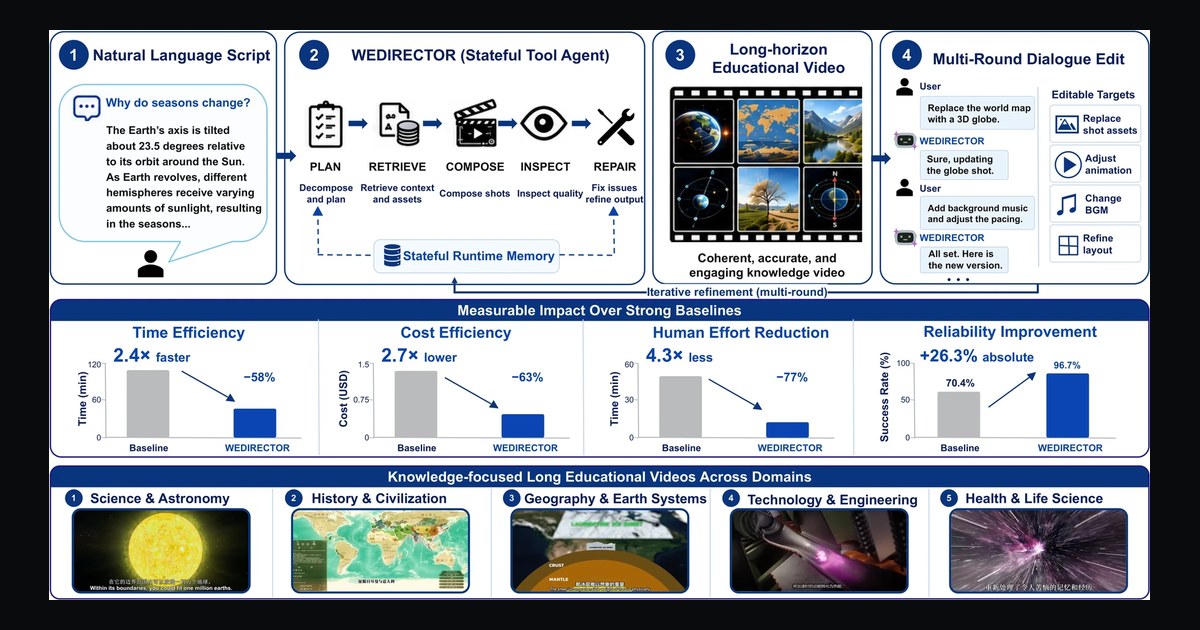
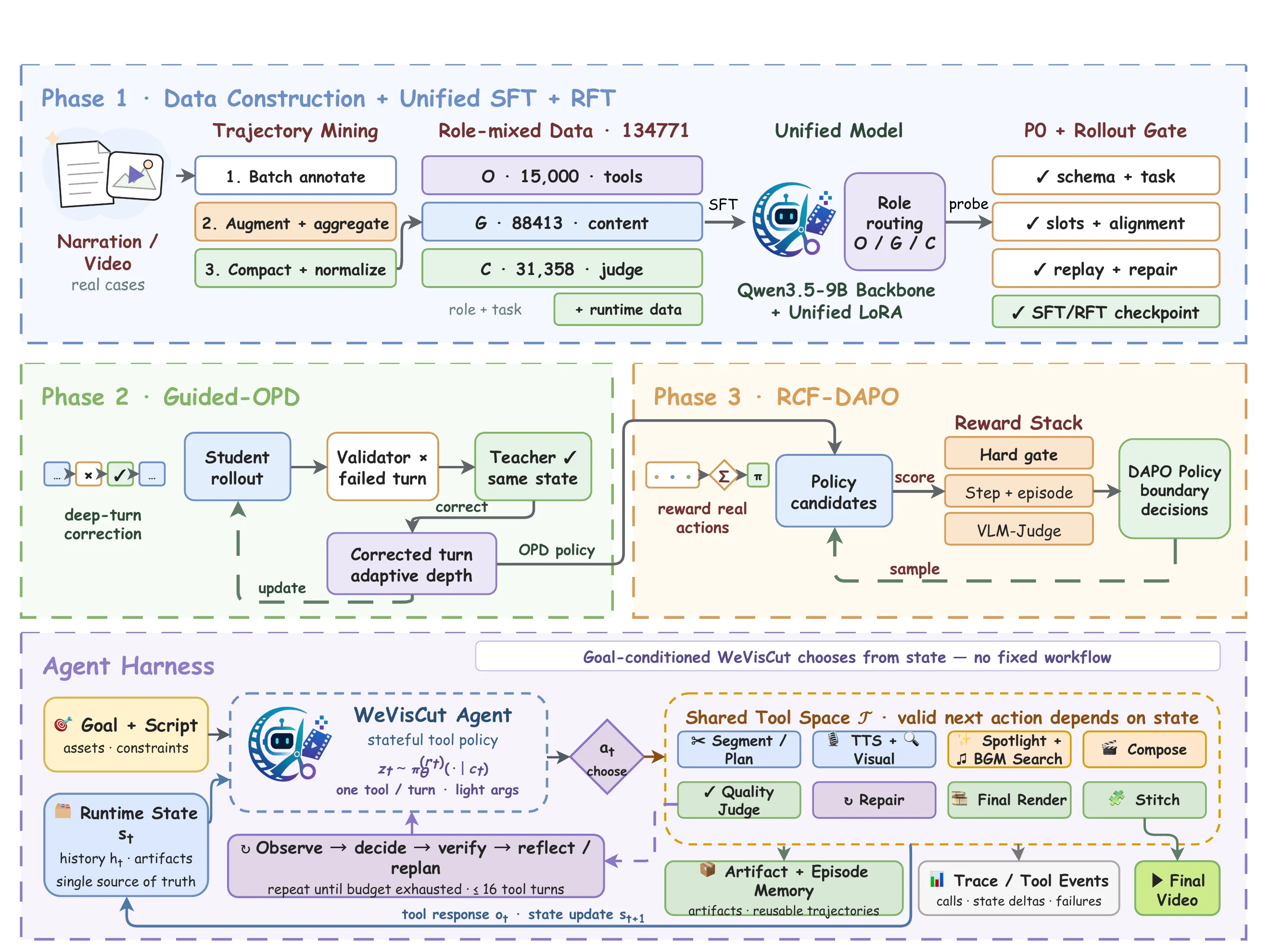
The release is presented through public materials: an arXiv paper and a Tencent Research project page. The concept is described in the system's name itself—the entire editing room in one agent, from narration to long-form video: a script is input, and an edited video is returned. Inside, a closed loop of four steps operates: a single policy model builds an editing plan, invokes editing tools, inspects the resulting video, and makes local corrections to failed segments instead of rebuilding the entire video. Quality assessment was conducted on a 100-task benchmark, where the outcome is summarized into an Overall score and a set of specific editing metrics. The materials separately describe the method for obtaining training data on which the entire result is based.
Context
To understand where the claimed results come from, the training method is crucial. The pipeline is called "editing inversion + verified replay": the system analyzes 3,750 finished edited videos, reconstructs the editing decisions that assembled them, and then verifies that the reproduced edit matches the original; this yields over 130,000 training examples from finished videos. The distinction of this approach is that the training signal is self-verifiable—the reconstructed edit either reproduces the source or it does not, so manual annotation is not required. The second layer of context is the debate between scale and specialization. The materials compare WeVisCut with a larger model from the same Qwen family—Qwen3.6-35B-A3B, which scores 77.7 compared to 90.5 for the 9B WeVisCut; this figure is presented as an argument that size alone does not provide specialization in a narrow agentic task.
Why This Matters for the Industry
For builders and companies, WeVisCut is valuable not as another video generator, but as an architectural template: a compact, specialized policy model covers the full agentic cycle—planning, tool invocation, self-checking, and pinpoint corrections—and, according to measurements in the paper, performs this work radically cheaper and more token-efficient than proxying the same tasks through frontier LLMs like Claude Opus 5 and Gemini 3.1 Pro. Combined with the intra-family comparison, where increasing size without specialization yielded a lower score, this is another argument in favor of fine-tuning models for specific tasks rather than the "just take a bigger model" strategy. The second shift is economic: in agentic pipelines where the model repeatedly invokes tools, execution cost quickly becomes the bottleneck, and costs per minute of finished video become a primary metric on par with quality; this changes both model selection for the process and budget justification. The third fork is openness: if code, weights, and the benchmark are released, independent replications and transfer of the template to adjacent domains like audio editing, slidecasts, and corporate video are expected; if the trend is confirmed, compact industry policy models of around 9B may become the default for expensive agentic processes, while frontier LLMs will be called pinpoint for complex steps. A caveat is important: this is an interpretation based on a single example, while today WeVisCut remains a research release without a deployable product or market.
Why This Matters for Users
For readers, this is a clear image of how an agent covers the entire video production cycle: from script and narration to a finished long-form video, with independent result checking and self-correction of errors. Such an agent cannot be used today: a research release was published, and there is no data on a service, API, weights, or pricing, so it is too early to incorporate WeVisCut into one's own production. The practical benefit now is methodological: the open materials allow one to analyze how the closed loop with local corrections is structured, how the training pipeline is built, and what specific metrics are used to evaluate editing; this will be useful for those who build agentic systems themselves or work with video and content generation. The forward-looking signal is this: if the declared execution economics are confirmed, mass production of long-form videos from scripts may become significantly cheaper, and such agents will most likely appear first in niche SaaS tools; this is a forecast, not a fact of today.
What Is Still Unknown / Limitations
Known unknowns should be kept in mind when reading the figures. The 100-task benchmark belongs to the system's authors: evaluation criteria and baseline launch conditions are not disclosed in the available materials, and breakdowns of specific metrics SCF, VNSM, TPR, LHC, and ERY are not provided, so results should be read as claimed by the developers, not independently verified. The 0.6-point gap from Claude Opus 5 may be within the margin of error until independent replication. The comparison with Qwen3.6-35B-A3B is methodologically incomplete: it does not follow from the materials whether the 35-billion-parameter model was fine-tuned with the same pipeline or if it was a direct call without specialization, so the conclusion that "specialization beats scale" is not yet strictly proven. There is no mention in the sources of code, weights, API, pricing, or latency measurements, and any product scenarios are built on the assumption of openness. Cost and token consumption measurements are provided in the paper and have not been reproduced by third parties. Finally, public attention is currently minimal: the publication has 1 point and 0 comments on Hacker News, meaning external expertise and discussion have not yet formed.
Sources
- WeVisCut — Tencent Research project page
- WeVisCut paper: The Whole Editing Room in One Agent, from Narration to Long-Form Video (arXiv 2610.38352)
- WeVisCut discussion on Hacker News
Author
Look at AI, editorial team