Researchers from Tsinghua University, Carnegie Mellon University, and CUHK (Yuze He, Yixiang Wei, Wang Zhao, Chuhao Chen, Yanning Zhou, Yong-Jin Liu) have presented HairDeck, a method that creates animation-ready stylized hair from a single portrait: sets of hair cards with spring-bone chains that give hair physics during movement. On the CHARM test set, the method is approximately 33 times faster and significantly more accurate than the sole predecessor. The code and weights are open, an online demo is available on Hugging Face Space, and the result can be immediately exported to a VRM avatar.


What Happened
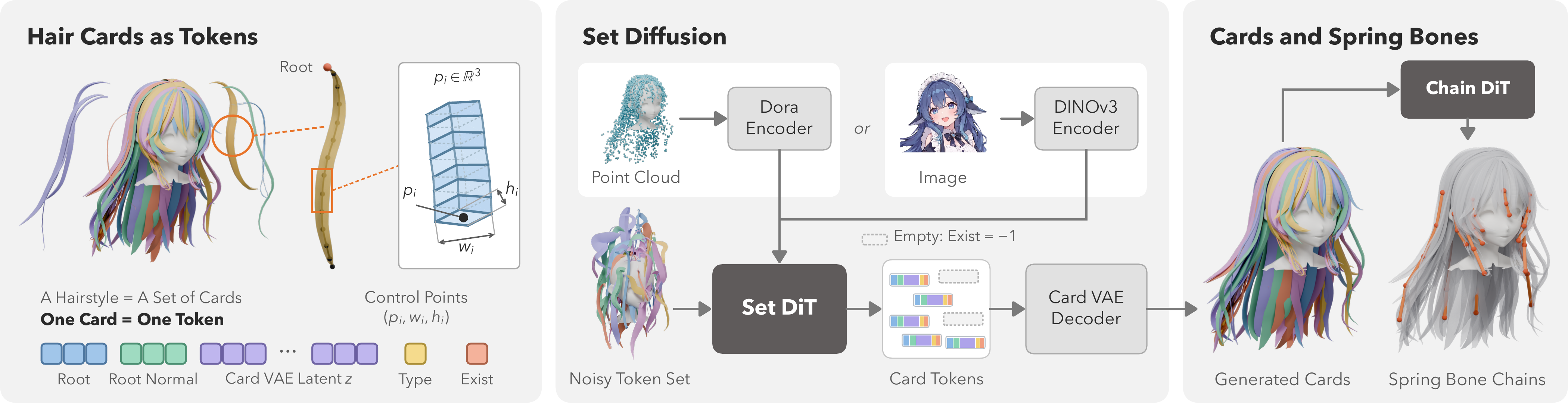
The preprint “HairDeck: Animation-Ready Stylized Hair Cards from a Single Image” (arXiv:2610.40599, submitted 29.10.2026) has been published, with code and weights released in open access. The method is two-stage: first, each hair card is encoded by a single token, and a set diffusion transformer generates the entire set of cards as an unordered set, where the condition can be either an image or a point cloud; then, a second diffusion transformer generates spring-bone chains to which the cards are attached via geometric skinning. On the CHARM test set, HairDeck reduces Chamfer distance by 44% (0.0066 vs. 0.0117) and reduces card orientation error from 40.0° to 16.8°, generating in ~1.01 seconds compared to 33.7 seconds. The hyz317/HairDeck repository has been published on GitHub, and an online demo is running on Hugging Face Space.
Context
Hair cards are ribbon-like “cards” from which artists assemble hair for stylized characters in games and VRM avatars: the orientation of the ribbons determines the correctness of shading, while spring-bone chains handle hair physics during movement. Until recently, such content was created manually, and the only generative analog, CHARM, worked autoregressively: it unfolded hair into a long sequence of control points and generated cards strictly one by one—this sequence was the main limitation of the approach. HairDeck solves the problem by changing the paradigm: the structured primitive becomes a separate token, and the entire set of cards is generated in parallel in a single pass of the diffusion model; this same architectural idea explains both the speedup and the improvement in metric quality.
Why This Matters for the Industry
HairDeck addresses a narrow but expensive link in the pipeline for creating stylized 3D characters: generating hair cards with animation readiness from a single reference. Generation in seconds instead of tens of seconds turns hair from a bespoke manual craft into a conveyor operation, directly accelerating production pipelines for VTuber avatars, games, and virtual characters. Since the code and weights are published under Apache-2.0, the hair generation step itself is immediately commoditized: it is no longer possible to protect it with a license, and value shifts to the wrapper and integrations around the weights. There is no ready-made hosted API—distribution occurs through a self-hosted environment with an NVIDIA CUDA GPU, so product teams need their own deployment or community wrappers; the appearance of such integrations in avatar tools is a likely but currently predictive scenario.
Why This Matters for Users
You can try it today: hair is generated in the browser via an online demo on Hugging Face Space or locally on Linux x86-64 with an NVIDIA CUDA GPU (Python 3.12, PyTorch 2.8, and CUDA 12.8); the weights are on Hugging Face under the name hyz317/HairDeck and are available for free. One portrait is transformed into animatable hair in seconds, with export to GLB with per-card UV and to a ready-made VRM avatar. For the VTuber scene, this means hair with physics for your avatar without manual modeling; specifically for try-on, camenduru/VRMHairMaker has already been released—a Docker application that puts the generated hair on a VRM avatar and shows live spring-bone physics directly in the browser.
What Is Still Unknown / Limitations
Comparisons are tied to the sole direct competitor and its own CHARM test set; there are no baselines from other method families, nor a perceptual evaluation of stylization, which numerical metrics do not replace. The idea of extending the set diffusion template to other sets of structured assets (clothing, props) is a hypothesis, not a result: no ablations or experiments outside hair cards are presented in the work. The model's behavior on non-CHARM data and realistic hair has not yet been tested; independent community measurements and real production applicability will be the key test of the method's generalization.
Sources
- HairDeck: Animation-Ready Stylized Hair Cards from a Single Image (arXiv:2610.40599)
- HairDeck — project page
- GitHub — hyz317/HairDeck (code and weights, Apache-2.0)
Author
Look at AI, editorial team