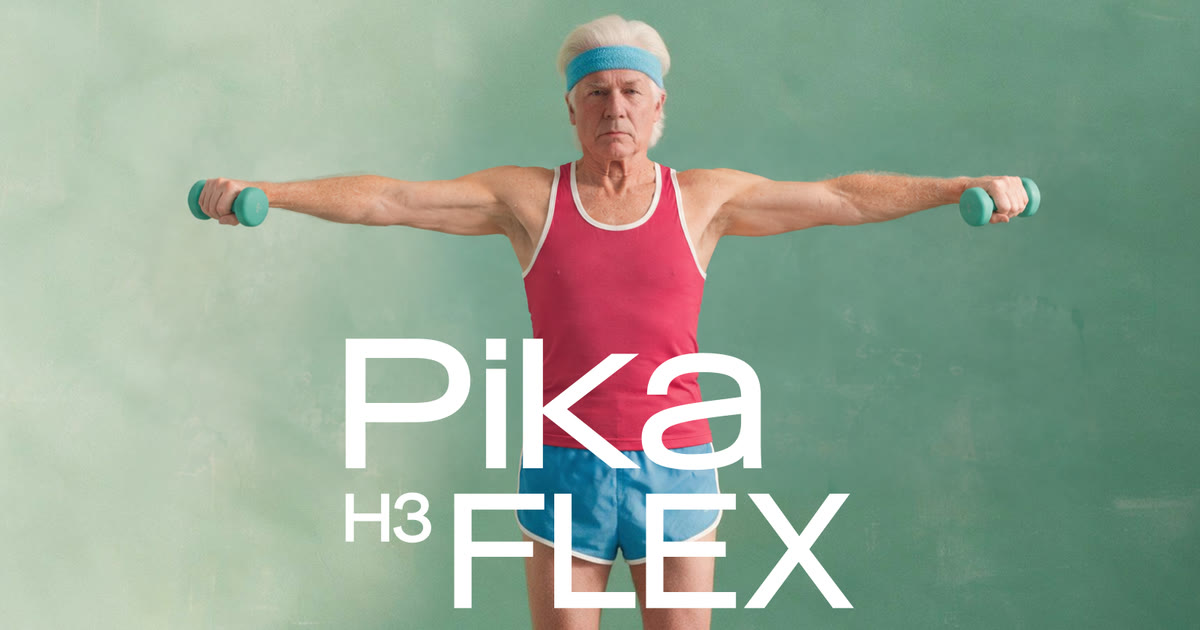
Pika Labs released Pika H3 Flex, an open video generation model with built-in synchronized audio. The model was fine-tuned using LoRA adapters based on the 33-billion parameter MiniMax H3 and creates clips in 6 sampling steps instead of 50: a 15-second fragment in 768p takes approximately 7 seconds of DiT computation. The company claims a 1.8x speedup and an 80% cost reduction compared to H3 Max. Weights are already available on Hugging Face, inference code is on GitHub, and the API with pricing starting from one cent per second of video is available at dev.pika.art.
What happened
Pika Labs introduced Pika H3 Flex, a fine-tuned version of the open 33-billion parameter MiniMax H3 model. The base was enhanced with two LoRA adapters, FL2VA and Ref2VA, and the sampling chain was reduced from 50 steps to 6: DiT computations for a 15-second clip at 768p resolution take approximately 7 seconds. According to the company, compared to H3 Max, speed increased by 1.8 times, and generation costs dropped by 80%. The model accepts up to 12 references—up to 9 images, 3 videos, and 3 audio files, including sketches and mood boards—and outputs five separate audio tracks via API: dialogue, music, SFX, foley, and ambient; the finished clip can be upscaled to 4K. The API at dev.pika.art is priced from $0.01 per second for text-to-video and from $0.03 per second for reference-to-video. On the DesignArena leaderboard, the model ranks 7th in the overall video category with a 60% win rate and Elo 1288, and 1st among open-weights models. Weights are published in the Pika-Labs/Pika-H3-Flex repository on Hugging Face, and inference code is on GitHub.
Context
MiniMax H3 is an open base video generation model with 33 billion parameters; Pika did not develop a new architecture but efficiently fine-tuned the existing base, updating only a small fraction of weights via LoRA. The reduction in sampling steps was achieved through human preference learning, so the main focus of the release is training methods rather than model architecture. The release is in open-weights format: weights can be downloaded and run locally, adapters are distributed under the MiniMax H3 Community License, and inference code is under Apache-2.0. The DesignArena metric is based on aggregated human preferences, where model positions are expressed in Elo and win rate: it shows which generations viewers choose but is not a technical measurement. The release background involves a shift in product patterns: cheap draft video generation is becoming a separate iterative layer of production, not just a final render.
Why this matters for the industry
The economics of iterative video production are changing for the industry. With per-second API pricing, scene drafts, targeted character and camera adjustments become cheap iterations accessible to studios and small teams, not just large platforms. Multi-reference control provides a ready mechanism for maintaining a single character across frames via image references, and separate audio tracks go directly into post-production instead of being mixed from a continuous mix. Open weights and code allow integrating the model into custom pipelines and reproducing the claimed fast mode locally without relying on third-party APIs, while open licenses pave the way for custom LoRA variants for niche styles on the same base—the FL2VA and Ref2VA path directly demonstrates this scenario. If independent checks confirm that the quality of the fast mode is comparable to full generation, reducing sampling steps through preference learning will become a standard technique in the open-weights segment, and the release will put pressure on prices across the video generation market.
Why this matters for users
The model can be tried right now; the release has three entry points. First, the API at dev.pika.art with per-second pricing, where the simple text-to-video mode is cheaper than the reference-based mode. Second, the Pika-Labs/Pika-H3-Flex weights on Hugging Face for local deployment: inference was tested on an NVIDIA H100 with 80 GB of memory, requiring Python 3.12 and an NVIDIA GPU. Third, the inference code on GitHub for building the environment independently. In practice, this means a scene draft can be obtained in seconds instead of minutes of waiting, the same character can be maintained across frames via image references, and sound can be received as separate tracks for custom mixing. For those who do not want to work with APIs and their own hardware, they will have to wait until November 2, 2026: on this day, the model will appear in the Pika consumer application.
What is currently unknown / limitations
Key release figures have not yet been independently verified: the speedup and savings compared to the previous H3 Max version are claims by Pika itself, with no third-party measurements available in accessible materials. The fine-tuning methodology on preferences has not been disclosed: there is no technical report, description of the reward model, or information on how preferences were collected. DesignArena measures aggregated viewer preferences and does not verify character consistency across frames, motion physics, temporal coherence, or possible artifacts of low-step sampling, and the model's position should be read with the context of the leaderboard: the place in the overall rating and the place among open weights are different claims. Claims about multi-reference and production-ready separate sound are supported by demonstrations but not metrics. Finally, the reproducibility of the claimed speed on hardware weaker than the control configuration in the materials is not described.
Sources
- Introducing Pika H3 Flex — Pika Blog
- Pika-Labs/Pika-H3-Flex — Hugging Face (model weights)
- Pika-Labs/Pika-H3-Flex — GitHub (inference code)
Author
Look at AI, editorial team