
Suno has opened a beta version of its MCP integration: the music generator connects to assistants like ChatGPT, Claude, Gemini, Claude Code, and Cursor via a universal server at https://api.suno.com/mcp. To access it, you only need to log in to your Suno account and grant permission; no API key is required. In a regular chat, you can request a song based on a description, turn a voice note into a track, or create a cover, and generations consume credits from your current plan, including the free tier. Access to the beta is open via an early access form on Suno's official page.

What happened
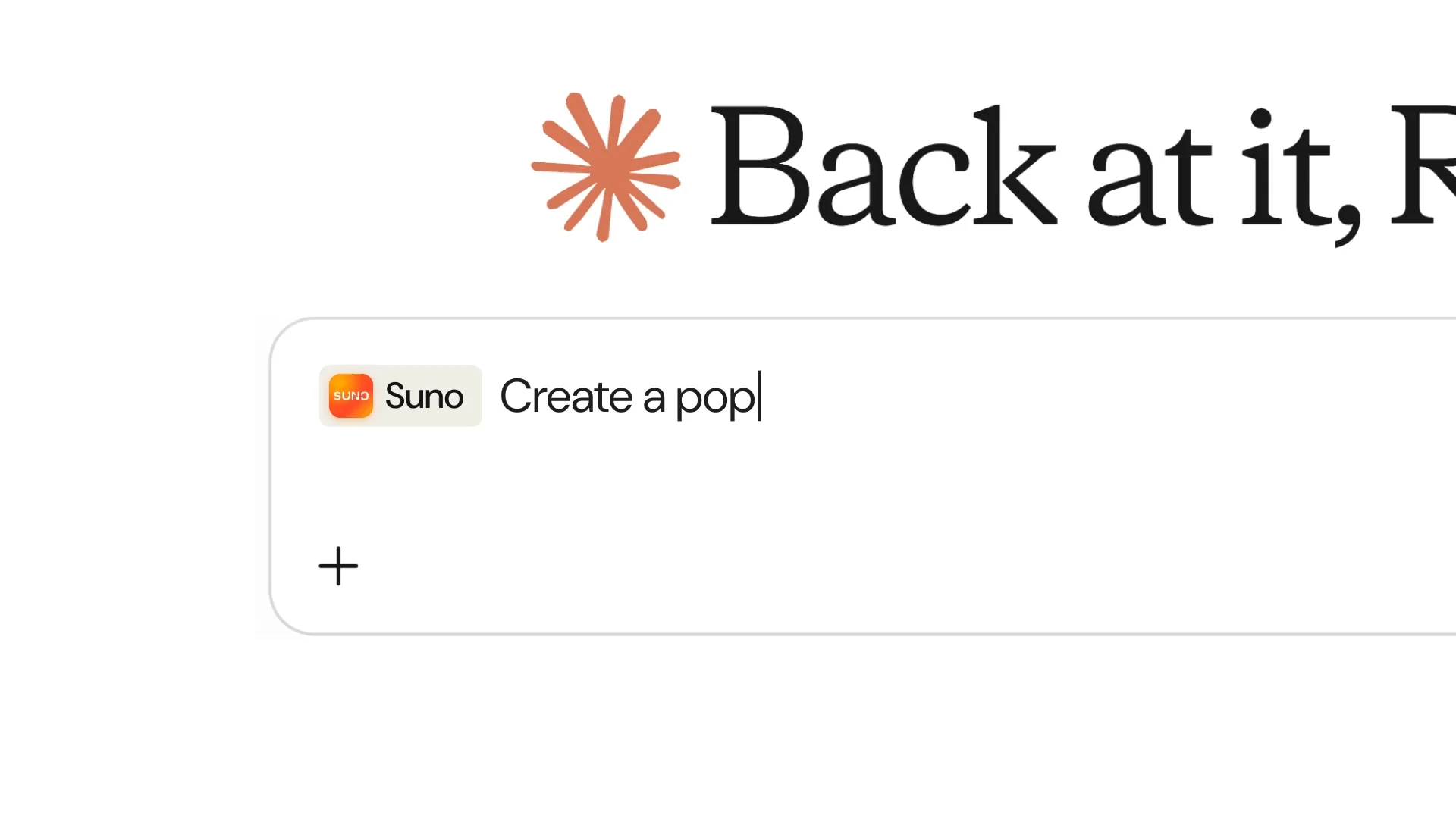
Suno has opened beta access to its MCP server, which connects the music generator to third-party AI assistants: ChatGPT, Claude, Gemini, Claude Code, and Cursor. Through the assistant, you can create songs from text descriptions, turn voice notes and audio fragments into full tracks, make covers and mashups, continue existing works — these are the Cover, Mashup, and Extend functions from the Suno library — and apply saved Suno Voices. The integration works on all plans, including the free tier: generation requests consume credits from the current plan, and finished tracks are automatically saved to the Suno library. You can get into the beta via the early access form on the suno.com/mcp page, and Suno has posted connection instructions for each assistant in its help center: in Cursor, the Suno server is written in mcp.json, in Claude Code, the command claude mcp add is executed, and login is done via the /mcp command.
Context
MCP (Model Context Protocol) is an open standard that allows AI assistants to work with external services by calling them as their own tools. Until now, connecting a generative service to a specific assistant usually meant a separate integration and API keys, but Suno managed with a single universal endpoint and user login via its own account. Technically, there is no new generative model here: the Suno backend is the same as in the app and API, and the chat assistant merely orchestrates calls and passes the dialogue context into them — the text of the future song, project plan, or video theme. The event is therefore interesting not for new model capabilities, but for the distribution channel itself: Suno is testing demand for music via chat, and the beta status with an early access list indicates a cautious launch to an experienced audience before a wide opening.
Why this matters for the industry
For the AI industry, the main point of this launch is the distribution pattern: a single MCP URL and login without an API key bring a consumer generative service to the audience of the largest assistants with almost no integration costs. Suno's music generation is right in the chats of ChatGPT, Claude, and Gemini, where the user does not need to re-explain the task to a separate application — the assistant uses the ready state of the dialogue. For other music generators and AI startups, this is a ready-made template for market entry: instead of integrating under each product, set up your own MCP server. If this scheme takes hold, large assistants will have catalogs of external tools, and competition will shift to who better orchestrates other people's models, whose connectors pass moderation first, and how tool-call quality, credit accounting, and limit observability are ensured. The assistants themselves are taking a step toward the role of aggregators of external generative functions.
Why this matters for users
For readers, this provides the ability to connect their Suno account to a familiar assistant and request music in plain words: "make a slowed acoustic cover of my last track" or "turn a voice note into an indie folk song." Iterations are done in the same dialogue with short remarks like "slower" or "add a bridge," and the assistant takes the correspondence context into account — it is enough to insert the song text or describe the concept once, without repeated explanations. You can ask the assistant directly about the remaining credits, so controlling expenses does not require leaving the conversation. Connection takes minutes: in Cursor, it is a couple of lines in mcp.json, in Claude Code — one command in the terminal. All finished tracks go to the Suno library and remain available even after the dialogue ends.
What is still unknown / limitations
This is a beta: access is opened after filling out the early access form at suno.com/mcp, so there are no guarantees of instant connection. The phrasing "works on all Suno plans" is not equivalent to "available to any user of any assistant" — some assistant hosts allow custom MCP connectors only on paid subscriptions. Official materials do not provide metrics on generation quality, delays, and call limits via MCP; practical data will likely accumulate as the beta expands. Finally, the thesis about MCP as a distribution standard currently relies on a single case — one vendor, one endpoint, five host assistants; confirmation will come when other consumer generative services repeat the "one URL plus login without an API key" scheme.
Sources
Author
Look at AI, editorial team