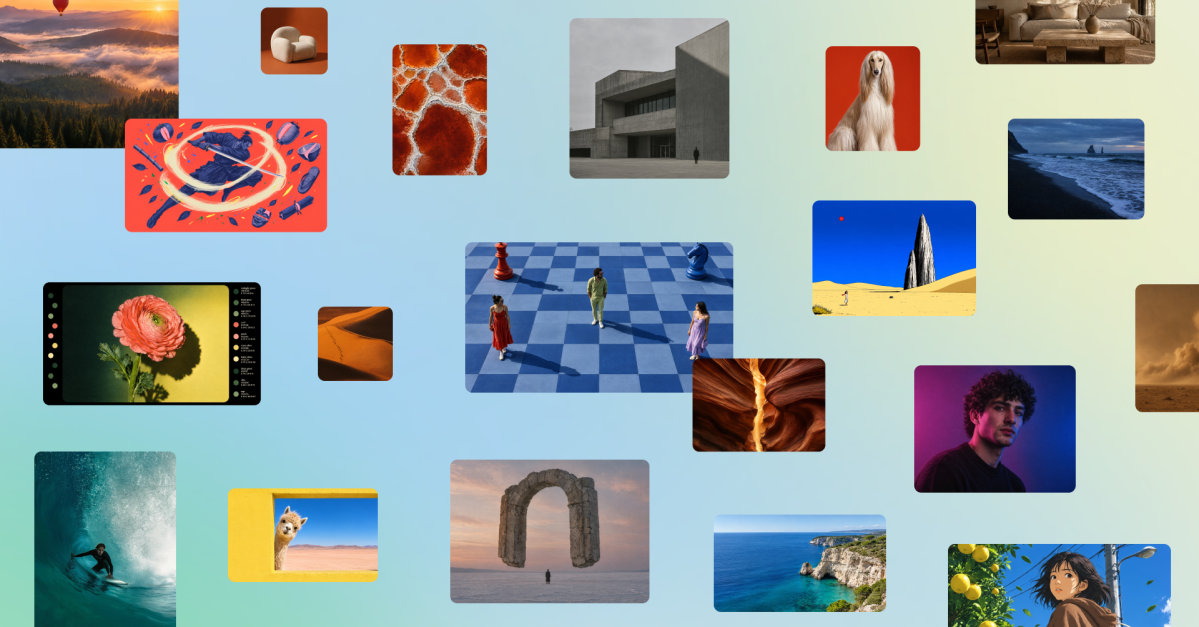
Canva has released Craft, its first in-house image generation model, developed by the internal Canva Research lab. Generation in the model is split into two steps: the model first creates a composition plan, then renders the image at up to 2K resolution in over 30 aspect ratios. Craft is already available in the Canva editor in Dream Lab mode and is open to third-party developers via a public API.


What happened
The key engineering feature of Craft is its two-stage architecture. In the first step, the model builds a scene plan: it defines the spatial relationships of objects, their scale, and the placement of text blocks; in the second step, it renders the final frame. Training was conducted on millions of design templates from Canva's library, so the company claims correct handling of typography and the generation of legible text, including in 55 languages. The Magic Layers feature, based on the model's internal markup, breaks down the finished result into editable vector elements. The external quality benchmark is fourth place among all image generation models on the DesignArena leaderboard. The release is already functioning as a product, not a research demo, and alongside it, faster versions Craft-fast and Craft-ultrafast were announced, as well as the Canva MCP server, through which AI agents, including scenarios with ChatGPT and Gemini, will be able to invoke the generator.
Context
Universal image generators of recent years have been optimized for photorealism and consistently stumble on two things: text distortion and broken layout composition. Canva bet on the opposite end—a vertical model not for images "in general," but for design artifacts where grid, typography, and legible captions matter. The idea of "plan first, then render" is not new to scientific literature, so the novelty of Craft lies more in the engineering plane: the approach has been brought to a mass product on domain data that competitors do not have—Canva's own template library. The launch format is also telling: while many labs show generation in demo videos, Canva released the model immediately as part of a working product, protecting its main assets—data and distribution. The announcement of the MCP server reflects a broader industry trend: image generation is ceasing to be a separate chat and is becoming a tool orchestrated by agents.
Why this matters for the industry
For product teams and developers, Craft is a composable block, not a chat toy: the public API allows embedding layout generation into their pipelines today, and the promised Canva MCP server will allow agents in ChatGPT and Gemini to invoke the generator directly from workflows. If the fast versions Craft-fast and Craft-ultrafast are released with acceptable quality, the vertical model will become the default candidate for mass design scenarios—from auto-generating creatives to wrappers and vertical SaaS on top of the generator. Competition in this scenario shifts from the beauty of the image to the quality of typography, the structure of the result, and the depth of integration with working tools. For founders, the signal is twofold: specialization for verticals on closed domain data works as a defensive strategy against universal generators, and market expectations may shift to results that come with structure—plan, render, editable layers—instead of a flat raster.
Why this matters for users
If you create posts, presentations, or infographics in Canva, Craft is already working in Dream Lab: the model outputs images with legible text and correct composition that do not need to be redrawn manually. Magic Layers breaks down the finished result into editable vector layers, so edits are made to individual elements rather than through full regeneration. The value is available without integrations, right in the editor, and developers can connect the model via the public API and test it on their tasks. Practical advice: pricing, request limits, and latency have not yet been published, so the decision to use it in production should be made based on your own measurements—a minimal pilot is a fixed set of 50–100 of your prompts, necessarily with Cyrillic, to check text legibility and composition in your scenarios.
What is still unknown / limitations
There is no independent scientific verification of the claims yet: no open weights, technical report, or ablations linking the Canva template corpus to generation quality, so the "advantage from proprietary data" remains an interpretation, not a proven fact. The DesignArena protocol is not disclosed in the sources—it is unknown who evaluates, what the sample size is, and the composition of competitors, so a single line in the rating is weak evidence. The company claims legible text in 55 languages, but there are no publications of text rendering metrics by language, including Cyrillic, or a description of the internal markup method for Magic Layers. Pricing, request limits, and latency have not been published, so production readiness is assessed by each engineer only through their own measurements. Finally, there is a risk of bias toward the data domain: a model trained on Canva templates may be tailored to their aesthetics and structure, and generalization to photorealism and free scenes is not confirmed; it also remains open whether Craft will maintain its position on DesignArena in the coming months.
Sources
Author
Look at AI, editorial team