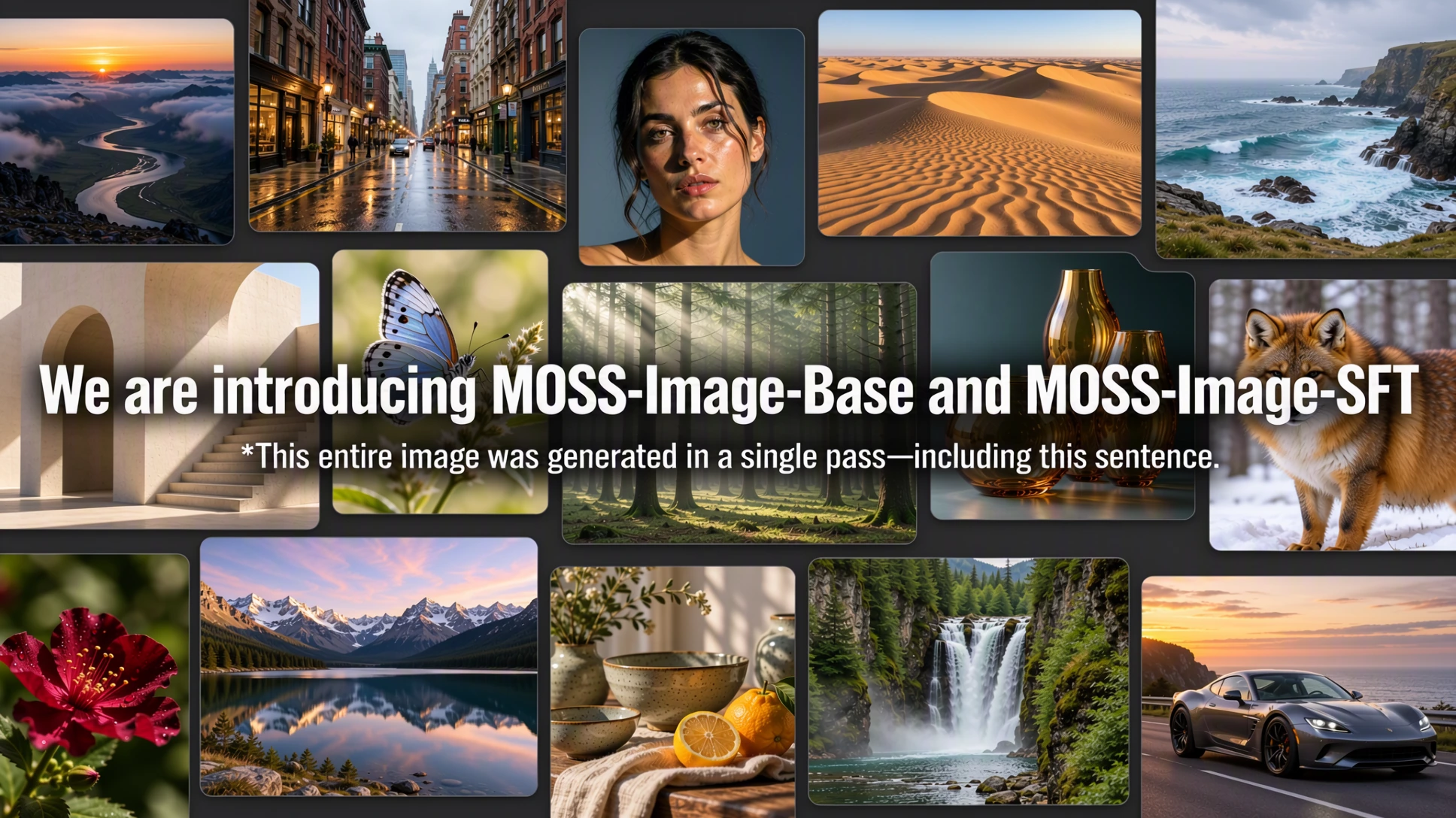
OpenMOSS Team has made MOSS-Image available — a family of text-to-image models built on a 5B-parameter DiT backbone — by publishing the code and weights under Apache-2.0 in MOSS-Image-Base and MOSS-Image-SFT variants. The main feature of the release is native layout control: the scene is specified not with free text but with a JSON prompt containing objects, text, and bounding boxes. The model is already available in a Hugging Face Spaces demo and for local deployment on an NVIDIA GPU, and it was released together with an official ComfyUI plugin and fine-tuning tooling.


What happened
On October 16, 2026, OpenMOSS Team published the code and weights for two model variants: the base MOSS-Image-Base and MOSS-Image-SFT, which was fine-tuned on curated data. Composition in MOSS-Image is specified with a JSON prompt that lists objects, text, and bounding boxes in yxyx format with coordinates from the canvas center, so the scene can be edited structurally by changing descriptions and boxes individually. The model renders text inside the image, including Chinese and handwritten text, accepts prompts up to 4K tokens long, and generates both anime and photorealistic images. Recommended generation settings are flow-matching Euler, 50 steps, CFG 3, shift 5, and, unusually, skipping the negative branch at layer 22. For the release, an official ComfyUI plugin, a Gradio interface, a Hugging Face Spaces demo, a LoRA guide in the repository, and a Prompt Enhancer skill that turns an idea into a detailed caption were prepared.
Context
The point of the release is not just another generative model, but a change in interface: instead of iterating over phrasings, the scene is described with a machine-readable specification whose individual elements can be changed precisely. MOSS-Image is built on a compact DiT backbone, and its VAE reuses the FLUX.2 small decoder — technically a rational compute saving, but also a cross-model combination that requires separate verification. The recommended pipeline is also specific: in addition to the steps and CFG familiar for flow-matching models, the authors prescribe skipping the negative branch at layer 22, and without a technical report this parameter remains a constant that must be copied as is. The context of its appearance is also important: an open model under Apache-2.0 with support for the latest diffusers is released when the ecosystem can already quickly test such weights with distillations and editor integrations.
Why this matters for the industry
For product teams, this is first and foremost a new programmable pipeline, not just another entry in the list of t2i models: layout JSON can be assembled by a script or an LLM agent, turning image generation into a regular tool call. The combination of open Apache-2.0 weights, a compact 5B parameter count, and support for the latest diffusers provides a short path from download to a working service: a prototype of a poster, infographic, or UI mockup generator based on JSON templates can be built in days, without vendor negotiations or subscriptions to someone else's generations. The LoRA guide lowers the barrier to fine-tuning for a niche, the Prompt Enhancer skill lets agents turn a raw idea into a detailed caption, and the community response confirms real interest: on the first day, an 8-step DMD distillation by lodestones and a ComfyUI conversion by nif0 appeared. If independent tests confirm box-following accuracy and text rendering quality, JSON control may become an expected norm for open text-to-image models, and community optimizations of this kind will significantly reduce inference costs.
Why this matters for users
The model can be tried right now without installation: the Hugging Face Spaces demo shows how MOSS-Image maintains bounding boxes and renders text. For local deployment, it is enough to download MOSS-Image-SFT and set up an environment on an NVIDIA GPU with Python 3.10 or newer, PyTorch 2.9 or higher, diffusers no older than 0.38, and transformers no older than 5.3; an alternative path is installing the official plugin through ComfyUI Manager. Thanks to the JSON format, editing the composition becomes a predictable operation: to move an object or replace a text label, it is enough to change the corresponding element of the specification, rather than guessing the prompt again. The Gradio interface from the repository covers the basic scenario, and the Prompt Enhancer skill helps those who find it easier to describe an idea in words than to assemble a layout manually.
What is still unknown / limitations
The open materials — the repository, model card, and project page — do not yet include a technical report or quantitative evals, so claims about text rendering quality, anime, and photorealism should be verified on your own use cases rather than from teasers. Practical data on latency and GPU requirements for production have also not been published, although deployment itself requires recent dependencies. The cross-model combination of the DiT backbone with the FLUX.2 VAE decoder needs verification of latent-space compatibility and the licensing status of such reuse. Some of the recommended pipeline settings are empirically justified only by examples: without a technical report, individual parameters such as skipping the negative branch at a specific layer remain magic constants and may hinder porting to other pipelines. Finally, this is a self-hosted path: hosting, scaling, and inference costs fall on the user.
Sources
- GitHub — OpenMOSS/MOSS-Image: official repository (5B DiT, layout control, Apache-2.0)
- OpenMOSS-Team/MOSS-Image-SFT — model card on Hugging Face
- MOSS-Image | Text-to-Image Generation with Native Layout Control — official project page
- lodestones/MOSS-Image-SFT-8-steps-dmd — community 8-step DMD distillation on Hugging Face
Author
Look at AI, editorial team