
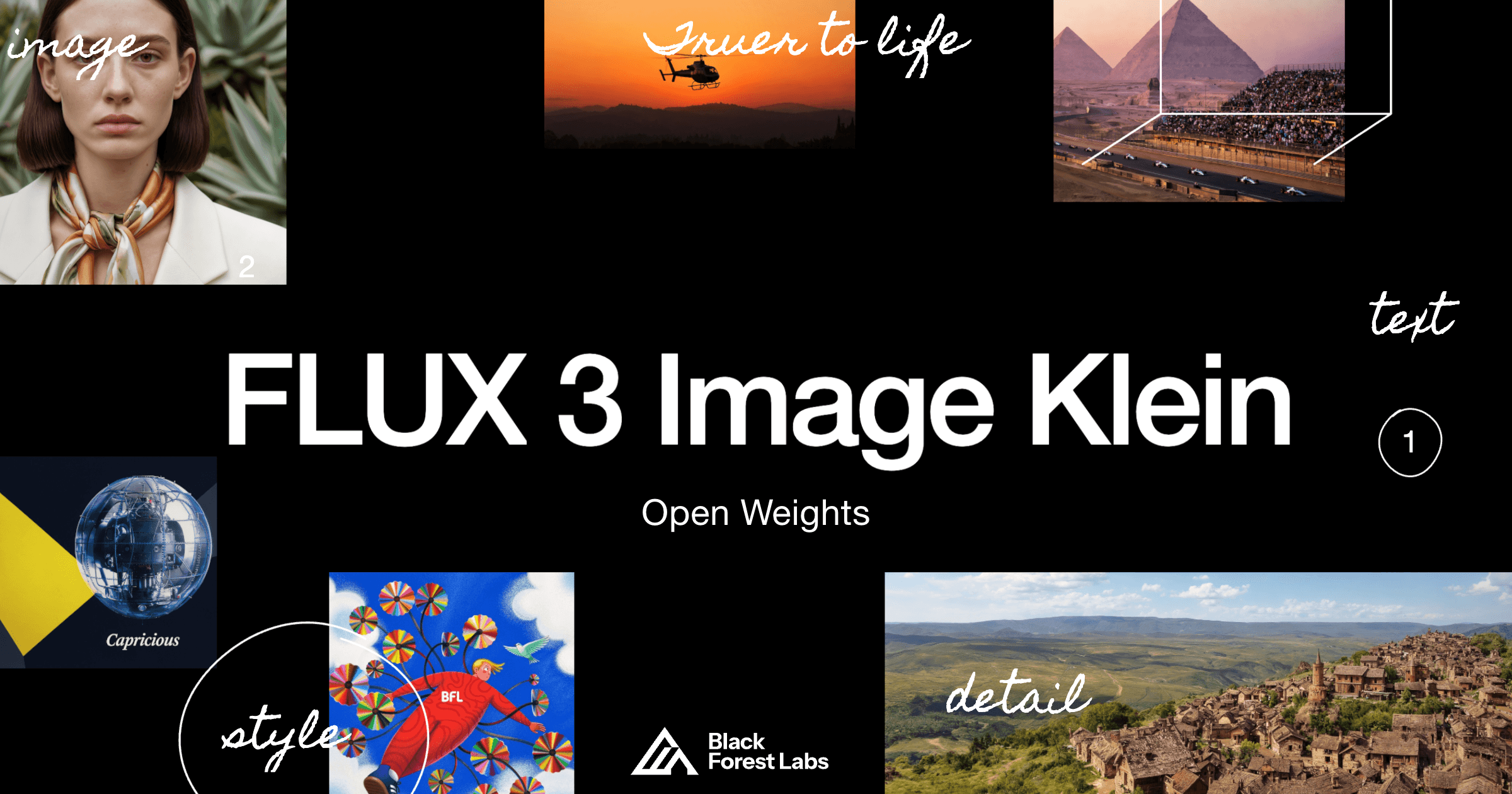
Black Forest Labs has released the weights for FLUX 3 Image Klein — a 5.6B parameter model that combines text-to-image generation, single-reference editing, and multi-image composition in a single checkpoint. The weights are available on Hugging Face under the FLUX Kommunity License, the distilled build runs locally on consumer GPUs, and the model can be tried in an HF Spaces demo or via API.
What happened
Black Forest Labs has made the FLUX 3 Image Klein checkpoints publicly available. The model's image transformer contains 5.6B parameters, and a single checkpoint covers multiple tasks: text-to-image, single-reference editing, composition from up to 10 reference images with one output image, and in-image text rendering. Element placement is specified using bounding boxes on a 0–1000 grid. Two weight variants were released: a 16-step distilled checkpoint without CFG — the same one used in the BFL API — and Klein Base, the non-distilled version with 50 steps and CFG 3.5, intended for fine-tuning and LoRA. Both are available in BF16, FP8, and NVFP4 formats. An int8 build for ComfyUI has been released, running on 8 GB VRAM at the RTX 3070 level. A 9B prompt upsampler was also published separately — a fine-tune of the Qwen3.5-9B model under the Apache 2.0 license.
Context
The release is easier to understand in the context of the overall system architecture. The headline 5.6B parameters refer only to the image transformer: the Qwen3-VL-4B-Instruct text encoder is provided separately, and the optional prompt upsampler adds another 9B, so the full system is heavier than the number suggests — a factor to consider when calculating VRAM and inference costs. The weights are distributed under the FLUX Kommunity License: commercial use is free for companies with revenue under $5M. The model's positioning is known from the announcement: according to BFL's internal evaluations, Klein leads in text-to-image, multi-reference generation, and editing, outperforming the closed Ideogram V4.5 and FLUX.2 [pro], and by Elo it gives +91 in text-to-image and +70 in editing over the previous FLUX.2 [klein] model with 38% less volume — 5.6B versus 9B parameters.
Why this matters for the industry
For the industry, this is the fulfillment of the promise from the FLUX 3 Image announcement and a rare case where an open-weights release can be put into production immediately. The distilled checkpoint matches the one used in the API, so a prototype can be moved to product without changing the model. Support for ComfyUI, HF Diffusers, SGLang, vLLM-Omni, and TensorRT-LLM is available from day one, and LoRA training is accessible through the Ostris AI Toolkit and NVIDIA NeMo AutoModel — the model integrates into existing pipelines without new layers. The economics change most noticeably: self-hosted inference on consumer GPUs and the stated API price starting at $0.009 per 1,000 images drive down the cost of generation and editing, the "raw" image becomes a commodity, and studios and startups must defend themselves higher up the stack — in vertical products, UX, and unique data.
Why this matters for users
The model can be tried in several ways right now: download the weights from Hugging Face by accepting the license terms, open the HF Spaces demo, or work through the BFL API. Local launch is realistic even on mainstream hardware: the distilled int8 version generates a one-megapixel image in about 4 seconds on an RTX 5090 and less than 9 seconds on an RTX 4070. Bounding boxes provide a clear editing interface: frame elements are recolored, moved, and deleted by text description. Multi-reference composition allows assembling one image from existing ones, and in-image text rendering by the model itself eliminates the need for separate text processing.
What is still unknown / limitations
The qualitative figures cited in the announcement are BFL's internal evaluations without a disclosed methodology, and the comparison baseline is the company's own previous model, so until independent verification, Klein's leadership should be considered a hypothesis rather than an established fact. Independent measurements of latency and performance in real serving stacks, as well as reports on the FP8 and NVFP4 variants, have not yet been published.
Sources
- FLUX 3 Image Klein: open weights, 5.6B parameters | Black Forest Labs
- black-forest-labs/flux-3-image-klein · Hugging Face
- Black Forest Labs' open-weights image model FLUX 3 Image Klein runs on consumer GPUs with just 8 GB of VRAM
Author
Look at AI, editorial team