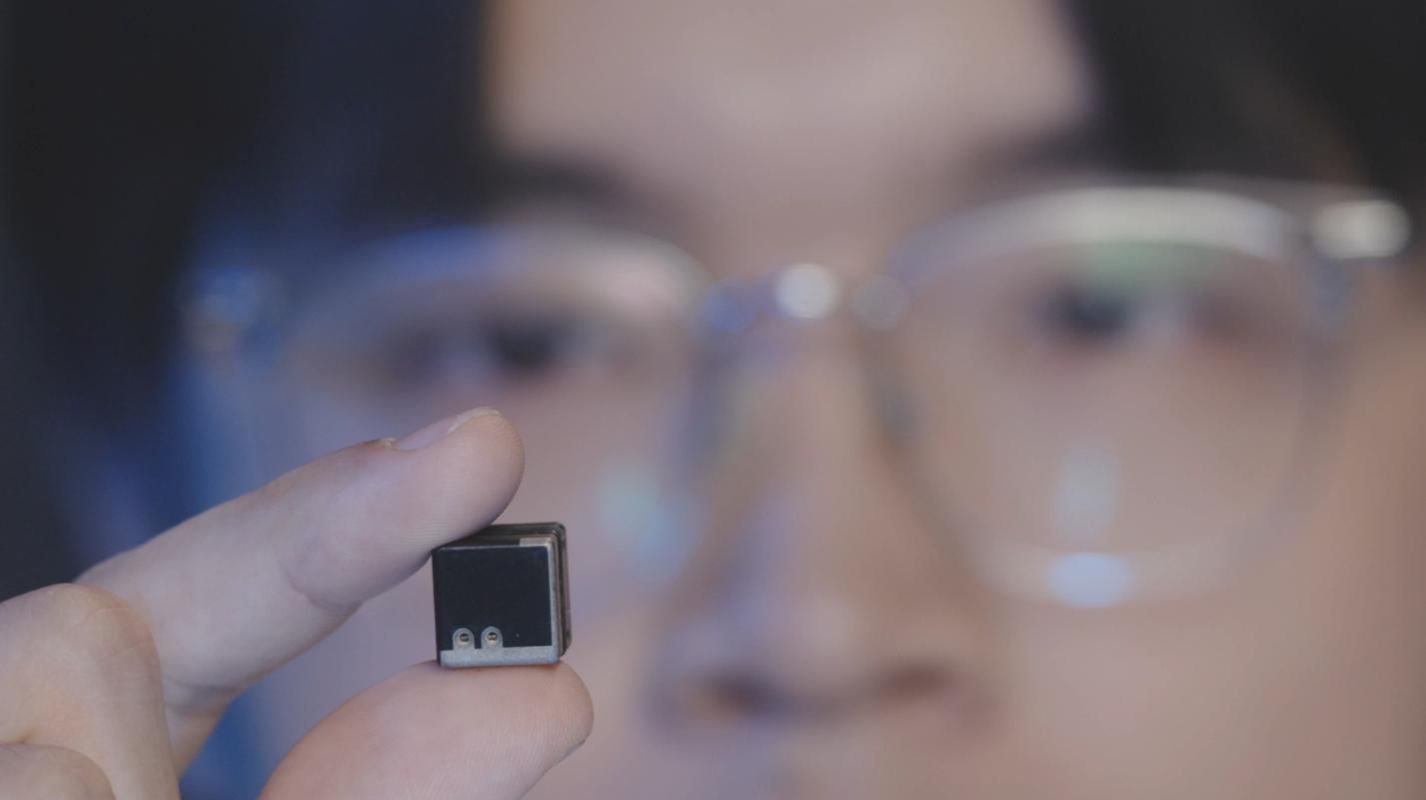
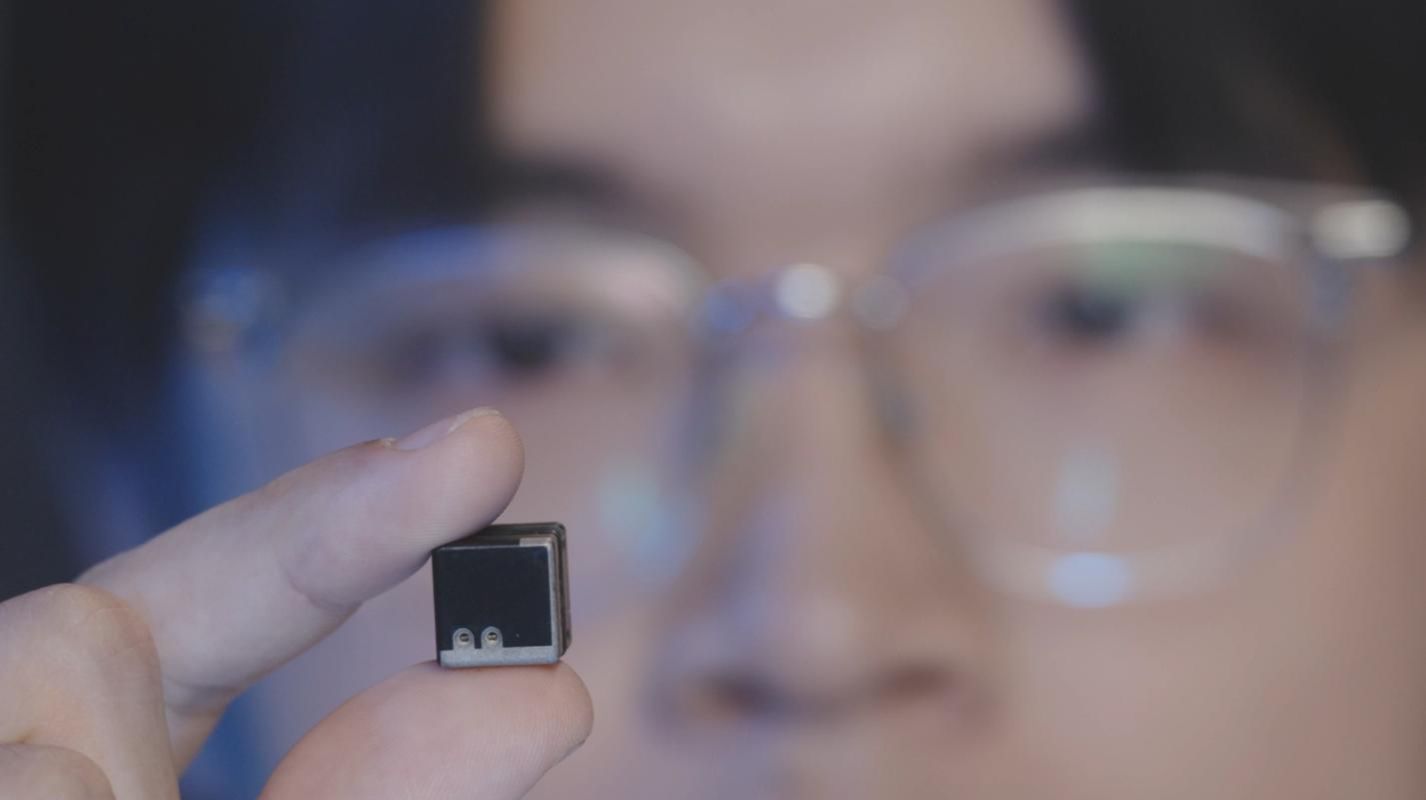
Tianjin University's Haihe Brain-Computer Interface Laboratory, together with Shengong Diting (Tianjin) Technology, unveiled a non-invasive EEG system called the "Shen Gong Xumi Brain Cube" weighing 3 grams and measuring 2 cm³ on September 30, 2026. The electrodes, filtering and digitization circuits, battery, and wireless module are integrated into a single casing that attaches to the scalp under the hair and is barely noticeable when worn. The developers claim a sampling rate of 1,000 samples per second, 8–10 hours of battery life, and compliance with the mandatory Chinese EEG safety standard GB 9706.226-2021, while the status of registration as a medical device with the NMPA has not been disclosed. The platform is aimed at long-term continuous monitoring of brain activity — from clinical scenarios to consumer and industrial applications.

What happened
On September 30, 2026, in Tianjin, Tianjin University's Haihe Brain-Computer Interface Laboratory and Shengong Diting (Tianjin) Technology showcased the "Shen Gong Xumi Brain Cube" system, which the developers call the world's smallest and lightest non-invasive neural interface platform. The key difference from familiar EEG caps, headsets, and headbands is full integration: electrodes, signal filtering and digitization, battery, and wireless module are housed in a single 3-gram, 2 cm³ casing that is fixed under the hair. The stated specifications include a sampling rate of 1,000 samples per second, 8–10 hours of battery life, and compliance with the GB 9706.226-2021 standard. Application targets are identified in three directions: clinical scenarios such as sleep tracking, neurofeedback, and rehabilitation; neurogames; and monitoring the condition of employees in energy-intensive and hazardous manufacturing.
Context
Non-invasive brain-computer interfaces have long been able to read brain activity from the surface of the head, but the main practical barrier remains bulky EEG caps with wires — because of them, continuous recording in everyday life and in the workplace is practically unattainable. Therefore, the new device is primarily an engineering achievement in integration, not a scientific breakthrough in EEG physics: the novelty lies in the fact that the entire chain from electrodes to wireless transmission is packed into a casing the size of a sugar cube. The team's seriousness is supported by accumulated commercialization experience: the laboratory claims more than twenty released neural devices in the Shen Gong series, which have already helped thousands of patients. Government policy also plays a role: China's BCI development plan, adopted in July 2025, directs the industry, among other things, to energy-intensive and hazardous manufacturing, which explains the priority of the industrial safety scenario. As a result, the race for non-invasive neural interfaces has shifted to a new class of "under the hair" devices.
Why this matters for the industry
For the industry, the key effect is a change in the unit economics of continuous EEG: long-term recording of brain signals ceases to be a clinical procedure with a cap and wires and becomes a wearable format on the level of smartwatches, paving the way for mass clinical monitoring, neurogames, and B2B employee monitoring. Teams working on sleep, neurofeedback, rehabilitation, and BCI games should reasonably build into their roadmap a scenario in which non-invasive EEG becomes a wearable class of sensors, and startups should redraw the map of the mobile EEG market: who makes the software, who makes the sensors, and who owns the patient datasets. However, for production, the effect is currently zero: the device has only been unveiled, and there are no prices, SDK, NMPA registration status, or validated signal quality metrics, so there is nothing to implement or purchase, and for research practice only the presentation itself is significant — without publication, dataset, or methodology. The only practical action now is to monitor official publications from Tianjin University and Shengong Diting (Tianjin) Technology and track the requirements of registration documents.
Why this matters for users
For the reader, this is the first representative of the "invisible" neural interface class: a sensor the size of a sugar cube hides in the hair and records EEG for up to ten hours without wires, meaning a neural interface can be worn all day at work or during gaming without looking like a "cyborg" or wearing a clinical cap. Behind this form factor are consumer scenarios, such as neurogames and sleep tracking: a compact recorder could theoretically enter the mass market by the same path as smartwatches. The technology cannot yet be tried in practice — this is a hardware announcement without sales, and that is exactly why it is reasonable to track two signals: NMPA registration status and price announcement. They will show whether the Brain Cube will become a medical device or a wellness gadget and when it can be tested outside the laboratory; until then, the claimed gaming and wellness scenarios should be treated with caution.
What is still unknown / limitations
Some of the stated figures are press release claims, not the results of independent verification: the title "world's smallest and lightest," a sampling rate of 1,000 Hz, and an operating time of 8–10 hours are not yet supported by a publication with methodology and data, and for EEG, the sampling rate is the least informative characteristic. The main technical question about signal quality remains open: hair increases electrode impedance and the share of motion artifacts, and there is no data on SNR in the sources. The number of electrodes and channels has not been disclosed, without which it is impossible to compare with existing EEG systems or verify the claimed clinical scenarios for sleep and neurorehabilitation. Compliance with GB 9706.226-2021 confirms the electrical safety of the equipment, but not diagnostic accuracy: the NMPA registration status has not been disclosed, and it is precisely this that separates a medical device from a wellness gadget. In addition, the price and SDK have not been announced, so it is premature to speak of the system's availability on the market.
Sources
- CCTV News: 3 grams! The world's lightest and smallest non-invasive brain-machine integrated system unveiled in Tianjin (Tianjin University News Network)
- Tianjin University Releases 3-Gram Brain-Signal Recorder Hidden in Hair (Inside BCI)
Author
Look at AI, editorial team