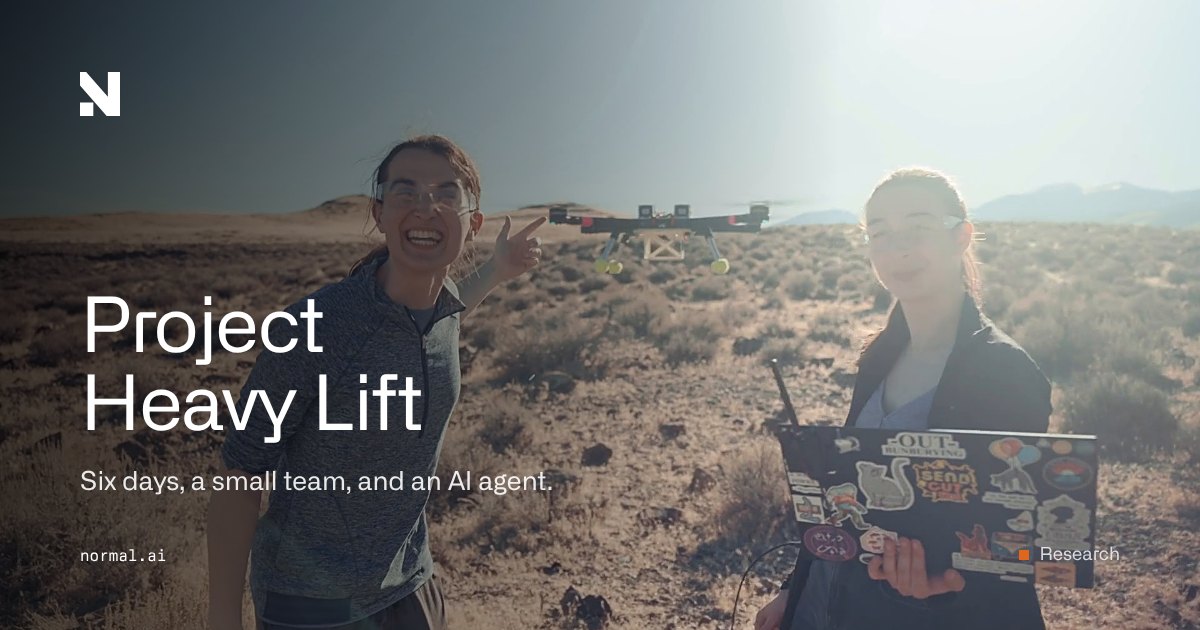
Startup Normal (normal.ai) published a breakdown of the Project Heavy Lift on November 16, 2026: a team of three engineers designed, ordered parts, and assembled a cargo drone with a payload capacity of up to 55 pounds (approx. 25 kg) in six days (October 31 – November 7) with the help of the Zeus AI agent. The drone completed its first flights under FAA Part 107 regulations and delivered cargo from November 5–7. Based on a single technical specification, the agent generated 50 design variants with CAD models, parts lists, and calculations, assembled a 34-page wiring book in 38 minutes, and independently placed orders for 36 parts from five suppliers totaling $1,933.72.

What happened
On November 16, 2026, startup Normal published a full breakdown of the Project Heavy Lift with all work artifacts. The project ran from October 31 to November 7: a team of three engineers worked with the Zeus agent, which generated 50 design variants of a cargo drone based on a single technical specification, each with its own CAD model, parts list, and calculations with references to Shigley's and Roark's handbooks. The agent then assembled a 34-page wiring book in 38 minutes, performed a finite element analysis of arm vibrations, independently placed orders for 36 parts from five suppliers totaling $1,933.72, and tracked the delivery of 94 items. The assembled drone, with a payload capacity of up to 55 pounds (approx. 25 kg), completed its first flights under FAA Part 107 regulations and delivered cargo from November 5–7. The company's post on X states that the Opus 5.5 model was used for the project; the specific model is not named on the normal.ai website, but among the generated variants, there are CAD files with opus-5-5 labels. A total of 5.7 billion tokens were consumed during the six days of work; in the published videos, the drone flies over a desert in Nevada, and the team lifts it in a workshop.
Context
Zeus is Normal's agentic system designed for teams creating physical devices: according to the vendor's formulation, a prompt for the agent is transformed into a CAD model, then into parts, and finally into a finished product. The case falls on the boundaries of agentic automation that emerged long before it: generating variants based on a technical specification with documentation, maintaining a parts list, procurement and order tracking, and project coordination with duplicate warnings are tasks that agents can already handle, while open CAD design and transferring assumptions from calculations to production instructions have traditionally remained in the human domain—and in this project, engineering decisions were still made by a human. The key to the agent's stability was the external framework: project decisions were fixed in a common registry of calculations, parts list, and decision log, which allowed tracking cascading interface changes between stages. Flights took place in the US under FAA Part 107 regulations, which govern the commercial operation of small unmanned aircraft, so cargo tests were conducted in a legal mode.
Why this matters for the industry
The value of the case for the industry lies in the documented division of labor: the agent handles labor-intensive, precise areas—iterating design variants, searching for and procuring components, tracking cascading interface changes, maintaining a decision registry—while engineering decisions remain with humans. This is one of the first publicly documented cases where an agent participated in the full development cycle of a physical device, showing that vertical agentic products for hardware teams are already functional in the structured part of the cycle; such an agent can be built without new technologies—around generating variants based on a technical specification with documentation, maintaining a BOM, procurement, and order tracking. The "fix decisions in a common registry" pattern is transferable to any agentic process in a company. A limiting factor is economics: the stated volume of consumed tokens indicates that such a setup is currently very expensive, and this order of cost refutes the simplified reading that "agents replaced the engineering team." The expected continuation is a wave of replications of the "agent builds a prototype" format in different domains, the first standardized comparisons, and the emergence of "agent for hardware prototyping" products with a decision registry, assumption checking before sending to production, and project token budgets.
Why this matters for users
Project materials are fully published: on the normal.ai/research/project-heavy-lift page, all 50 generated designs, CAD model timelapses, and flight videos are available, and in the company's @normalfactoryco thread on X, there is a project chronicle from the team's perspective. For those working with agents, the breakdown provides a ready-made checklist: agents are stable where decisions are fixed in a common registry—calculations, parts list, decision log—and weak where open design is required or assumptions are not conveyed to the executor. The practical rule applies to any engineering work, not just drones: agents can be given generation and comparison of variants, calculations, documentation assembly, supplier search, purchasing on behalf of the team, and delivery tracking, while leaving engineering judgment and review to humans.
What is still unknown / limitations
This is a vendor self-report: both primary sources were published by Normal itself, and there is no methodology, baseline, or independent verification of artifacts, so the case is better read as a demonstration of capability rather than a reproducible result. It is unknown how much time and money three engineers would have spent on such a project without an agent, so the conclusion that "the agent replaced the engineering team" is unsupported. Model attribution relies on the company's post on X and labels within CAD files, not on a methodological description; there is no data on the specific model version, prompts, toolset, or the degree of human involvement in the loop. The authors themselves noted failure modes: the agent is weak where engineering judgment, open CAD changes, and transferring assumptions from calculations to production instructions are required. Finally, token consumption is given without a monetary estimate, and metrics for variant quality, latency, and project cost were not published, so transferring the approach to production as an autonomous device development pipeline is premature.
Sources
- Project Heavy Lift · Building a drone with an AI agent in six days — Normal, official research post
- Normal (@normalfactoryco) on X: We used Opus 5.5 to make a 55lb drone — Introducing Project Heavy Lift
Author
Look at AI, editorial team