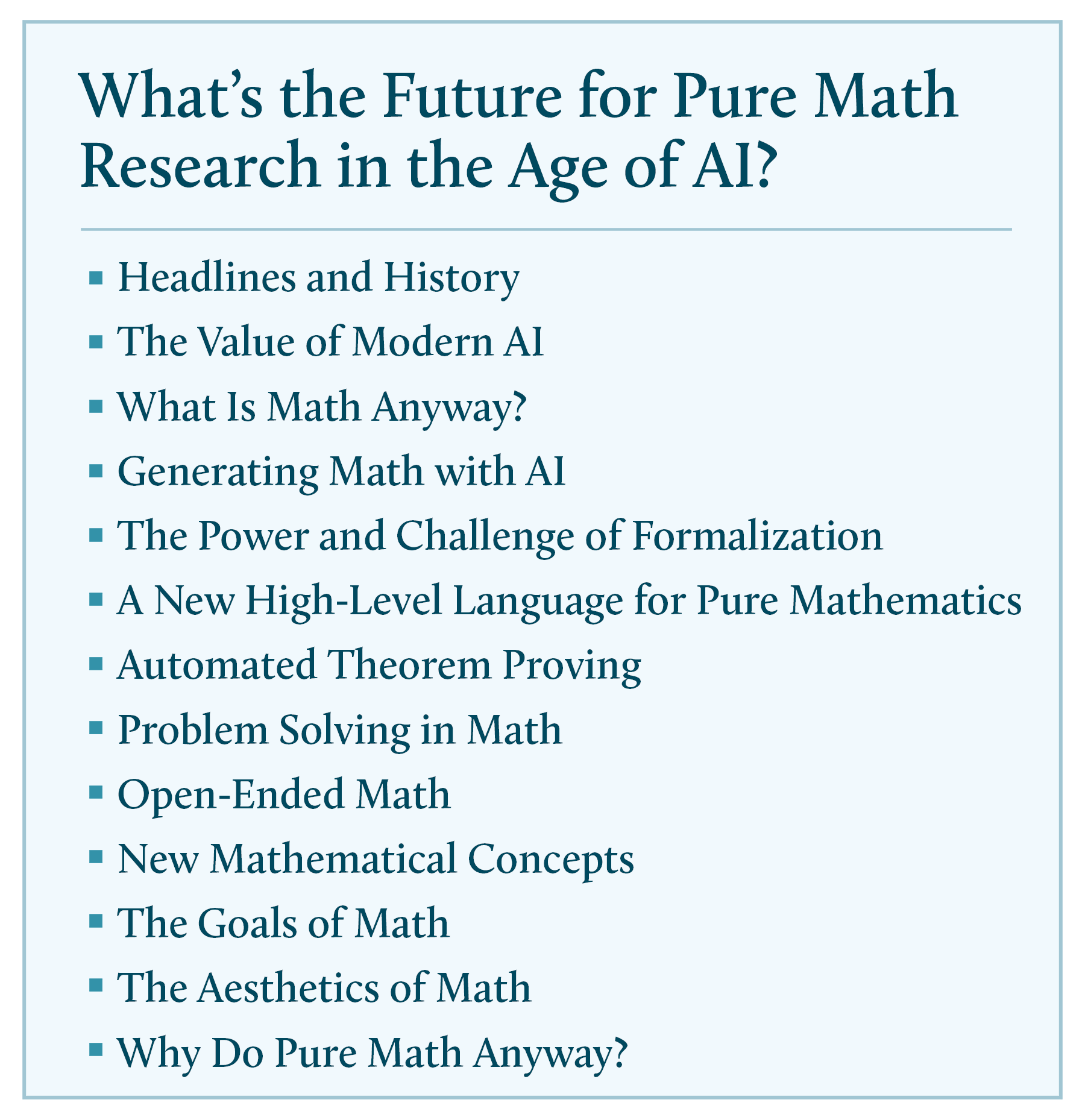
Stephen Wolfram published the essay “What's the Future for Pure Math Research in the Age of AI?”, in which he argues: AI will not replace mathematicians, because modern models primarily leverage the already accumulated corpus of human knowledge, while fundamentally new mathematics is born from computation. Practically, he proposes a “LLM assistant plus symbolic computational engine” setup via Wolfram MCP, with answers verified by computation rather than text plausibility. The announced extension of Wolfram Language with pure mathematics constructs is intended to bring executable research papers closer, where every statement can be verified by computation.
What happened
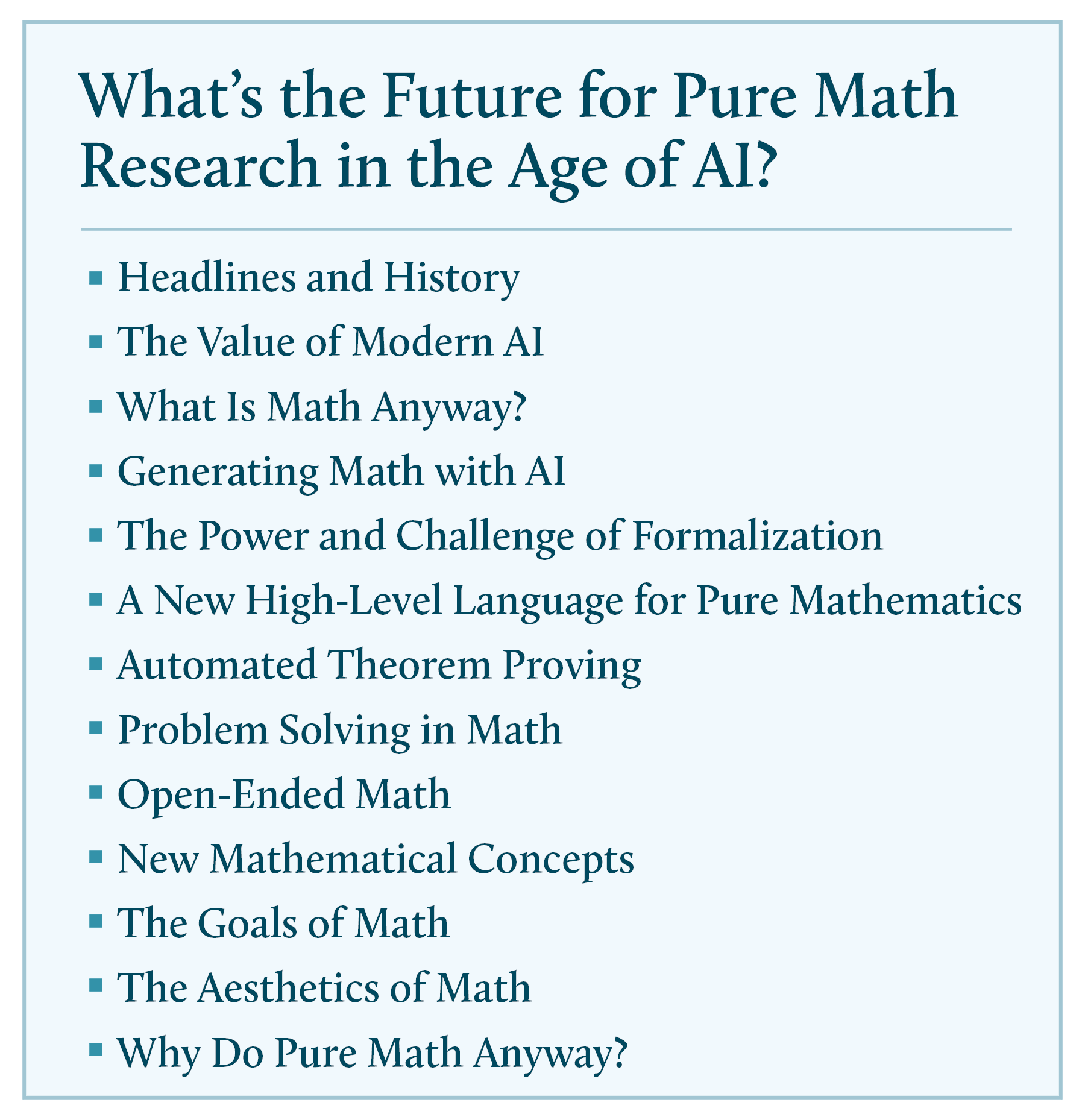
On September 28, 2026, Stephen Wolfram published the essay “What's the Future for Pure Math Research in the Age of AI?” on writings.stephenwolfram.com, and on September 30 read it aloud in a livestream on the Wolfram YouTube channel: the 1:52:15 recording gathered about 22,000 views, and the discussion is unfolding on Hacker News. In the substantive part of the essay, the author formulates key theses: “modern AI is primarily a way to leverage the existing corpus of human knowledge,” “great mathematics are defined by the questions they ask,” and goal-setting remains human. The practical part of the text is a specific scheme: an AI assistant connects to a symbolic computational engine via Wolfram MCP, after which its answers are verified by computation, not by trusting smooth text. In the same material, Wolfram announces an extension of Wolfram Language with pure mathematics constructs — sheaves, Lie groups, Clifford algebras — with the ultimate goal of an executable computational version of every mathematical statement in a research paper.
Context
The argument is embedded in the long-standing genre of predictions about the automation of science: according to the author's recollection, when Mathematica was launched in 1988, the “end of mathematics” was also predicted, but instead of the profession disappearing, the level of solvable problems grew. The theoretical basis of the essay is the ideas of the computational universe and the Ruliad: the space of all possible computations, from which “alien,” non-human mathematics inaccessible to direct human intuition may arise. According to Wolfram's logic, a neural network model relies on texts already written by people, so it works well with the existing corpus of knowledge, while the generation of fundamentally new mathematics is assigned to computation, not probabilistic guessing of the next token. At the same time, the entire essay remains a methodological framework, not a technical result: it contains no benchmarks or implemented experiments, only the author's argumentation and a description of a working architecture.
Why this matters for the industry
For the industry, the value of the essay is not the forecast, but the description of an already being deployed architecture: an LLM assistant connected via Wolfram MCP to a symbolic engine turns plausible statistical text into verifiable computations, and such a stack is assembled without developing new machine learning. For founders, a business signal is visible: Wolfram is opening outward access to a computational engine built over decades, and announcing an extension of the language toward pure mathematics — a measurable step toward executable research papers, where every statement has an executable computational version. A separate transferable asset is a criterion for checking big news: the weak link of hybrids remains autoformalization, and an automatic checker may prove the wrong statement that the author intended, choosing a convenient interpretation; headlines like “AI solved an open problem” should be read only after ensuring that exactly the claimed statement was formalized. If the announced extension is released publicly with documentation, a wave of hybrid workflows “LLM plus symbolic verification” and the first executable formalizations of research statements is likely.
Why this matters for users
Readers can adopt working techniques today. First — connect your AI assistant to a computational engine via Wolfram MCP: according to the author, “it takes a few seconds.” Second — do not take smooth text at face value: a model's result can be differentiated or integrated, and a dubious generalization can be crushed by a computationally found counterexample. Wolfram sets a benchmark for healthy caution with a personal example: daily by email he receives texts with the external texture of a mathematical paper and near-zero real correctness. For those following the AI-for-math topic, this provides a simple optic: to distinguish a result confirmed by computation from a plausible retelling that is stylistically indistinguishable from it.
What is still unknown / limitations
Methodological caveats are significant. The formulation “connection in a few seconds” and the announcement of the Wolfram Language extension are statements by the author-vendor: the materials contain no independent methodology, reliability measurements of the hybrid stack, or latency figures. The extension remains an announcement without timelines, specifications, or public examples, so it is too early to rely on it in plans. The central thesis itself is an epistemological hypothesis, not a measurement result: the sources contain no benchmarks on the ability of LLMs to generate fundamentally new theorems. Finally, when replicating hybrid stacks around Wolfram Language and MCP, dependence on a single vendor is possible, and comparable alternatives are not considered in the reviewed materials.
Sources
- What’s the Future for Pure Math Research in the Age of AI?—Stephen Wolfram Writings
- What’s the Future for Pure Math Research in the Age of AI? (Wolfram, YouTube livestream, 1:52:15)
- [What's the Future for Pure Math Research in the Age of AI? [Wolfram] | Hacker News](https://news.ycombinator.com/item?id=49950524)
Author
Look at AI, editorial team