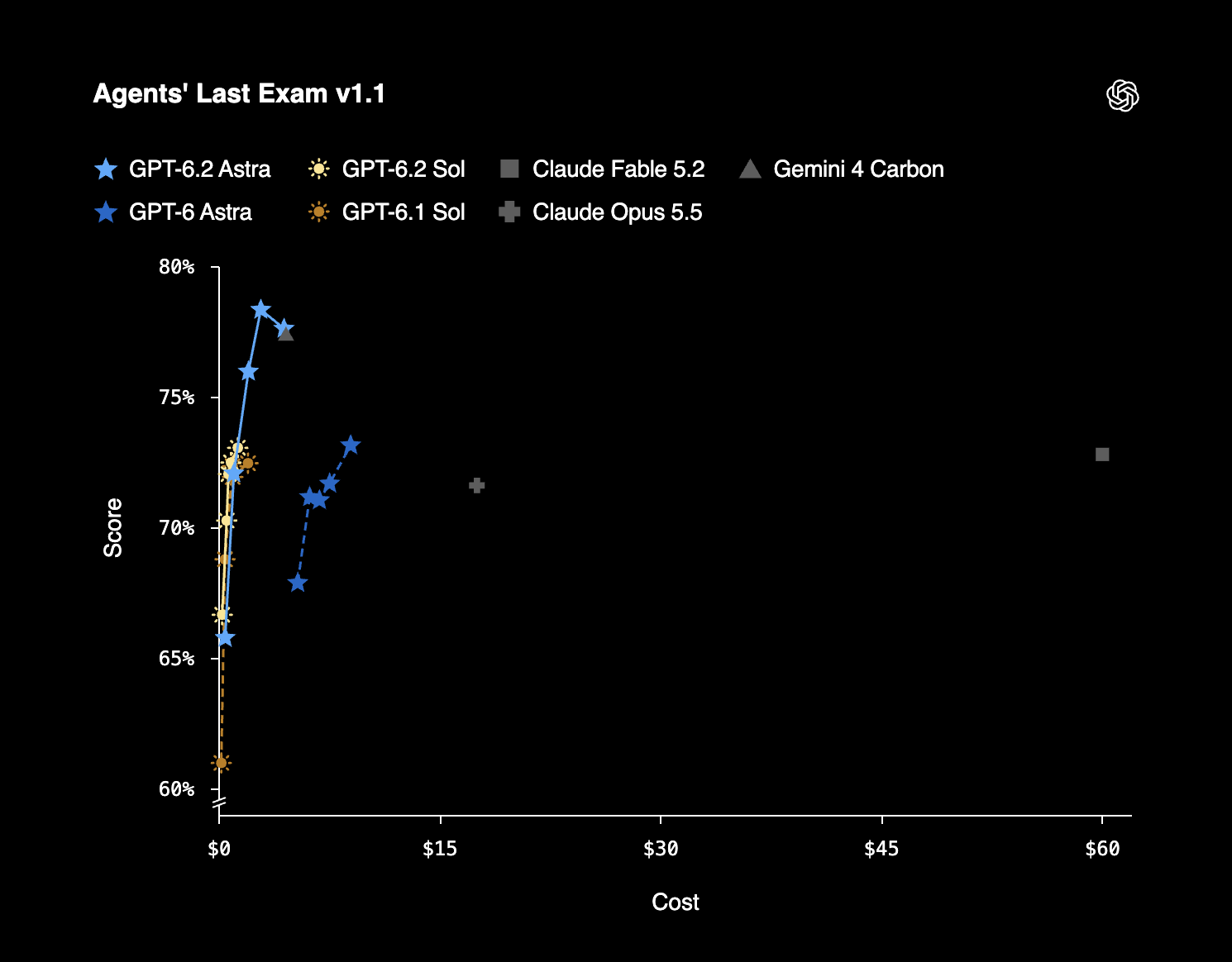
On November 17, 2026, OpenAI released two models simultaneously: the frontier model GPT-6.2 Astra for complex tasks and GPT-6.2 Sol for everyday routines. Astra's input tokens became 20% cheaper, dropping to $8 per million, while output tokens cost $40; the cache became 60% cheaper, and its lifespan is no longer limited. Sol retained its previous rate of $2/$10 per million tokens, where the first figure is input and the second is output. Both models are already working in ChatGPT Work, Codex, and the API, so savings and quality can be tested on your own tasks the same day; however, key quality figures currently rely on vendor benchmarks and await independent verification.


What happened
On November 17, 2026, OpenAI released two models from the GPT-6.2 line: Astra and Sol. Astra is aimed at complex scenarios — code, document processing, 3D, and cybersecurity; its rate of $8 per million input tokens and $40 per million output tokens is 20% cheaper than the predecessor GPT-6 Astra. The cost of the cache has been reduced by 60%, and its lifespan has become unlimited. Sol is oriented toward everyday tasks and maintained its previous rate of $2/$10 per million tokens without a price change. Both models are already available in ChatGPT Work, Codex, and the API for Plus, Pro, Enterprise, and Edu subscribers, and the Ultrafast mode, previously tied only to the Pro 500 tier, has been extended to Pro 200. According to vendor data, Astra gained 22 points on the ExploitBench Internal Port cybersecurity benchmark and 5.2 points on Agents' Last Exam; simultaneously, the GPT-6.2 Astra & Sol System Card model card was published on the OpenAI Deployment Safety Hub portal.
Context
GPT-6.2 is not a generational shift but an incremental iteration within the GPT-6.x line, and there is no basis to regard it as a scientific breakthrough: the core of the release lies in economics, not in new capabilities. OpenAI is lowering the price of access to frontier intelligence and moving the cache from a utility technical option to a first-class billing mechanism, which now determines the cost of long sessions. Competitive pressure is also at play: Anthropic with Claude 5.2 and Google with Gemini 4 are already operating in the market, and in OpenAI's own comparative materials, the Gemini Carbon model on the private GDPval v2 benchmark appears cheaper and higher quality than Opus and Fable. Thus, OpenAI's previous advantage in the combination of price and quality has ceased to be self-evident, and the price reduction of Astra should logically be viewed as a response to this shift rather than a gesture of generosity. Another detail to keep in mind when reading the release figures: significant comparisons are conducted on benchmarks controlled by the vendor itself, including the private GDPval v2, so it is reasonable to immediately apply methodological skepticism to the claimed improvements.
Why this matters for the industry
For the industry, the meaning of the release lies in unit economics, not a leap in capabilities. It hits hardest on scenarios with long sessions: agent pipelines, coding assistants, and RAG applications with active context reuse receive a double reduction — on input and on cache — and savings grow with the length of the working session. The pricing itself dictates the architecture: heavy pipeline steps are moved to Astra, routine ones remain with Sol, and a router with escalation becomes the default structure for agent products, while Astra becomes a candidate for enterprise scenarios where the price per solved task, not per token, is critical. The expected reaction from competitors — a price cut in return or new iterations — will accelerate the "benchmark wars" cycle, making it more important to monitor prices than announcements. For startups on top of the API, the picture is mixed: the margin of thin wrappers will continue to shrink, value shifts to orchestration, routing between models, and proprietary data, but the persistent cache opens a window for product repackaging — project memory, background agents working for days, and a "long warm context" architecture instead of aggressive prompt slicing for a short window. If the price reduction trajectory is maintained in subsequent generations, the cost of a unit of agent work will drop by an order of magnitude, and the main constraint will become not the token price, but the reliability and verification of agents.
Why this matters for users
For readers, everything new is available immediately, without a waitlist or migration. For the first time, the extended Ultrafast mode for Sol, available on a broader Pro tier, means fast everyday work for those who did not previously have such access. The persistent cache saves quota in long sessions: context no longer needs to be rebuilt after expiration, so long dialogues and agent scenarios start to cost less on the same subscription plan. Since the models are already included in the app and API, a reasonable step is to run Astra on your own complex tasks like code, documents, or 3D, and Sol on routine tasks, comparing the result not with vendor graphs but with your own baseline. API project owners will have enough time in one evening to move one long workflow to Astra with aggressive cache reuse and measure the bill before and after, assessing the savings on actual load.
What is still unknown / limitations
The main limitation concerns quality. The increase on the cyber benchmark was obtained on the ExploitBench Internal Port set with the "Internal" label, which cannot be reproduced outside OpenAI, so the 22 points remain a vendor claim subject to verification, not an established fact; the 5.2 points on Agents' Last Exam is a modest increment, not a breakthrough in ratings. The private GDPval v2 belongs to OpenAI itself, and models are usually tuned to such sets, so comparisons with predecessors Sol 6.1 and Astra 6, as well as independent replications on external datasets, will be more informative — these should be expected in the coming months, along with price movements from Anthropic and Google. The phrase "best model for scientists" remains a promise until third-party verification. Finally, actual latency figures and the real cache effect on specific traffic types are not confirmed in open materials, so teams should verify these parameters with measurements on their own scenarios.
Sources
- GPT-6.2 Astra and Sol are now available — OpenAI Developer Community
- GPT-6.2 Astra & Sol System Card — OpenAI Deployment Safety Hub
Author
Look at AI, editorial team