
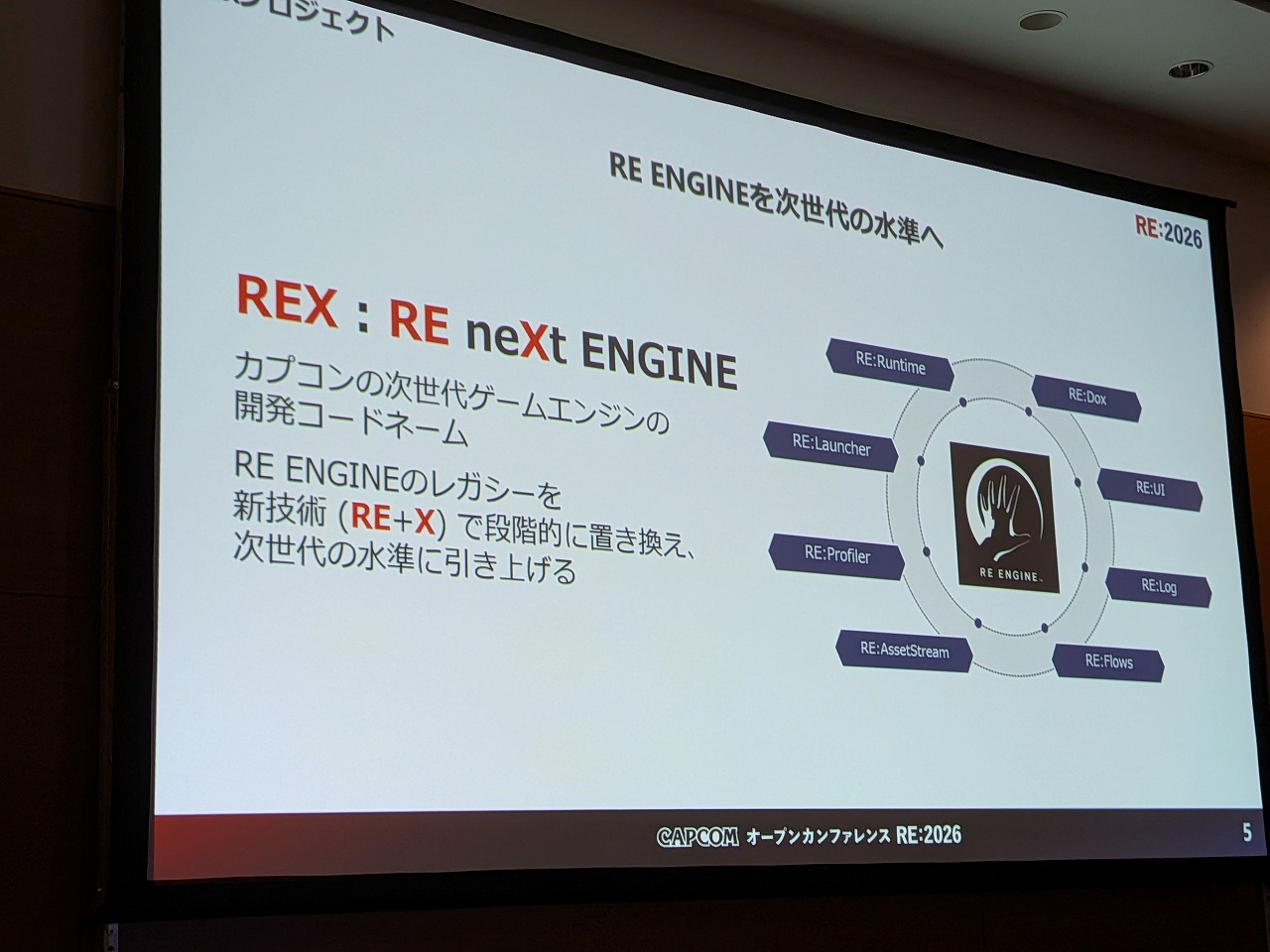
Capcom is moving its main game engine, RE ENGINE — the foundation of Resident Evil 7 and more than two dozen major studio releases — into the category of an "AI-generation game engine." Programmer Satoshi Ishida announced the REX project: the engine will not be rewritten from scratch; instead, it will be built up with modules prefixed RE::, and Capcom will open-source some improvements specifically for AI training so that the development pipeline is readable not only by humans but also by models.

What Happened
The announcement took place on October 2, 2026, at the internal Capcom Open Conference RE:2026. The REX project is described as a series of modules that build up the engine. RE:Dox addresses the task of unified and fast processing of any data. RE:UI presents a lightweight interface framework for tools, free from freezes and GC pauses. RE:Log moves logging to compact ID logs with automatic translation and a central repository. RE:Flows allows visual prototyping of game logic, after which such prototypes are automatically converted into "the world's most widely used programming language." RE:Runtime offers a new runtime based on its own fast language RE:C++ with block-based batch memory processing. It was separately announced that Capcom will publish some REX improvements in open source specifically for AI training.
Context
The scale of the project is defined by the engine's status: RE ENGINE has powered Resident Evil 7 and 27+ major Capcom releases, and over 2,000 developers work with it. The strategy is also telling: instead of a new engine from scratch, the company is modernizing a live production tool on which games continue to be released in parallel — such a migration does not stop releases. The frame is set by the talk's title itself, as quoted by IGN: "Our Goal Is a Future Where We Create Games Together with AI" — the goal is a future where games are created together with AI. From this premise follows the REX principle: the engine and its environment are designed so that they can be analyzed not only by the engineering team but also by models.
Why This Matters for the Industry
For the industry, the announcement is valuable as a concrete, not declarative, plan for integrating AI into large-scale game production. Unifying development for machine readability — a common fast language instead of heterogeneous tools, standardized ID logs with a central repository — is interpreted as data preparation for future AI tools, and the promised open components become a potential dataset for training models. The stated goals of the program — auto code generation and auto bug playtests — if executed, will give the industry a rare real benchmark of how AI accelerates game development in a studio's production environment. The pattern of "incremental modules on top of a working engine" can be copied by other teams that need AI modernization without stopping game releases.
Why This Matters for Users
For players and readers, the main clarification: "creating games together with AI" at Capcom does not mean AI content. The company explicitly rejected AI assets in final games — AI accelerates assembly, testing, and debugging, i.e., internal development processes, not the content of the games themselves. The announcement brings no immediate changes to games. The practical benefit is observational: if the promised open-source REX components become publicly available, their code will allow, for the first time, to examine how machine-readable development is structured at an AAA studio, and the reference points for tracking are Capcom's future technical talks on the project's modules.
What Is Still Unknown / Limitations
For now, this is a roadmap, not a release: no RE::* feature has been shown in action, there are no APIs, code, or demonstrations, and the performance of the new modules has not been confirmed by independent sources. No metrics or benchmarks have been announced for the goals of auto code generation and auto bug playtests by which progress could be verified. Discussion of the announcement on Hacker News is empty, meaning there is no third-party expertise either. The timelines, composition, and licenses of the promised open-source deliveries, as well as the scenarios in which the engine will actually start being "read" by models, have not been named.
Sources
- IGN: Capcom Announces Plans to Transform the RE Engine Into an AI-Generation Game Engine
- GameBiz: Japanese report on Satoshi Ishida's talk on the REX project
- Hacker News: discussion of the announcement (id 49947081)
Author
Look at AI, editorial team