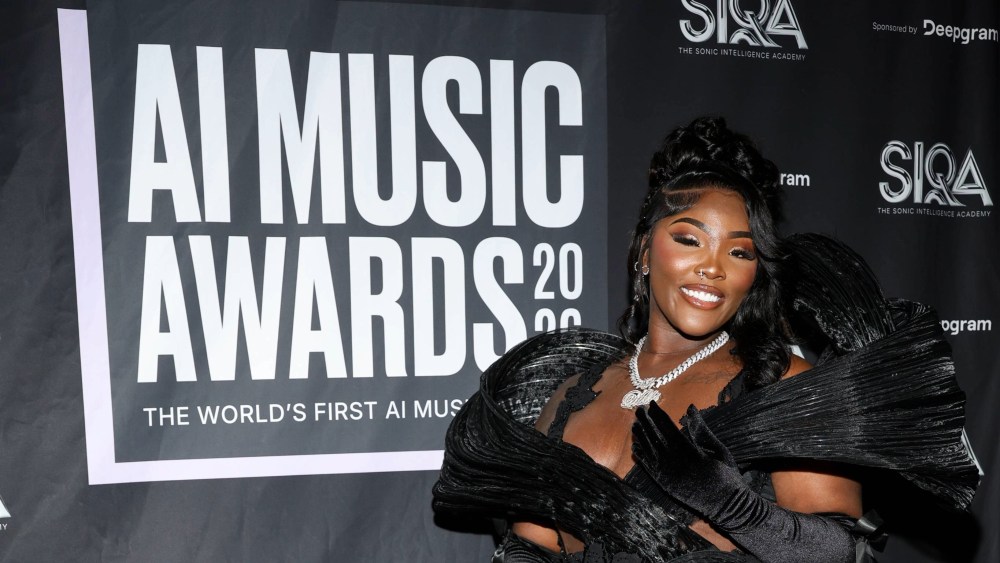
On November 13, 2026, at The Mayan club in downtown Los Angeles, the Sonic Intelligence Academy held the first AI Music Awards, which it positions as the "AI equivalent" of the Grammy Awards. Winners in 25 categories were chosen by AI artists registered in the SIQA registry, and the top awards went to the AI persona Xania Monet, whose track "How Was I Supposed to Know?" reportedly became the first AI performer song to enter the Billboard charts. The paradox of the evening was that the show, intended as a demonstration of the institutional maturity of AI music, was accompanied by a 30-minute delay and glitches in sponsor Deepgram's voice technologies.

What Happened
The Sonic Intelligence Academy (SIQA) organized the evening, with the venue being The Mayan club in Downtown Los Angeles. Awards were presented in 25 categories, including AI Song of the Year, Best AI Pop Song, and Best Human+AI Hybrid Song. All tracks were divided into three classes: fully generated, created with AI assistance, and "Human + AI Hybrid." Voting took place within the community: awards were distributed by AI artists registered in the SIQA Verified Registry. The title of AI Artist of the Year and Song of the Year went to the AI persona Xania Monet with the R&B track "How Was I Supposed to Know?". Variety described the evening as chaotic: the ceremony was delayed by approximately 30 minutes, the teleprompter failed, sponsor Deepgram's voice intros glitched, and awards were presented with errors.
Context
The ceremony must be read in conjunction with the infrastructure SIQA is building around AI music. In January 2026, the organization launched its own charts after Billboard refused to include AI tracks; these were joined by the Verified Registry—a registry with artist origin verification, a taxonomy of human involvement levels, and an awards show with a red carpet. All of this is a response to a situation where AI music is stuck in a legal plane: the generative music industry is preoccupied with lawsuits against Suno and Udio, and there is no channel for institutional recognition of AI tracks in the mainstream. SIQA's strategy is to not wait for recognition from existing institutions like the Recording Academy, but to build a parallel system where AI music is recognized by its own community. Notably, the argument for legitimacy in this system is the "human layer": the AI persona Xania Monet has a human creator, Telisha "Nikki" Jones, and the discussion of her success revolves around authorship and attribution, not just model capabilities.
Why This Matters for the Industry
For the industry, the event marks a precedent for building a parallel recognition system: where the Recording Academy and Billboard do not accept AI tracks, their own charts, provenance registry, and awards emerge. For builders, this is a reproducible pattern—a proprietary recognition institution for a class of content that existing institutions do not serve. The practical takeaway for teams working with generative content: origin labeling is becoming a market requirement, and it should be built into pipelines from day one, not after the fact. Within a six-month horizon, a wave of registry and chart clones for AI content is likely, as are the first provenance features in creative tools as a differentiator, while the breakdown into fully generated, AI-assisted, and Human + AI Hybrid risks becoming a standard metadata field in generative pipelines. On a two-year horizon, bifurcation is possible: parallel institutions will either take root and divide AI music into two institutional worlds, or the function of recognition will be absorbed by the mainstream. The economic effect is currently zero: the awards did not create new revenue streams, and no direct API or developer product is visible in the sources, however, the attraction of Deepgram's sponsorship budget and the low cost of registration in the Verified Registry give startups and AI artists a window for early positioning. A separate lesson—negative: a public failure of live voice infrastructure at a show about industry maturity is a stress test, the results of which should be considered when planning live voice AI deployments.
Why This Matters for Users
For listeners, this is the first case where an AI persona takes the top awards at a music awards show, and its music enters old institutions like Billboard. The taxonomy of fully generated, AI-assisted, and Human + AI Hybrid is potentially useful to the reader: it allows explicitly distinguishing tracks by the degree of machine involvement, which is not yet available in familiar streaming services. The results should be viewed soberly: the awards were chosen by the registered AI artists themselves, so voting currently functions as a community assessment and marketing tool, not as an independent measure of quality. The practical takeaway for reader-creators: the "human layer"—the author's name, text authorship, prompt engineering—is becoming the central argument for the legitimacy of AI projects, and it is this, not the quality of generation, that is discussed as the justification for awards.
What Is Still Unknown / Limitations
Conclusions from the event require caveats. The entry of Xania Monet's track into the Billboard charts is given in the sources as "reportedly" and relies essentially on a single source; the chart position is an indicator of distribution and promotion, not proof of independent listener demand. The voting methodology is not disclosed: evaluation criteria, number of votes, presence of blinding, and independence of judges from the organizer are unknown, so the awards should correctly be considered a benchmark without a protocol. Criteria for classifying tracks into fully generated, AI-assisted, and Human + AI Hybrid classes have not been published, so the taxonomy is currently only a proto-formalization of the degree of human involvement. The technical stack of the winning track is not disclosed, and its success says nothing about the capabilities of specific generative models. Finally, it is unknown whether SIQA will open the Verified Registry via API or public profiles—this determines whether the registry will become infrastructure for the ecosystem or a closed marketing asset.
Sources
- Inside the AI Music Awards, An Attempt to Normalize Tech-Backed Tunes — Variety
- AI Music Awards 2026 (The AIMAs) | Official Site — SIQA
- AI music gets its own awards show — The News International
Author
Look at AI, editorial team