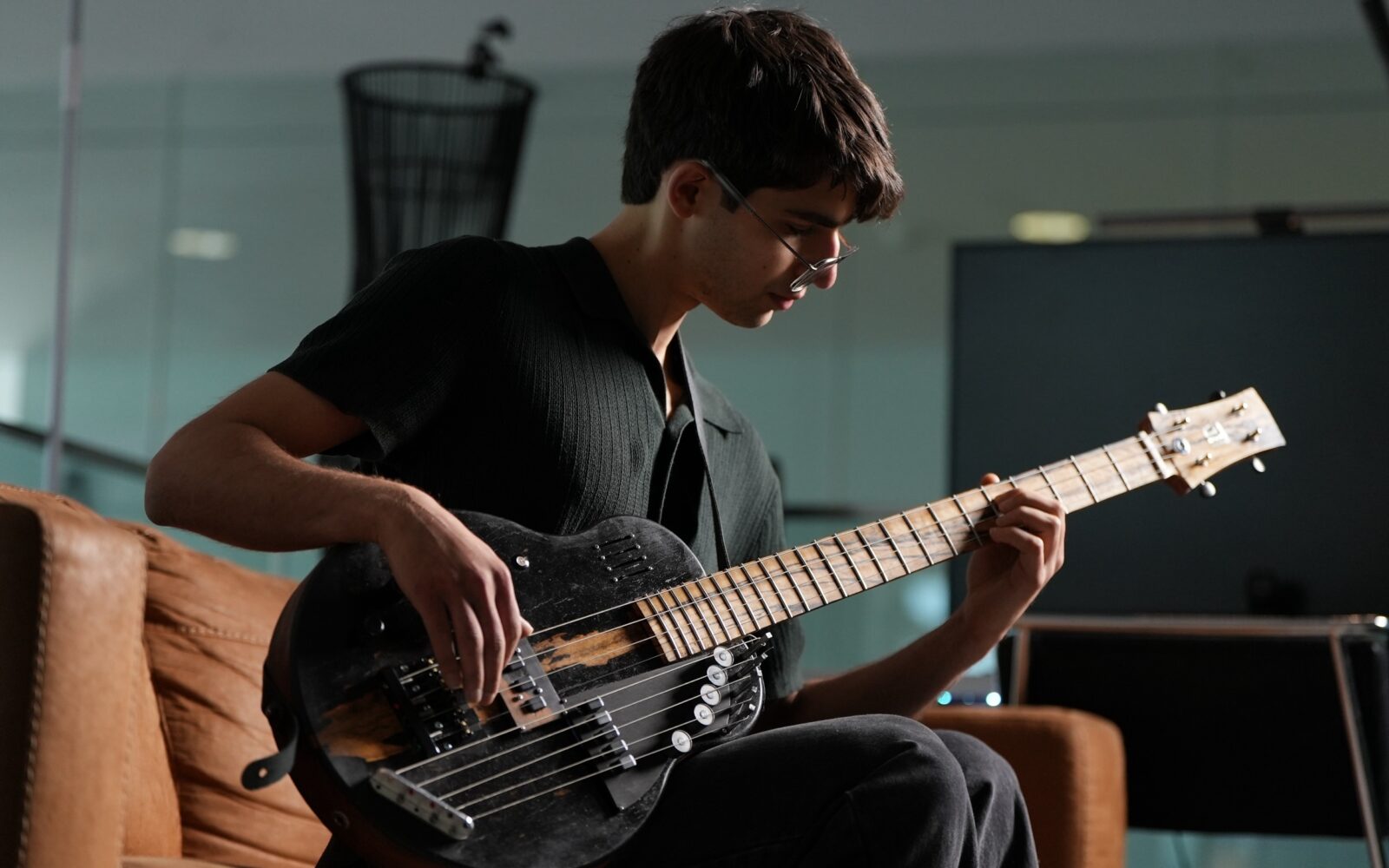
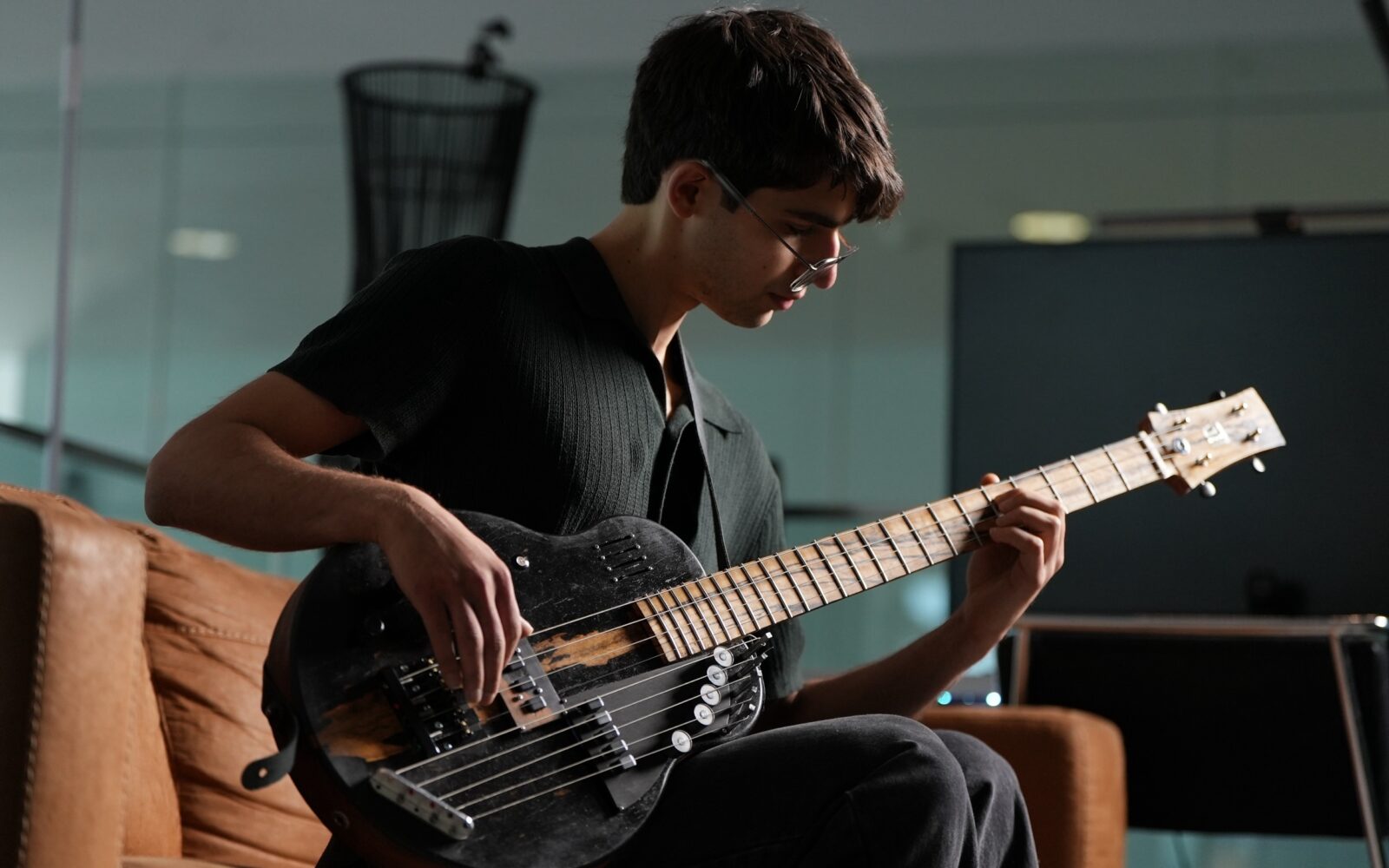
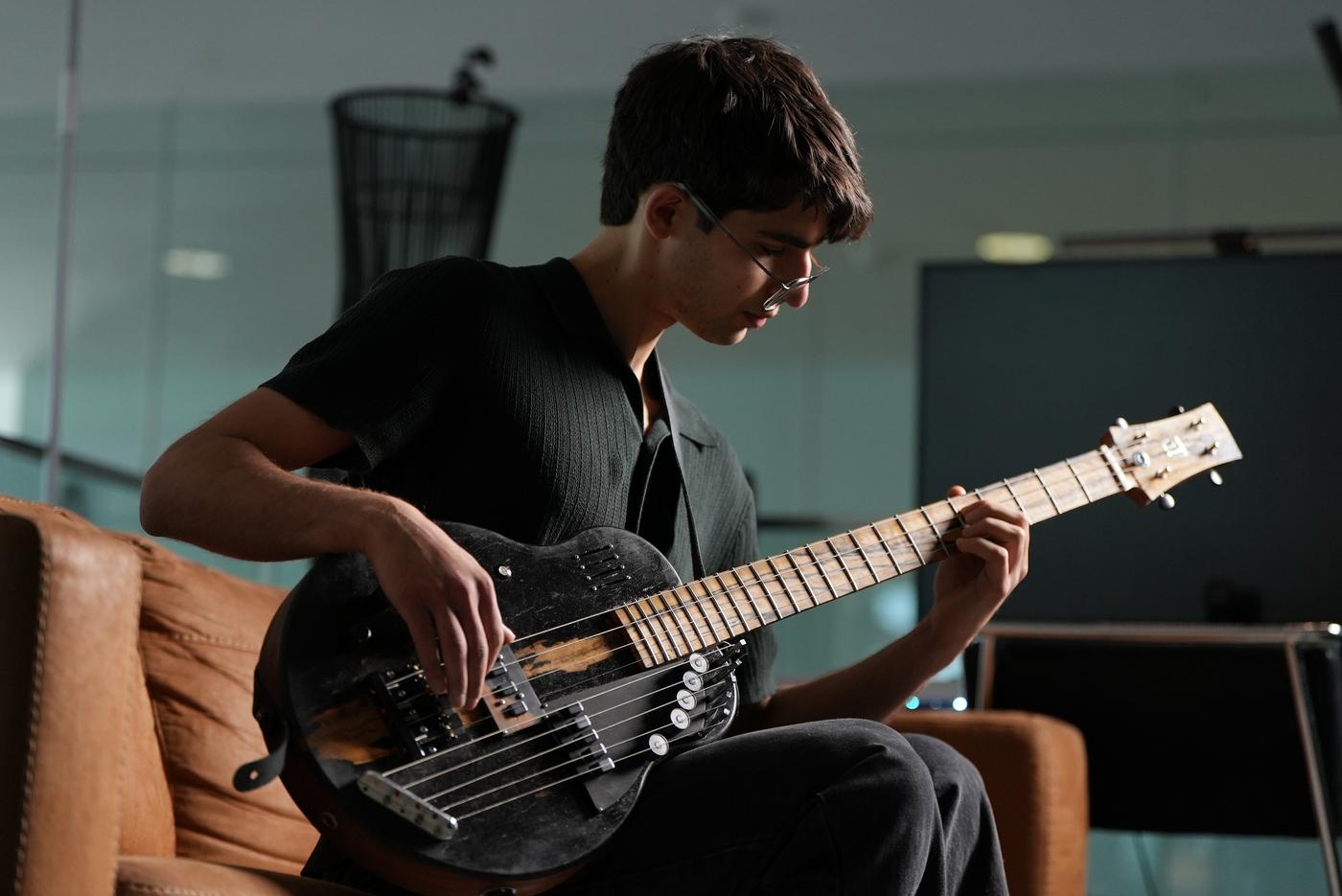
Antonis Christou, a researcher at the MIT Media Lab from the Opera of the Future group, presented Automatar — a bass guitar with an NVIDIA Jetson Orin NX single-board module physically embedded in its body. The musician plays on four main strings, while a locally running AI model analyzes the performance and electromagnetically vibrates five additional strings, building harmony on the fly. The project is interesting as a rare case where machine learning is fully integrated into an acoustic instrument: the neural network responds not through a screen, but through the mechanics of the strings.
What happened
Automatar is a research prototype, not a mass-produced product: its description is published on the MIT Media Lab project page and in a CreativeApplications.Net article. The signal chain is set up as follows: a Bela Mini with the SuperCollider environment processes the sound of the main strings, the signal is converted to MIDI with pitch determination for each string individually, after which the model generates sine waves that excite the additional strings through high-voltage operational amplifiers. The body is assembled from exotic dark wood Pale Moon Ebony and mahogany; traditional luthier work here is combined with CNC milling and 3D printing.
Context
The project was developed in the Opera of the Future group at the MIT Media Lab research laboratory and is presented as an example of the physical AI approach, where machine learning interacts with the real world through mechanics rather than an application interface: local inference here replaces cloud assistants. Notably, the entire system is assembled from off-the-shelf components — NVIDIA Jetson Orin NX, Bela Mini, SuperCollider, and a standard MIDI pipeline; this signals that edge hardware for audio tasks has already become affordable at the level of a graduate student project. From the perspective of ML research, the rarity lies not in the model, but in the interface: the neural network effectively performs the role of a drive for physical strings, and the generation output goes through the instrument's mechanics.
Why this matters for the industry
There is nothing ready for deployment here: this is a single prototype without an API, prices, or disclosed production plans, so the project does not provide a direct commercial effect. Its value lies elsewhere — as an architectural reference: the pattern of 'Bela and SuperCollider for real-time plus Jetson for local model, connected via MIDI' can be transferred to your own tasks — interactive installations, MIDI controllers, physical interfaces, educational or rehabilitation devices. The project also marks a market shift: local AI inference on off-the-shelf hardware is already being embedded in musical instruments, not just in server pipelines. In the next six months, amateur reproductions and forks of such an architecture are likely in the maker community and on NIME-format stages, however, this is an expectation, not a plan stated by the authors, especially if the code and methodology remain closed.
Why this matters for users
For the reader, the project is useful as a living example of how an AI instrument can complement a musician rather than replace them: the guitar reacts to the playing and builds harmony, leaving the decisions to the performer. You can look inside via the video and the project page on the MIT Media Lab website, and the architecture based on Jetson, Bela, and SuperCollider with a MIDI pipeline should be considered as an educational example of an embedded system for your own experiments at the intersection of music, hardware, and machine learning. You cannot buy Automatar: the instrument exists in a single copy, without prices, a run, or buyers, so for the average user, it is more of a source of ideas than an accessible device.
What is currently unknown / limitations
Key characteristics have not yet been publicly confirmed. Abandoning the cloud removes only network latency: the end-to-end response time from pitch detection to the vibration of an additional string has not been measured or published anywhere, so 'real-time operation' remains a plausible architectural claim, not a measured fact. There are no details of the AI model itself: without disclosing the methodology, it is impossible to determine where the boundary lies between a trainable harmony generator and classic harmonic rules calculated on the fly. There are also no publications, code, datasets, or metrics, and public verification is minimal: the discussion on Hacker News has one rating and contains no comments, so one has to rely on the MIT Media Lab project page and the CreativeApplications.Net description.
Sources
- Automatar – An Intelligent AI Guitar (CreativeApplications.Net)
- Automatar: Intelligent AI Guitar — MIT Media Lab project page
- Antonis Christou — author's page (MIT Media Lab, Opera of the Future)
Author
Look at AI, editorial team