
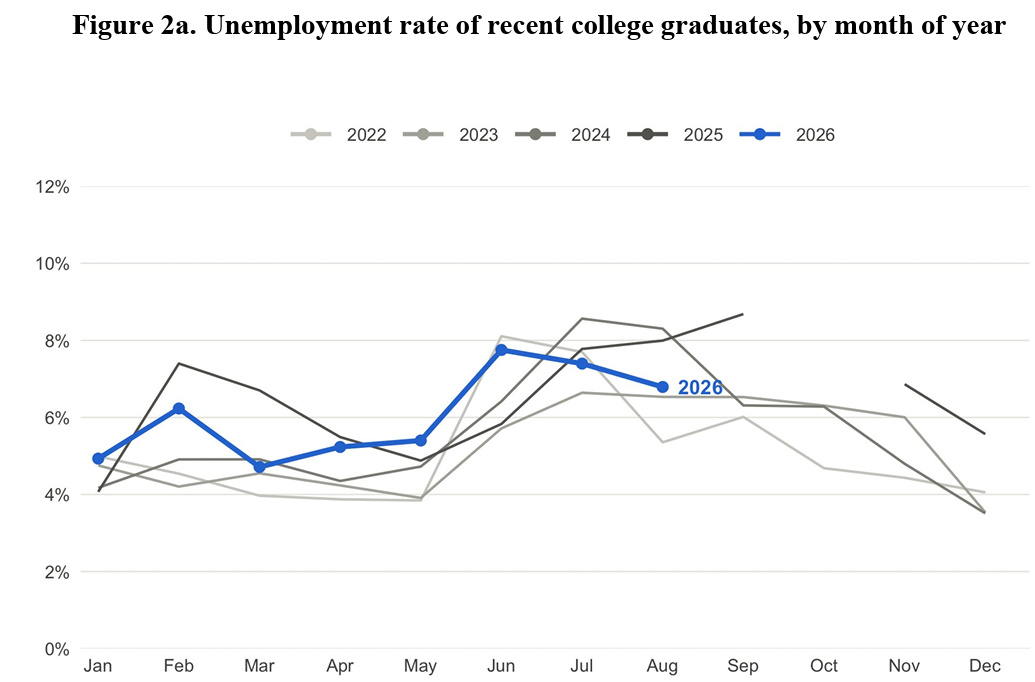
Economists Robert Fairlie and Jane Wu, in CESifo Working Paper No. 12994, examined for the first time the impact of AI on unemployment among recent college graduates using microdata from the U.S. Census Bureau's American Current Population Survey (CPS) for June–August 2026. Unemployment among 22–25-year-old bachelor's graduates was 7.3% — within the normal 6.3–7.8% range, and differences in trends from older graduates, youth without higher education, and occupations with varying AI exposure were statistically insignificant. The widely circulated claim that "AI is killing junior hiring" is not yet confirmed by official statistics.

What happened
Robert Fairlie and Jane Wu published CESifo Working Paper No. 12994 in September 2026, which is also distributed as IZA Discussion Paper No. 18945. The authors conducted the first analysis of AI's impact on unemployment among recent college graduates using microdata from the U.S. Census Bureau's American Current Population Survey (CPS) for June–August 2026. The unemployment rate among 22–25-year-old bachelor's graduates was 7.3% in summer 2026 and remained within the normal range of recent years: 6.3% in 2022 and 7.8% in 2024. Differences in dynamics between this group and older graduates aged 30–49, youth without higher education, and occupations with varying degrees of "AI exposure" were statistically insignificant. The only significant signal in the data — a positive correlation between 2026 unemployment and the availability of remote work in an occupation, not with AI exposure as such.
Context
The backdrop for the publication was the widely spread narrative that AI is hitting the hiring of entry-level specialists, and an earlier Stanford study on ADP data, where hiring for entry-level positions in "AI-exposed" industries lagged. Fairlie and Wu explain the discrepancy with Stanford by the different nature of the data: ADP is based on payroll records and reflects job vacancy supply, while CPS records actual labor demand. The choice of metric here determines the conclusion: a "hiring failure" visible in payroll data is not confirmed by household surveys. The work status is also important: this is a working paper that has not undergone peer review, with a very early observation window — only three summer months of 2026. Such an early point makes the result more valuable as a "pre-effect" baseline than as a final verdict on any narrative.
Why this matters for the industry
For the industry, this is the first direct empirical refutation of the claim that "AI is killing junior hiring," based on census data rather than ADP payroll data, and therefore capturing actual labor demand, not just job vacancy supply. It will be harder for companies to explain hiring cuts as "AI replacement": citing the Stanford/ADP narrative in pitches and PR now contradicts labor demand microdata, and decisions about team structure are better made based on internal evals and productivity metrics. The bet on junior hiring and products that accelerate new hires' time to productivity remains viable, and the zero effect provides a counterargument against cuts masked by this narrative. Economists, in turn, get a baseline: if AI's effect on graduates exists, it will have to be sought in later cohorts, which sets a benchmark for planning hiring and talent pipelines several years ahead.
Why this matters for users
If you are a student or entry-level specialist in IT and data, the panic about "graduates without a future" is not yet confirmed by official statistics: 7.3% summer unemployment in 2026 is normal for this season, not an anomaly, and there is no reason to abandon entry-level career plans because of AI today. It is also useful to know the counterargument: the only risk signal found is related to occupations where remote work is available, not to occupations with high AI exposure, so when choosing a field, it is more reasonable to consider the location-tied nature of work, not abstract lists of "occupations under threat." For those currently looking for their first job, the zero result is an argument in debates about "juniors are no longer being hired." The full article PDF is open via DOI 10.65864/b7z61mhr8d, so conclusions can be verified from the primary source.
What is still unknown / limitations
There are enough caveats, and the main ones are from the authors themselves. This is a working paper that has not undergone peer review, and its observation window is limited to three summer months of 2026, so the zero effect does not yet transfer to subsequent seasons. The authors explicitly warn: as AI use in the workplace deepens, 2027 and later cohorts may be hit harder. The found correlation between unemployment and remote work does not reveal the mechanism: this could be a geographic channel — work that can be done from anywhere — rather than direct replacement of a junior by a model, and this hypothesis still needs to be tested. Until independent replications — new CPS waves for fall–winter 2026, full annual data instead of three months, other countries and cohorts — it is more correct to speak of the absence of a statistically significant effect in one season, rather than a final refutation of the thesis about AI replacing graduates.
Sources
- AI was supposed to hit new grads hard. So far, unemployment data says otherwise — Ars Technica (Kyle Orland)
- The Early Impacts of AI on Employment Among Recent College Graduates — CESifo Working Paper No. 12994 (Fairlie, Wu; ifo Institute)
- The Early Impacts of AI on Employment among Recent College Graduates — IZA Discussion Paper No. 18945
Author
Look at AI, editorial team