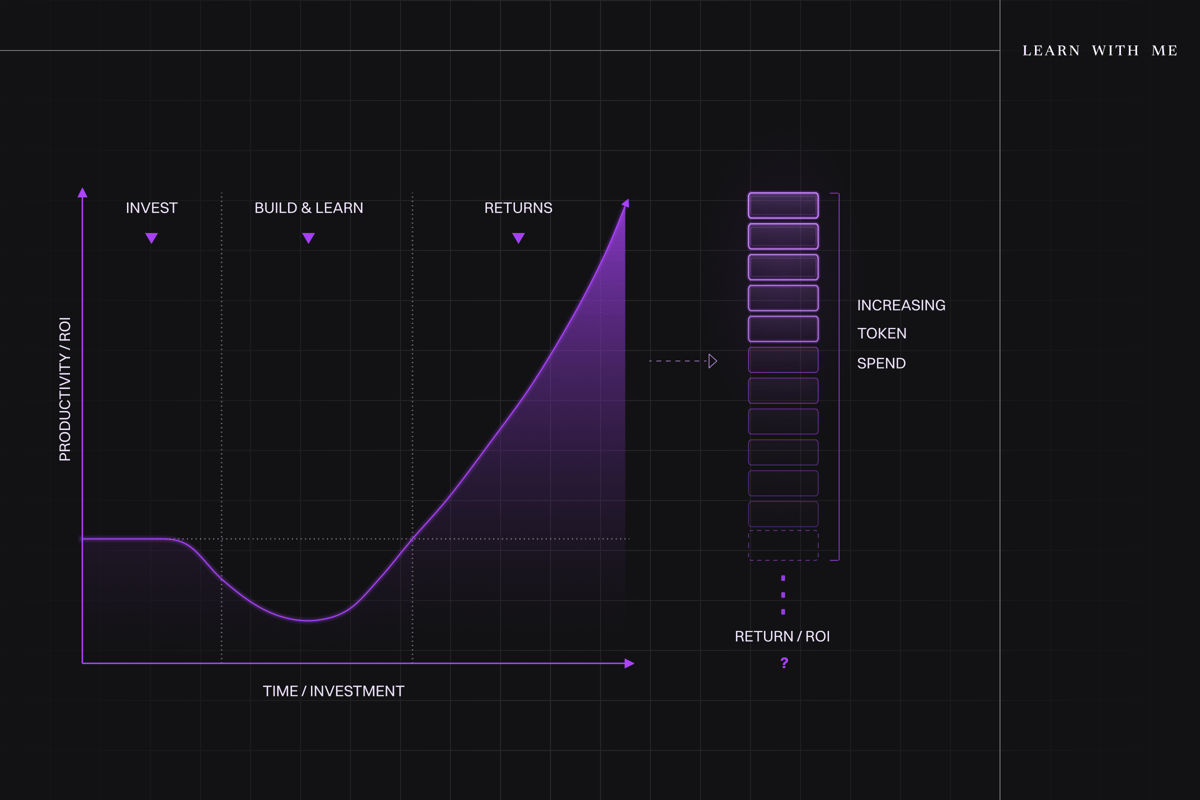
Chamath Palihapitiya (Social Capital Research) published a breakdown titled 'Why AI is booming, but productivity isn't' on September 25, 2026, explaining why the explosive growth in AI usage is not reflected in productivity statistics. According to the Ramp index, built on data from over 70,000 US companies, median AI spending is $12.50 per employee per month, with an average employee cost of about $8,500 per month, meaning the technology pays for itself with a productivity increase of roughly 0.15%, or three additional productive minutes per week. The author's conclusion: the barrier today is not the price of models, but work organization, so the gains go to companies that restructured their processes, not just those that bought the same tools.

What happened
Chamath Palihapitiya released a text titled 'Why AI is booming, but productivity isn't' at Social Capital Research, focusing on the divergence between mass AI adoption and productivity stagnation. The author relies on Ramp index data and concludes that inference costs are no longer a constraint: he calls token bills a 'rounding error' and shifts the real costs to process restructuring and retraining people. In support, he cites a P&G experiment where one employee with AI prepared product proposals at the level of a pair without AI, and the conclusion from MIT economists that automation pays off when AI steps are grouped into a chain and a human checks the result once at the end, rather than after each step. The third pillar of the breakdown is a 2026 experiment on 515 startups, where identical access to AI tools produced very different results depending on how work was organized.
Context
The breakdown embeds today's situation in the history of the 1987 Solow paradox, when the growth in computer usage was not reflected in productivity statistics: after reorganizing work around computers, US productivity growth accelerated from about 1.5% per year in the 1973–1995 period to about 3.3% in 1995–2003. The author transfers this logic to AI and formulates a testable prediction: the macro effect will be determined by the speed of adoption in large companies, not the speed of model progress. The reason the technology is not yet converting into measurable growth, in his view, is organizational: AI cheapens the production of individual tasks, but does not reduce coordination, calls, and approvals, which take up a large part of the corporate week, so the freed-up minutes are devalued.
Why this matters for the industry
For the industry, the central signal of the breakdown is that value is shifting from access to models to organizing work around them: at these inference prices, access is commoditized, 'another wrapper over an LLM' is not protected by anything, and the defensible layer of the product becomes process management, where AI operations are assembled into a controlled pipeline with human review. The experiment on 515 startups showed the heterogeneity of the effect: with identical tools, almost all of the revenue gain went to the top 10% of firms that restructured their processes, while the group that simply adopted others' reorganization schemes ended up with 1.9x the revenue of the control group in total. The practical takeaway for companies: to straighten out processes before automation, following the logic of Musk's 5 steps — question requirements, delete, simplify, accelerate, and only then automate; otherwise, AI does not add, but multiplies existing inefficiency.
Why this matters for users
The breakdown gives the reader a checklist applicable to their own AI experiments. Before automation, it is worth removing unnecessary process steps, combining AI operations into chains with one human check at the end instead of a review after each step, and not overpaying for an expensive model where a cheap one is enough. The median inference bill according to Ramp data is minuscule, so almost any company or individual employee can try it, and pilots usually do not require budget approvals. However, as the breakdown emphasizes, the gain comes from restructuring work, not the tool itself, so it makes sense to test not a new model, but a modified process scheme. It is worth noting that the author's full ROI playbook is behind a paywall.
What is still unknown / limitations
The breakdown remains an economic hypothesis with clear logic, but so far with weak reproducibility. The methodology of the experiment on 515 startups is not visible from the compressed retelling: the selection of firms, the structure of the control group, the duration of observation, and the definition of the revenue metric are unknown, so the 1.9x figure should not be read as a pure causal effect — it is indistinguishable from a selection effect, where the gain is created by initially stronger companies, not adopted reorganization schemes. The prediction, built on the parallel with the Solow paradox, also remains a hypothesis: its test criterion will be the speed of process restructuring in large companies, not the pace of development of the models themselves.
Sources
- Deep Dive: Why AI is booming, but productivity isn't (Chamath Palihapitiya, Social Capital Research)
- Hacker News — discussion: Why AI is booming, but productivity isn't
Author
Look at AI, editorial team