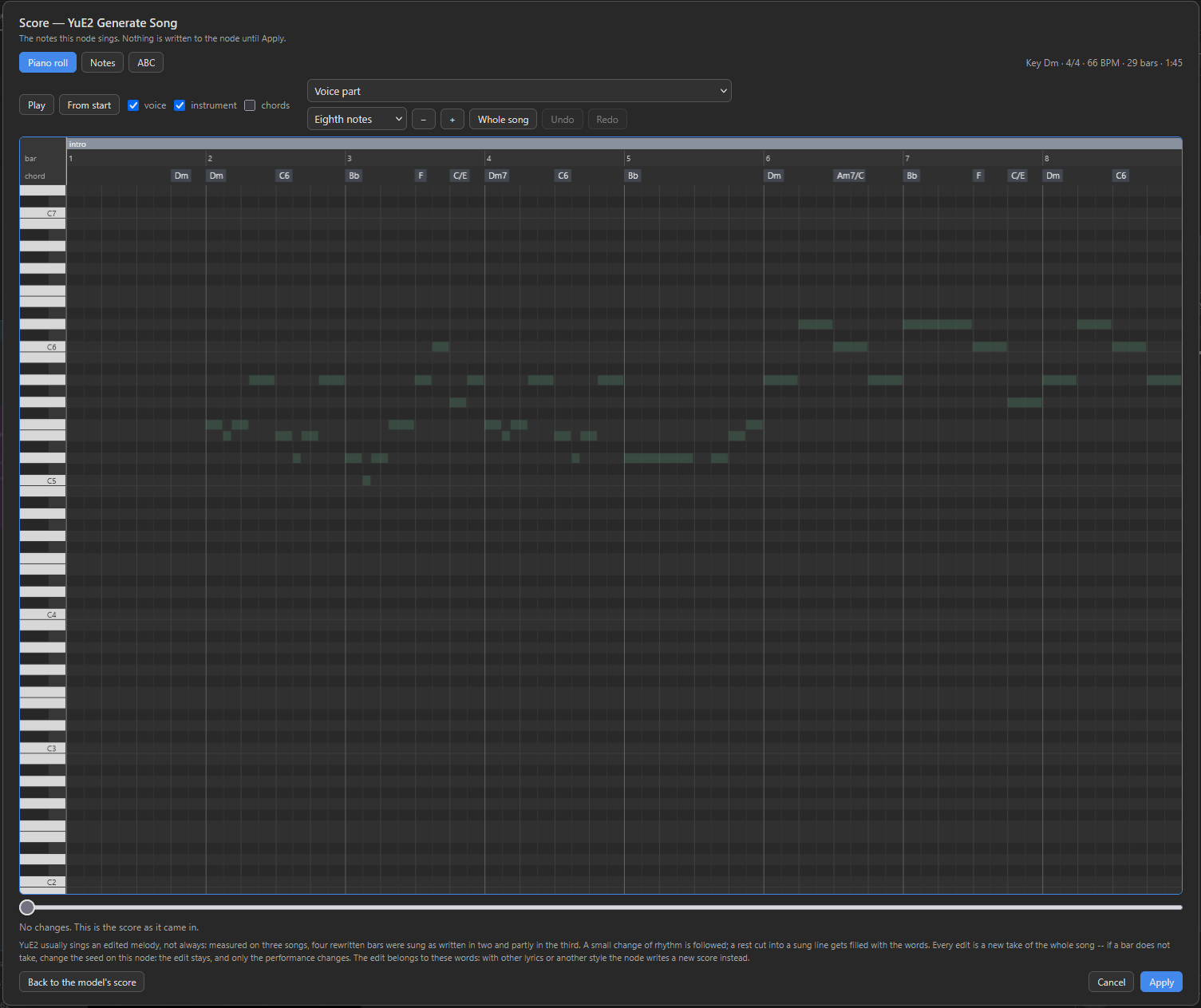
The community package pytraveler/YuE2-ComfyUI released version v0.4.0 (September 14, 2026). In local music generation with the m-a-p/YuE2-3B model in ComfyUI, a score editor has appeared: notes can be edited in the score before 'performance', and the model re-sings only the changed measures.


What happened
The new version adds a score editor to the package: a window over the ComfyUI canvas with three tabs — piano roll, sheet music based on abcjs 6.7.0, and ABC text. After editing notes in any of the tabs, the user starts the performance, and the audio is resynthesized only for the changed measures, not for the entire track. Overall, the package, starting from versions v0.1.1–v0.3.0 from September 13–14, 2026, generates 48 kHz stereo songs from a style description and text. The built-in YuE2 Write Song node writes style and lyrics with [Verse]/[Chorus] tags from a single line of an idea: it uses any local GGUF model or, if there is none, downloads Qwen3.5-4B-Q4_K_M (2.55 GB).
Context
The package is built around the open model m-a-p/YuE2-3B, whose weights are distributed under the CC BY-NC 4.0 license. The key feature of the model is a two-stage pipeline: first it writes a symbolic ABC score, a text-based musical notation, and only then 'sings' it. It is precisely this symbolic intermediate representation that makes local score editing and re-singing of individual measures possible. On the model card on Hugging Face (data as of September 12, 2026), YuE2-3B shows 6.9632 on WildSongBench compared to 6.8721 for Suno v5. pytraveler/YuE2-ComfyUI is a community adaptation of the m-a-p/YuE2-3B project for ComfyUI: the first versions v0.1.1–v0.3.0 were released on September 13–14, 2026, and v0.4.0 was published on September 14.
Why this matters for the industry
For the industry, v0.4.0 is not just a package update, but a public example of a working architecture for editable music synthesis. The symbolic intermediate representation between text and audio synthesis turns one-shot generation into an iterative production workflow: the melody and individual phrases are edited at the score level, and the audio is resynthesized only for the changed measures. The combination of the open-weight YuE2-3B model, ComfyUI nodes, and a score editor becomes a reproducible prototype of a music editor stack. The INT8 ConvRot checkpoint from Comfy-Org at 3.69 GB compared to 7.26 GB for BF16 and offload mode show that the pipeline fits on consumer GPUs. At the same time, the CC BY-NC 4.0 license on the base model weights limits direct commercial use of YuE2-3B itself, so for businesses the value lies in the architecture and tooling, not in the weights.
Why this matters for users
For those who work in ComfyUI or want to generate music locally, the package is practically usable today: installation with a single git clone into the custom_nodes folder, weights (7.26 GB BF16 or 3.69 GB INT8) are found automatically or downloaded on first launch, and six ready-made workflow templates are available in the ComfyUI browser. VRAM in offload mode: ~4.9 GiB for a 40-second track and ~11.5 GiB for a 4-minute song; on an RTX 5090, a 75-second song is generated in 40.2 seconds, approximately 1.9 times faster than real time. The score editor solves a practical problem: if the model wrote a phrase poorly, it can be 'fixed' by editing notes directly in the piano roll, without reprocessing the entire track.
What is still unknown / limitations
Some claims require verification. The WildSongBench comparison of 6.9632 vs 6.8721 for Suno v5 (a gap of ~1.3%) is based on a best-of-8 evaluation — the average of the best of 8 samples, which requires 8x inference cost and overestimates the score; the sample size, confidence intervals, and confirmation that Suno v5 was evaluated in the same way are not provided. The quality difference between the INT8 ConvRot and BF16 checkpoints is not evaluated anywhere: there are no metrics or blind listening tests. The VRAM figures (~4.9 GiB and ~11.5 GiB) are only valid in offload mode, where only the necessary half of the weights is kept on the card, so actual consumption depends on the mode. The model weights are distributed under the non-commercial CC BY-NC 4.0 license, which limits commercial use.
Sources
- YuE2-ComfyUI v0.4.0 — GitHub release (pytraveler/YuE2-ComfyUI)
- pytraveler/YuE2-ComfyUI repository: README and CHANGELOG
- m-a-p/YuE2-3B — Hugging Face model card (WildSongBench benchmarks as of September 12, 2026)
Author
Look at AI, editorial team