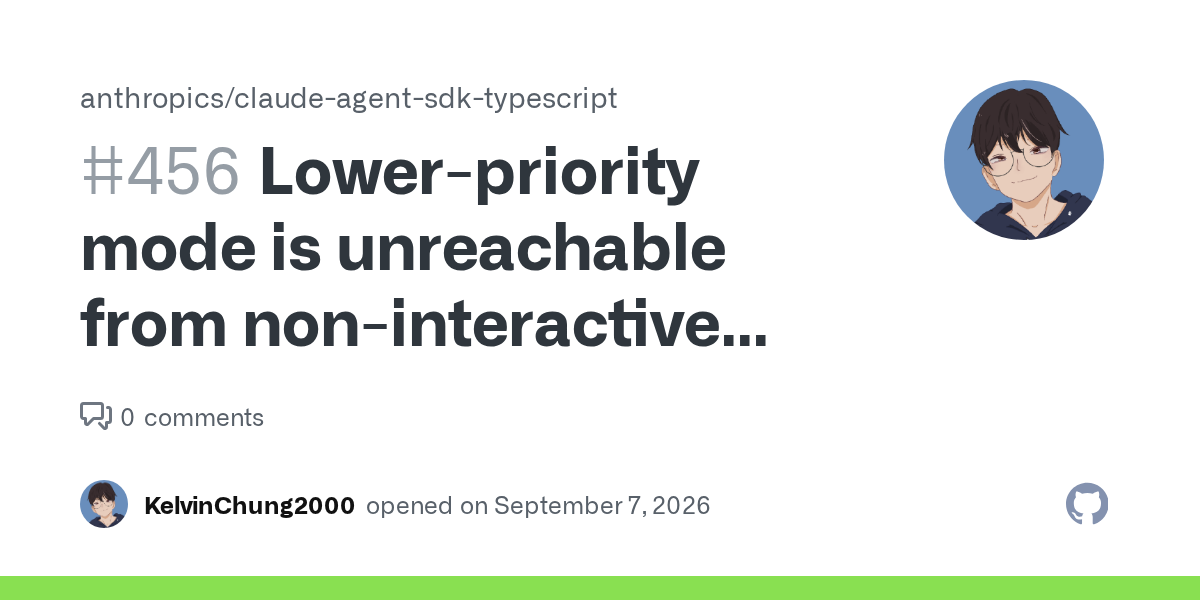
In Claude Code, as observed on CLI version 2.1.263, there is a hidden /low-priority mode: when the 5-hour limit is exhausted, the terminal offers “Continue now at lower priority,” and requests continue to run in a low-priority queue when Anthropic has spare capacity. The command is not visible when cycling through commands — it is declared with the flags supportsNonInteractive: false and isHidden: true, is available only in an interactive terminal, and, according to the post, is enabled by a server-side flag for not all accounts. The mechanism’s existence is independently confirmed by open issue #456 in the anthropics/claude-agent-sdk-typescript repository: the mode cannot yet be invoked from the SDK or non-interactive sessions.

What happened
A check on CLI 2.1.263 showed that after the 5-hour usage limit is exhausted, the terminal offers to continue via “Continue now at lower priority” or the /low-priority command. Requests accepted this way are not dropped; they enter a low-priority queue and run in the gaps when Anthropic has spare capacity. The mode has its own lower-priority allowance, and requests spent in it consume the weekly limit as regular usage. The mechanism is also visible from the SDK side: the T3 Code team in issue #456 describes that the lowPriorityOffer field arrives in the SDK via rate_limit_event, but the mode cannot yet be invoked from non-interactive and SDK sessions, so the authors are asking for access to it.
Context
The documented Claude Code limits model is based on 5-hour usage windows and weekly limits, as described in the Anthropic help center. The /low-priority mode fits into this model as an additional path: instead of waiting for the next window, an interactive user can move to a low-priority queue. The command’s hidden status and the server-side flag point to a gradual rollout: the mode’s absence on some accounts is an expected state, not a bug, so generalizing “the feature is available to everyone” from a single observation would be incorrect. The gap is also visible in the SDK: the autoContinueAtUsageLimit flag exists there, but there is no lower-priority counterpart yet.
Why this matters for the industry
For the industry, this is a practical shift from a hard reset at the 5-hour window to load prioritization within subscription limits: peak load is smoothed by a queue on spare capacity, and the limit stops being a binary refusal and becomes managed degradation. The “offer instead of hard stop” scheme is a ready-to-borrow template for products working with inference quotas. At the same time, issue #456 highlights the growing gap between the interactive CLI and SDK automation: production pipelines cannot yet use the queue. If Anthropic responds to T3 Code’s request with a setting like autoContinueAtUsageLimit for lower priority, background agents and CI pipelines will get a legitimate way to survive limits without failures — this is an interpretation, not a confirmed plan.
Why this matters for users
If you have hit the 5-hour Claude Code limit, check whether a dialog offering “Continue now at lower priority” or the /low-priority command has appeared: it lets you continue working immediately, without waiting for the window reset. The cost is being placed in a queue on spare capacity, a separate lower-priority allowance, and consuming the weekly limit as with regular usage. On some accounts the mode simply does not exist due to a server-side flag, and in the SDK and non-interactive sessions it is unavailable, so it cannot yet be relied on for automation.
What is still unknown / limitations
The observation is based on a single author and one CLI version, 2.1.263. Queue behavior is nondeterministic and undocumented: a request may be processed immediately or may wait for spare capacity, and the delay cannot be predicted. The size of the lower-priority allowance is not disclosed, and the interpretation of weekly-limit consumption is the post author’s interpretation. The scale of the server-side flag rollout across accounts is unknown. Anthropic has not yet responded in issue #456 to T3 Code’s request to open access from the SDK, so the timing and format of a resolution remain unknown.
Sources
- Lower-priority mode is unreachable from non-interactive and SDK sessions · Issue #456 · anthropics/claude-agent-sdk-typescript
- Models, usage, and limits in Claude Code | Claude Help Center (Anthropic)
Author
Look at AI, editorial team