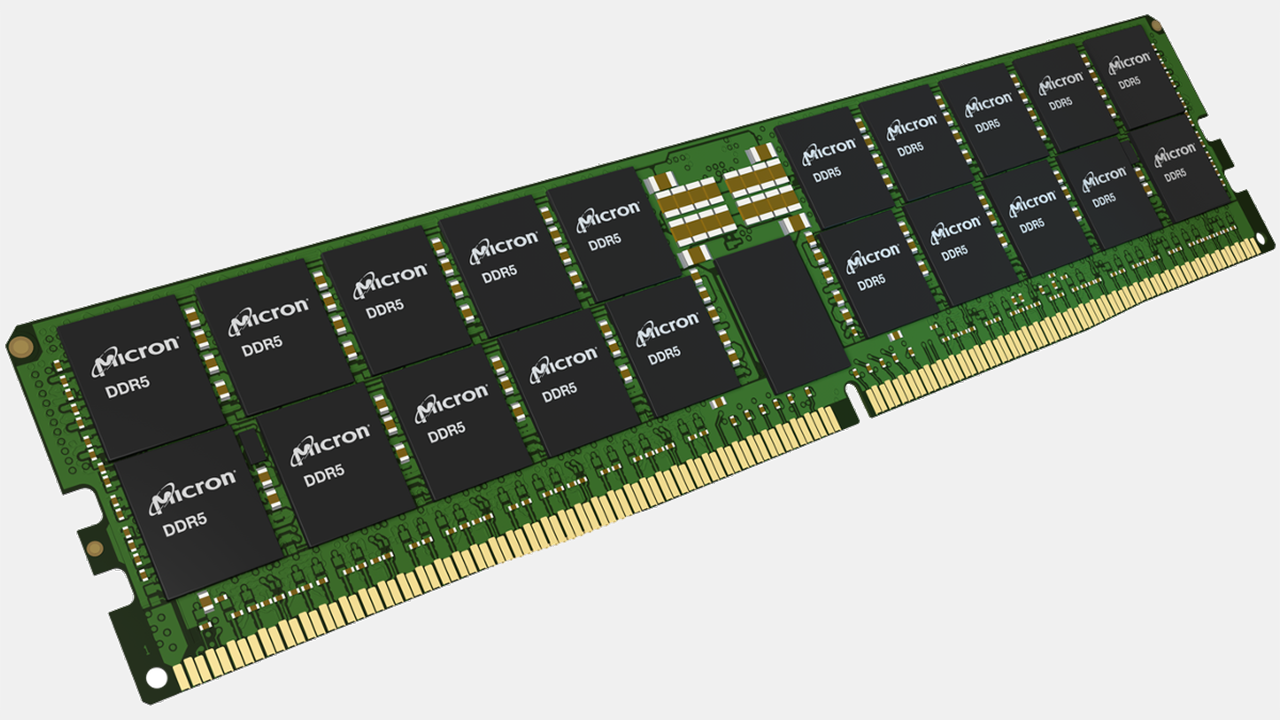
Micron demonstrated the world's first 512 GB DDR5 RDIMM server module, designed for data transfer rates up to 9200 MT/s. The record capacity is achieved through vertical stacking of DRAM dies connected by through-silicon vias (TSV). AMD and Intel are already validating the module on their server platforms, and mass production is planned for the second half of 2027.

What happened
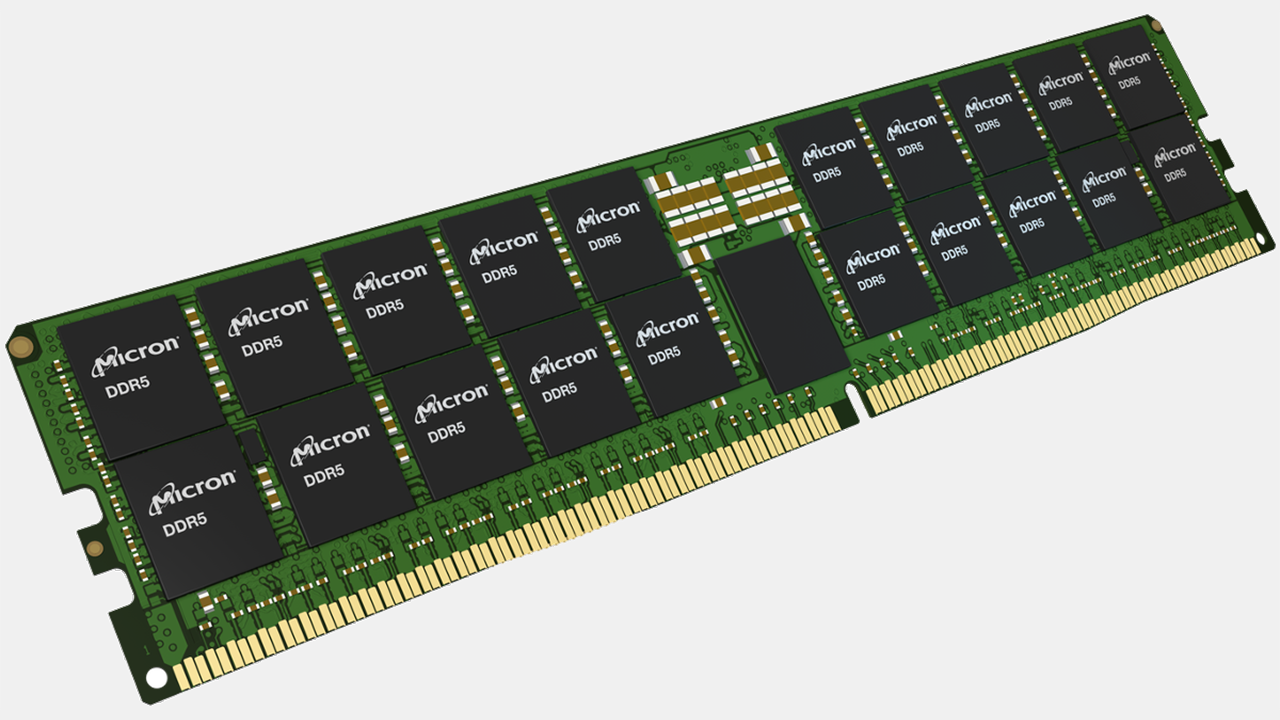
Micron showed the world's first 512 GB DDR5 RDIMM server module with speeds up to 9200 MT/s. The record DDR5 capacity is achieved through vertical stacking of DRAM dies connected via TSV (through-silicon via) — through-silicon vias, i.e., vertical inter-layer connections within the die. In a standard server with two processors and 24 slots, such modules provide up to 12 TB of RAM. According to Micron's own measurements, one 512 GB module consumes 16 W compared to 44.2 W for four 128 GB modules — more than 60% less at the same total capacity. On memory-bound tasks, the company reports up to a 1.4× performance increase in Spark analytics on the SVM workload compared to configurations with 256 GB modules, and also cites benefits for RocksDB and Redis.
Context
Today, mass-market DDR5 RDIMM server modules are produced in capacities up to 256 GB, so Micron is doubling the capacity of a single module. From a scientific standpoint, the novelty is moderate: this is a packaging innovation, where TSV serves as a way to vertically connect DRAM dies and double module density, rather than a new memory cell type or a new process node. The engineering result is nonetheless significant — for the first time, the capacity of a single RDIMM has been brought to 512 GB. The credibility of the claim is bolstered by the fact that the module is undergoing platform validation by AMD and Intel, and the project mentions the involvement of JPMorganChase. The key economic logic of the new product is improving the metric of "watts and slots per terabyte of RAM," which underpins the cost of server configurations with large memory volumes.
Why this matters for the industry
Doubling the capacity of a single RDIMM while reducing power consumption by more than 60% changes the economics of servers for LLM inference, agentic systems, and in-memory databases. Up to 12 TB of RAM in a standard 2-socket chassis allows large datasets and the state of agentic systems to be kept in DRAM without accessing slower storage tiers, making the "entire knowledge base in memory" architecture practically achievable. One 512 GB module instead of four 128 GB modules saves both energy and slots, reducing the base cost of a node and simplifying platform design. The involvement of AMD, Intel, and JPMorganChase confirms that major platform manufacturers and institutional users are viewing such memory density as a real development vector, not a marketing demonstration sample.
Why this matters for users
If you are calculating the cost of RAM population for a server for inference or a Spark cluster, the key date is the second half of 2027, when mass production is planned. Even now, when designing new server nodes, it is reasonable not to fix the configuration of "four 128 GB modules per unit of volume," but to plan for a variant with fewer slots for a large volume: one 512 GB module saves both watts and slots, and AMD and Intel promise compatibility with future server platforms. It is still too early to buy or plan deployment: validation is not complete, and prices are not available. In the coming months, expect interim validation results from AMD and Intel, and if Micron publishes its measurement methodology, it will be possible to independently verify the 1.4× figure on Spark and the 16 W figure.
What is still unknown / limitations
The key figures — up to 1.4× on Spark and 16 W per module — were obtained by Micron itself, and the conditions of the power consumption measurement (idle, typical load, or maximum) are not disclosed in the sources. The Spark test methodology, dataset sizes, and baseline configuration have not been published, reproducibility has not been confirmed, and there is a risk that a winning scenario was chosen where memory is inherently the bottleneck. The positioning of "up to 12 TB of RAM changes the class of product architectures" is a vendor pitch, not independent verification. AMD and Intel validation is not complete, prices are not disclosed, the mass-produced product will not appear before the second half of 2027, and the real effect will depend on prices, the yield of good dies in TSV packaging, and the final platform specifications.
Sources
- Micron: press release Micron Advances Memory Innovation With the World's First Ultra-Dense Module for Next-Generation Servers
- Tom's Hardware: Micron announces 512GB DDR5-9200 memory modules with 16W power draw
- TechPowerUp: Micron Develops 512 GB DDR5 RDIMM Server Memory Reaching 9200 MT/s
Author
Look at AI, editorial team