
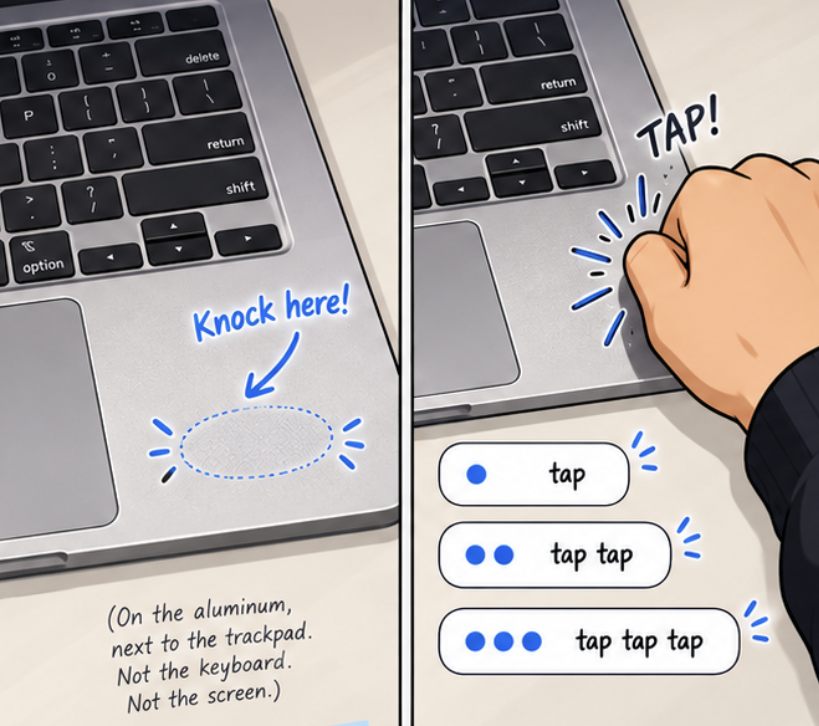
Developer jaskirat released MacTap 2.1.0, a free open-source menubar app for macOS under the MIT license. The app recognizes one, two, or three taps on a MacBook case and performs assigned actions, and recognition works entirely on-device, without network or account.
What happened
Release v2.1.0 came out on September 8, 2026, and on September 9, within the first four hours after launch, the app page reported 5,214 downloads; the jaskirat1616/mactap-app GitHub repository had 210 stars at the time of publication. You can assign copy, paste, screenshot, Lock Screen, running shell commands and AppleScript, as well as accepting and rejecting AI prompts in Cursor and Claude Code to a gesture. The app works on MacBooks with M2 and newer chips, as well as M1 Pro, Max, and Ultra, where the case accelerometer is visible as an SPU HID device; the original M1 Air (MacBookAir10,1) is not supported, and the minimum system version is macOS 14.6.
Context
The gesture as a control method is familiar to iPhone owners: Apple offers the closed Back Tap feature, where a user cannot bind their own automations to the gesture. MacTap relies on a similar hardware idea, but on the macOS side: on Apple Silicon chips, the case accelerometer is available to programmers as an SPU HID device, and its signal is converted into an arbitrary input event. Essentially, this is an engineering integration of an existing hardware feature: the developer materials contain no ML model, no description of the recognition algorithm, and no benchmarks, and no server infrastructure is required.
Why this matters for the industry
For automation developers, MacTap elevates the case accelerometer to the rank of a programmable physical interface: unlike the closed Back Tap on iPhone, on macOS you can bind almost any automation to a gesture. The tap recognition layer becomes a freely available part of the stack, since the code is open, the license is MIT, and processing does not require servers, and value shifts upward, to the layer of ready-made scenarios and gesture presets. This is a reproducible pattern of a cheap on-device interface, where all processing of a physical gesture is closed locally, without APIs and maintenance costs.
Why this matters for users
If you have a MacBook on M2 or newer, or M1 Pro/Max, and macOS 14.6 or higher is installed, the barrier to entry is minimal: download v2.1.0 from GitHub, grant Accessibility permission, and assign taps to your actions. Examples in the materials include one tap for a screenshot, two for Lock Screen, and a tap on the left part of the case to run your own shell script. The app is free, open source, and works offline, without an account.
What is still unknown / limitations
There are no independent measurements: latency, recognition accuracy, and false trigger frequency are not documented, and a description of the algorithm is absent from the materials. The figures of 5,214 downloads in the first four hours and 210 stars on GitHub are taken from the developer's own sources, so this is an indicator of hype, not a quality assessment. The solution is platform-fragile: everything relies on the availability of the accelerometer as an SPU HID device, and Apple may change access in future versions of macOS. Moreover, this is an integration of an existing hardware feature, not a new achievement in recognition, so the scale of impact on the industry is not yet confirmed.
Sources
- jaskirat1616/mactap-app — GitHub (README and MacTap 2.1.0 release)
- MacTap — official product page (mactap.vercel.app)
- MacTap announcement tweet from @jaskirat (launch)
Author
Look at AI, editorial team