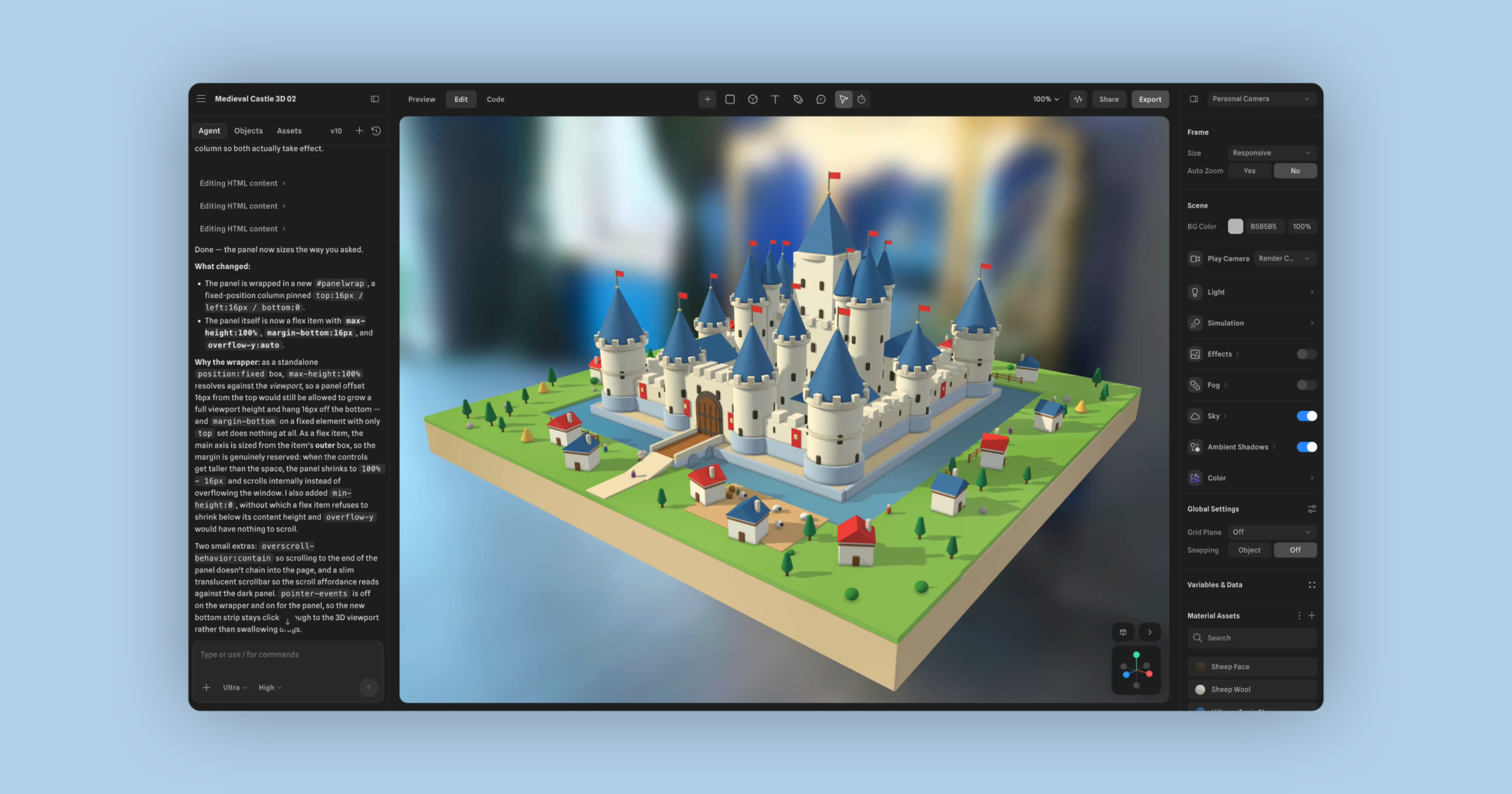
Spline has released V2 — a complete overhaul of its 3D editor, designed for working with AI agents. The default rendering now runs on WebGPU, WebGL remains a fallback, the built-in agent builds scenes using the same tools as a human, and third-party assistants connect to the editor via an MCP server. Everything is already available in the browser and in the desktop app for macOS and Windows.
What happened
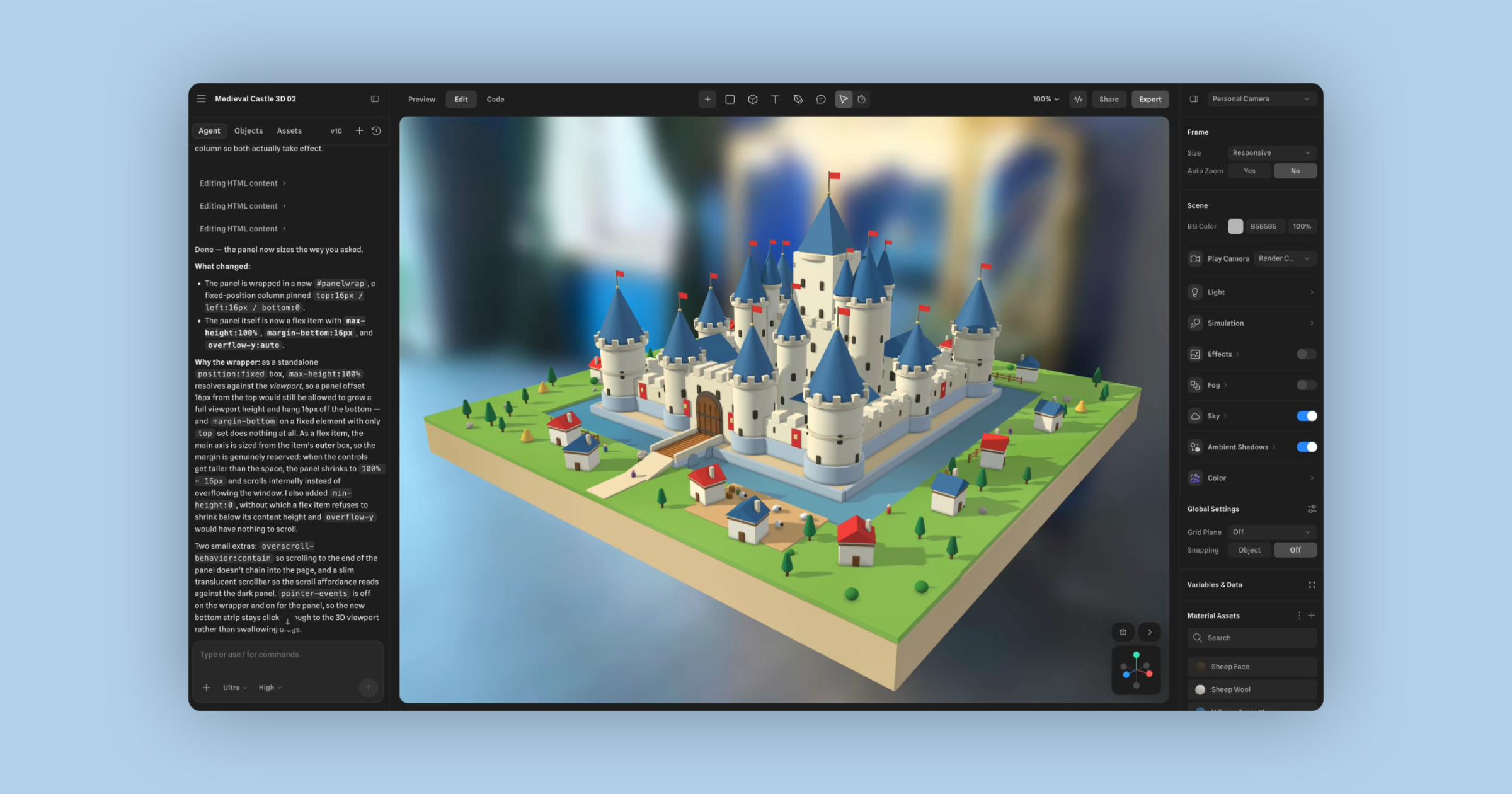
On August 20, 2026, Spline published the V2 release — a complete overhaul of its browser-based 3D editor. Default rendering has been moved to WebGPU, WebGL is retained as a fallback, and the graphics part has received a full PBR pass. The built-in Spline AI Agent works through the same editor tools as a human: it reads the scene, creates objects, materials, lights, cameras, particles, performs boolean operations, and configures sky, variables, and interactivity through events and states. The agent arranges objects using a constraint solver: instead of manual coordinates, it operates with relationships like "next to," "above," and "opposite." Code generated by the agent in HTML/JS connects to the scene via an HTML overlay with a bridge to 3D. Through the MCP server, third-party agents connect to the editor — Claude Code, Claude Desktop, ChatGPT, Cursor, VS Code, and Antigravity. Along with the release, a rebuilt desktop app for macOS and Windows with tabs and scene isolation was released.
Context
The key to understanding the release is the agentic architecture, not the graphics. Moving the default rendering to WebGPU aligns with the industry vector, and opening the editor to third-party assistants via MCP reflects a broader trend: creative tools are starting to work as servers to which universal AI agents connect. The actions of the built-in agent are observed directly in the familiar editor interface, not in a separate chat, which makes its work verifiable. The most interesting engineering decision is the abandonment of coordinates in layout: fragile numerical spatial reasoning has been moved out of the language model into a constraint solver, the model formulates a constraint in words, and the solver calculates the exact position of objects. The hybrid of a declarative scene and generated code complements the picture: the model moves to HTML/JS where it is inconvenient to describe the task with scene objects.
Why this matters for the industry
Spline V2 turns the editor into a tool that AI agents control with the same rights as a human: the same file can be opened by a human, built upon by the built-in agent, and expanded by a third-party assistant. This is a working "agentic" creative pipeline, not a demo, and a ready-made template for other design tools: the editor itself acts as an MCP server, so integration does not require a separate layer. WebGPU rendering, according to the developers' statements, reduces rendering overhead — heavy scenes with a large number of objects remain interactive directly in the browser, which paves the way for full-fledged 3D tools without installation. For startups, this is a signal that the production of interactive 3D content is becoming cheaper and faster. If the "editor as an MCP server" pattern becomes the norm for creative tools, the focus of development will shift from manual editing to orchestration and control: guardrails for agent edits, scene diffs, and automated tests of interactivity, and tools will compete on how conveniently they give themselves to agents — the completeness of MCP tools, the readability of the scene as a state, and declarative constraints.
Why this matters for users
Everything is already available without a waitlist. The editor opens in the browser at app.spline.design: in Chrome and Edge, rendering goes through WebGPU, in other cases WebGL is enabled. The desktop app for macOS and Windows is available for download. The built-in agent works directly from the Agent tab in the sidebar, and to connect an external assistant, it is enough to run it next to the desktop app — Spline finds supported AI tools itself, without configuration. A realistic application today is prototyping: the agent quickly assembles a scene, materials, lights, and simple interactivity, and a human polishes the result manually. The release claims can be checked by hand in about an hour, which is rare for "agentic" announcements.
What is still unknown / limitations
Claims about rendering speed and the reliability of the agentic workflow are not supported by published benchmarks: the phrasing about "interactive heavy scenes" and working "out of the box" are interpretations, not measurements, and until independent tests, they should be read as marketing. The mechanics of auto-detection of running AI tools and the agent's rights to the user's file are not documented — this is both a security issue and an unexplored surface. It is not described how the consistency of generated HTML/JS with the scene state is controlled during subsequent edits. The quality of the agent has not been moved to metrics, so everyone checks it on their own scenes.
Sources
Author
Look at AI, editorial team