A series of third-party tools has emerged around the open video model MiniMax H3, which generates clips up to 2K and 15 seconds long with native stereo sound. The VDN-Minimax-H3 distillate creates a 14.4-second 768p clip in 11.23 seconds on eight NVIDIA B200 accelerators in FP8 — faster than the video itself. The TensorRT version of the VAE speeds up decoding in ComfyUI by up to 1.7 times, while a patch for ostris ai-toolkit turns a control video into a frame-by-frame aligned V2V guide and compresses the text embedding cache by almost 90 times. However, the model's license is not valid in the US, the European Union, the UK, and South Korea.


What happened
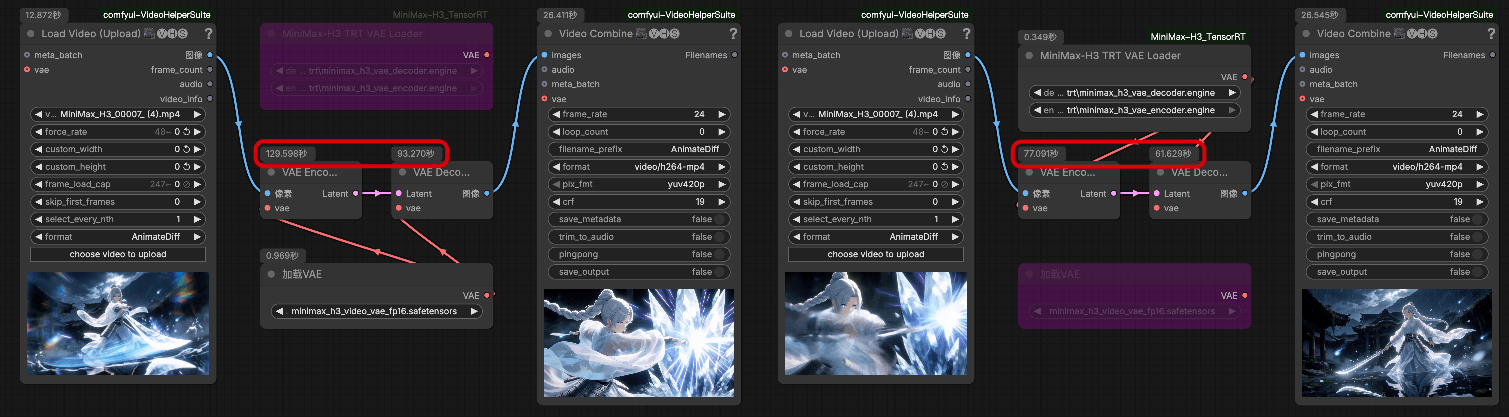
The GreenNeuralRobots channel published its fourteenth roundup of materials under the #minimaxH3 hashtag with links to third-party tools; all links have been checked and are working. The main release in the roundup is VDN-Minimax-H3 from OpenVDN: a hybrid linear + softmax attention architecture, where a linear attention branch and two LoRA adapters are added to the untouched backbone weights. According to the model card, the model generates a 14.4-second 768p clip in 8 steps in 11.23 seconds on an 8×B200 configuration in FP8, which is approximately 3 times faster than the dense H3 on a single GPU; the weights, about 82 GB in size, are available for public download. For ComfyUI, lihaoyun6 released ComfyUI-H3VAE_TRT — a TensorRT/ONNX version of the H3 VAE with decoding acceleration of up to 1.7 times; the project has gathered 162 stars, and the ONNX weight files are in the lihaoyun6/MiniMax-H3-VAE-ONNX repository. In addition, alisson-anjos published a patch for ostris ai-toolkit with the align_video_refs and control_latent_only flags: the control video becomes an aligned V2V guide, where guide frame i controls output frame i, and the control_latent_only mode reduces the text embedding cache from 84 MB to approximately 0.9 MB per sample. According to the model card, 114 LoRAs have already been published based on H3.
Context
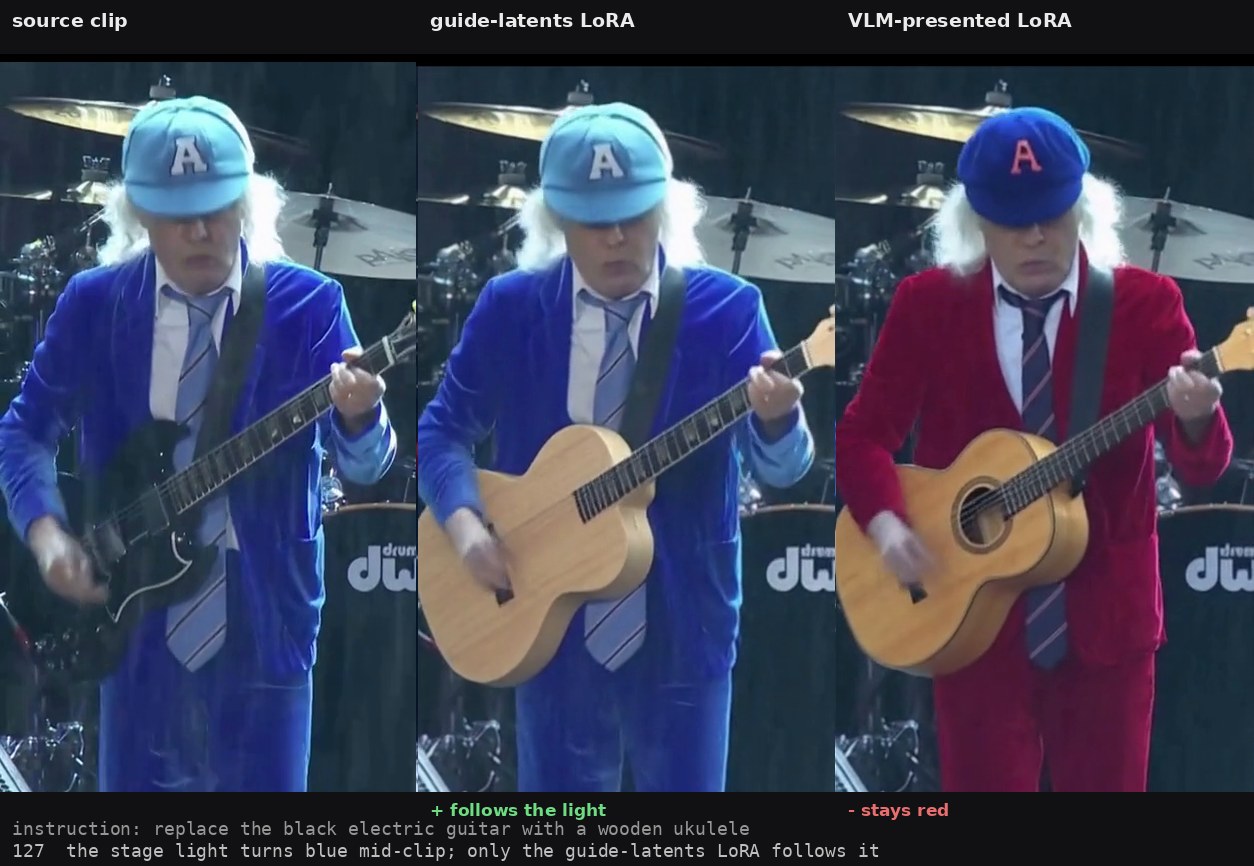
MiniMax H3 is an open video model that outputs clips up to 2K and 15 seconds long with native stereo sound. Around it, the classic open-model cycle is being reproduced: first, a distillate is released that reduces the number of diffusion sampling steps, then accelerated implementations of the VAE decoder, which converts latents into frames, and finally, a stream of LoRA fine-tunes — lightweight adapters for specific styles and tasks. The patch for ai-toolkit follows an IC-LoRA-style approach: the LoRA is trained on guide latents through a common rotary-clock, so the guide tracks lighting changes frame-by-frame and preserves embedded text, which can be seen in the examples in the gist; during inference of the trained model, the control video is resampled to 24 fps by the ostris node. A separate legal context: VDN-Minimax-H3 has a geographically restricted Community License — it is valid everywhere except the US, the EU, the UK, and South Korea.
Why this matters for the industry
It is indicative for the industry that the ecosystem reproduced the entire open-model cycle just days after the release of H3: distillation to 8 steps, decoder acceleration via TensorRT, and a stream of 114 LoRA fine-tunes. Generating 768p video faster than its own playback moves video diffusion from the "long render wait" category to interactive and real-time scenarios — this direction is demonstrated by the film-game interdimensional-game, where each frame is created on the fly. The control_latent_only mode reduces the cost of preparing V2V datasets to approximately 1 GB instead of 105 GB, lowering the barrier to entry for training video LoRAs. If the distillate's numbers are independently confirmed, it is likely that the pattern of "linear branch plus LoRA adapters with a frozen backbone" will be repeated for other open video backbones, and the combination of "8 steps plus TRT-VAE" will become the standard inference for H3-compatible pipelines. At the same time, the geographical restriction of the Community License directly affects who can legally use the weights and derivative products.
Why this matters for users
Everything in the roundup can be tried today. ComfyUI-H3VAE_TRT is installed as a custom node and provides up to 1.7 times decoding speedup, and a w4a16_awq decoder is provided for graphics cards with less than 12 GB of VRAM. LoRAs for VHS aesthetics and photorealistic close-ups Facial-Realism-CloseUp can be downloaded from Hugging Face, and the H3-LongVideos workflow is distributed as a ZIP archive via a direct link. For those who train LoRAs on video editing, the ai-toolkit patch is most useful: align_video_refs provides frame-by-frame V2V guide synchronization, where guide latents track light changes and preserve embedded text, and control_latent_only sharply compresses the embedding cache. The patch is enabled with two flags, and during inference of the trained model, the guide is resampled to 24 fps by the ostris node. The cost of the experiment drops to almost zero — in a day, you can test a product hypothesis on V2V control or a niche style.
What is still unknown / limitations
The flagship number of VDN-Minimax-H3 is a single self-reported measurement of one configuration: 8 steps, 768p, 14.4-second clip, 8×B200, FP8. There are no independent benchmarks on a single GPU and on consumer cards yet, nor measurements of the distillate's quality against the dense model, so a general ability of the model to such speed does not follow from a single measurement. The film-game interdimensional-game is a demonstration, not a measurement: the hardware, fps, resolution, and model version are not disclosed, so the real-time claim should be correctly considered a demonstration of a direction. The quality reduction in TRT-VAE is stated by the author but not quantified by metrics. Finally, the terms of the Community License should be checked according to the license text for a specific jurisdiction and use scenario, including derivative models.
Sources
- OpenVDN/vdn-minimax-h3 — Model Card (Hugging Face)
- alisson-anjos — MiniMax-H3 ref2va: aligned video guides (IC-LoRA style v2v) for ai-toolkit (GitHub Gist)
- lihaoyun6/ComfyUI-H3VAE_TRT — TensorRT VAE for MiniMax-H3 in ComfyUI (GitHub)
Author
Look at AI, editorial team