
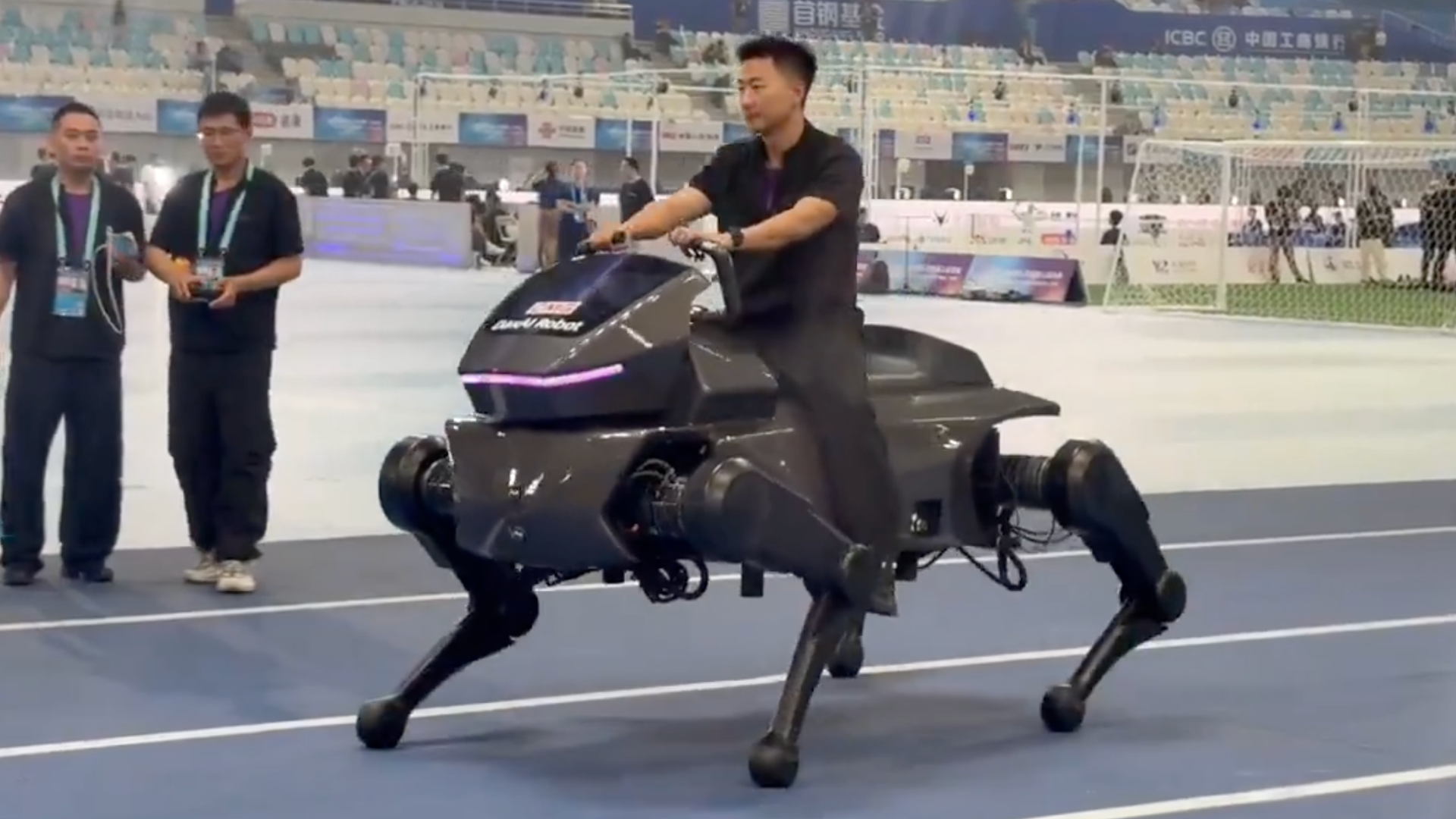
China's DaxAI Robotics unveiled the Qiji X1 quadruped robo-horse with a saddle and steering wheel at the World Robot Conference in Beijing and opened pre-orders for the first batch through the JD.com marketplace. The price is around 289,000 yuan, or approximately $43,000. This is the first time a "robo-horse" can be actually ordered, not just seen in a demo.

What happened
The Qiji X1 weighs 300 kg and lifts the same amount of cargo, reaches 7–10 km/h, travels up to 40 km on a single charge, and operates for up to 10 hours from a high-voltage battery; the maximum joint torque reaches 1400 Nm. Movement is handled by the built-in DaxBrain-WM world model, which adjusts foot placement for slopes, gravel, and mud. In live demos, the robot walked straight, moved sideways, and turned in place. DaxAI signed a three-year agreement with JD.com: pre-orders for the first batch come with five years of free maintenance and updates, and mass production is scheduled for the end of the year. The lineup also includes the wheel-legged Qiji XS version and the heavy T1000 model.
Context
Riding quadrupeds have so far remained a showcase item: the Kawasaki Corleo exists only as a concept, and the DEEP Robotics robo-horse has only reached a limited series with a 50 kg payload. DaxAI's presentation is different because it is backed by a public price tag, a contract with a major marketplace, and a service package—signs of a production product rather than an exhibition stand. The niche the company is targeting is heavy walking platforms for off-road tourism, rescue operations, and infrastructure inspections. The purely walking design limits speed under load, so the wheel-legged Qiji XS hybrid appears to be an attempt to cover scenarios where walking alone is not enough.
Why this matters for the industry
For the industry, the signal is not the robot itself but the established commercial model: heavy walking platforms now have public price benchmarks, a sales channel through JD.com, and a long-term service package. This is the foundation for vertical products on such platforms, but the window for hardware differentiation is narrowing, and value is shifting to software, service, and operational data. Building third-party solutions on the Qiji is not yet possible: no access for external developers has been announced. The event does not affect the scientific landscape—there are no publications, datasets, or open benchmarks.
Why this matters for users
Now readers have a specific price tag and channel: transportation that doesn't need roads can be reserved like a regular product on a marketplace. The stated payload and range add up to a clear scenario—a two-person trip with gear into the forest and back without refueling or track preparation. For those who value speed more, the Qiji XS is worth looking at: 320 kg, up to 40 km/h, and 60 km range for around 359,000 yuan, which is already at the level of an ATV. This is still a reservation, not a purchase: there is still waiting for serial deliveries.
What is still unknown / limitations
All Qiji X1 specifications come from DaxAI and are reported by the media: there are no independent measurements, and the conditions under which the mass, speed, and autonomy are stated are not disclosed. DaxBrain-WM is described in a single phrase—without architecture, training data, or comparison with classic MPC and RL controllers, so it is too early to call it a world model in the scientific sense. The demonstrated set of skills is basic locomotion for modern quadrupeds; no one has shown prolonged operation under full load on rough terrain. There is no data on reliability, failures, or joint wear, and the mass production timeline remains a company statement that needs to be confirmed by the first deliveries.
Sources
- Interesting Engineering — report from the World Robot Conference in Beijing
- Futura-Sciences — review of the Qiji X1 robo-horse
- Wedoany — on the DaxAI and JD.com agreement
Author
Look at AI, editorial team