
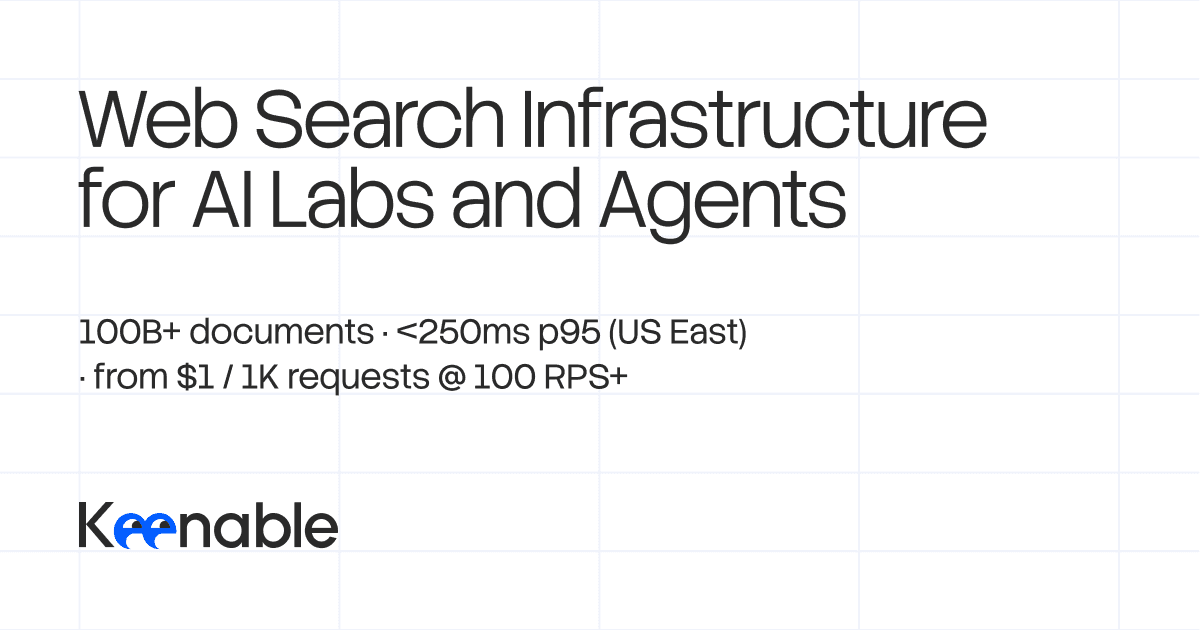
Startup Keenable has emerged from stealth and announced a $26M seed round led by Accel, with participation from Conviction and angels from Google, xAI, NVIDIA, Amazon, and Hugging Face. The company is building a search index of 100+ billion documents specifically for AI agents and claims query latency of under 250 milliseconds.

What happened
Keenable's founders are Andrey Styskin, former head of search and advertising at Yandex with a business of approximately $2 billion, and then director of web infrastructure at Amazon AGI, and Matthias Petri, former Principal Applied Scientist at Amazon AGI who worked on web grounding for Alexa. According to TechCrunch and the official website, the search is already running in production at several AI labs and inference providers. The service is available via the MCP endpoint api.keenable.ai/mcp, public pricing starts at $1 per 1,000 requests at a load of 100+ RPS, and after registration on keenable.ai, 100,000 free requests are issued. On the open NEEDLE benchmark (keenableai.github.io/needle), Keenable compares itself to serper, Exa, Tavily, Perplexity, and Parallel, claiming the best ranking quality at the lowest public price in the niche.
Context
The event is taking place against the backdrop of the winding down of Google Custom Search and Bing Search API, which left AI agent developers with almost no web-scale search APIs. Keenable is entering this niche alongside Exa and Brave Search API and stands out by offering on-prem deployment for labs and point-in-time search Time Machine, where the query_time parameter rewinds both the corpus and ranking to a specified point in time. The company's stated strategy is to build indexes for specific agent tasks rather than human queries, an attempt to outcompete Google on price specifically for agent queries.
Why this matters for the industry
For product teams, Keenable becomes a ready-made building block: native MCP integration through the search_web_pages and fetch_page_content tools allows connecting search to an agent in minutes. The public price anchor of $1 per 1,000 requests puts pressure on the entire search API segment for agents and forces Exa, Brave Search API, Tavily, serper, and Perplexity to respond on price or latency. On-prem deployment opens the API to labs that cannot send requests to external clouds, and the NEEDLE benchmark becomes the first open comparison of 'quality and price' in the niche: if it becomes widely adopted, the agent search market will begin to be compared by transparent metrics rather than marketing claims.
Why this matters for users
Any reader can register on keenable.ai, get 100,000 free requests, and connect search to their own agent through the MCP tools search_web_pages and fetch_page_content. On the free limit, you can measure latency and quality on your own queries and use Keenable as a cheaper alternative or fallback for serper and Exa in a prototype. Moving to production immediately is premature: a vendor benchmark does not replace your own quality assessment on your tasks.
What is still unknown / limitations
The claim of SOTA ranking quality relies on the single NEEDLE benchmark, compiled by the vendor itself: the composition of queries, metrics, and methodology for comparison with serper, Exa, Tavily, Perplexity, and Parallel are not disclosed, so the result cannot be independently reproduced. Technical details of the index and ranking are also not published: the type of retrieval, embedding and ranking models, and the update and freshness scheme of the corpus remain closed. The latency of under 250 ms is claimed only for p95 in the US East region — there is no data for other regions, for loads above the stated 100+ RPS, and for latency dynamics as the corpus grows. Finally, the figure of '100+ billion documents' is not accompanied by disclosed metrics of coverage, deduplication, and freshness, and for agents that depend on data currency, corpus freshness is more important than raw volume.
Sources
- TechCrunch: Accel-backed Keenable is indexing the web for AI agents
- Keenable — official website
- NEEDLE — open search quality and price benchmark from Keenable
Author
Look at AI, editorial team