
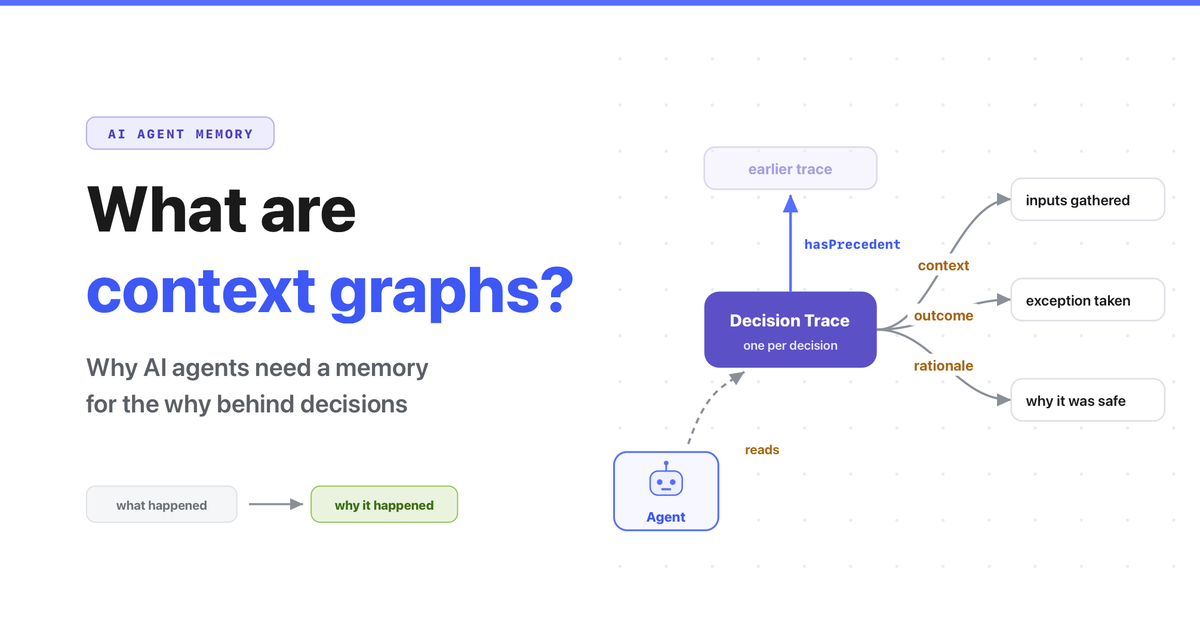
The new Context Graphs concept proposes a shift from simple fact storage to capturing decision-making logic, allowing AI agents to not only know "what" happened but also understand "why" a particular choice was made.
What Happened
Context Graphs technology has been introduced, which structures the memory of AI agents through nodes (entities) and edges (relationships). Instead of using the "flat" context characteristic of standard RAG, this approach creates "decision traces," allowing agents to quickly retrieve logic and account for exceptions.
Context
Traditional retrieval methods (RAG) often face the problem of data loss in the middle of the context window and do not provide an understanding of cause-and-effect relationships. This leads to modern agents making mistakes due to a lack of deep contextual understanding, despite having access to data.
Why It Matters for the Industry
For the industry, this means a transition from simple document retrieval to creating reliable systems with "logical memory." Using graph structures allows for a reduced need for constant fine-tuning to update business logic and lowers latency and cost by replacing complex agentic search loops with structured data retrieval.
Why It Matters for Users
Users will get more predictable and autonomous assistants that understand the rules of the game and accumulated experience, rather than just quoting instructions. This will solve the problem of AI "freezing" and errors caused by a misunderstanding of situational context.
What Is Not Yet Known / Limitations
At the current stage, the technology is a conceptual research shift, requiring the implementation of specialized graph databases or new indexing schemes for effective use in real-world services.
Sources
Author
Look at AI, Editorial Team