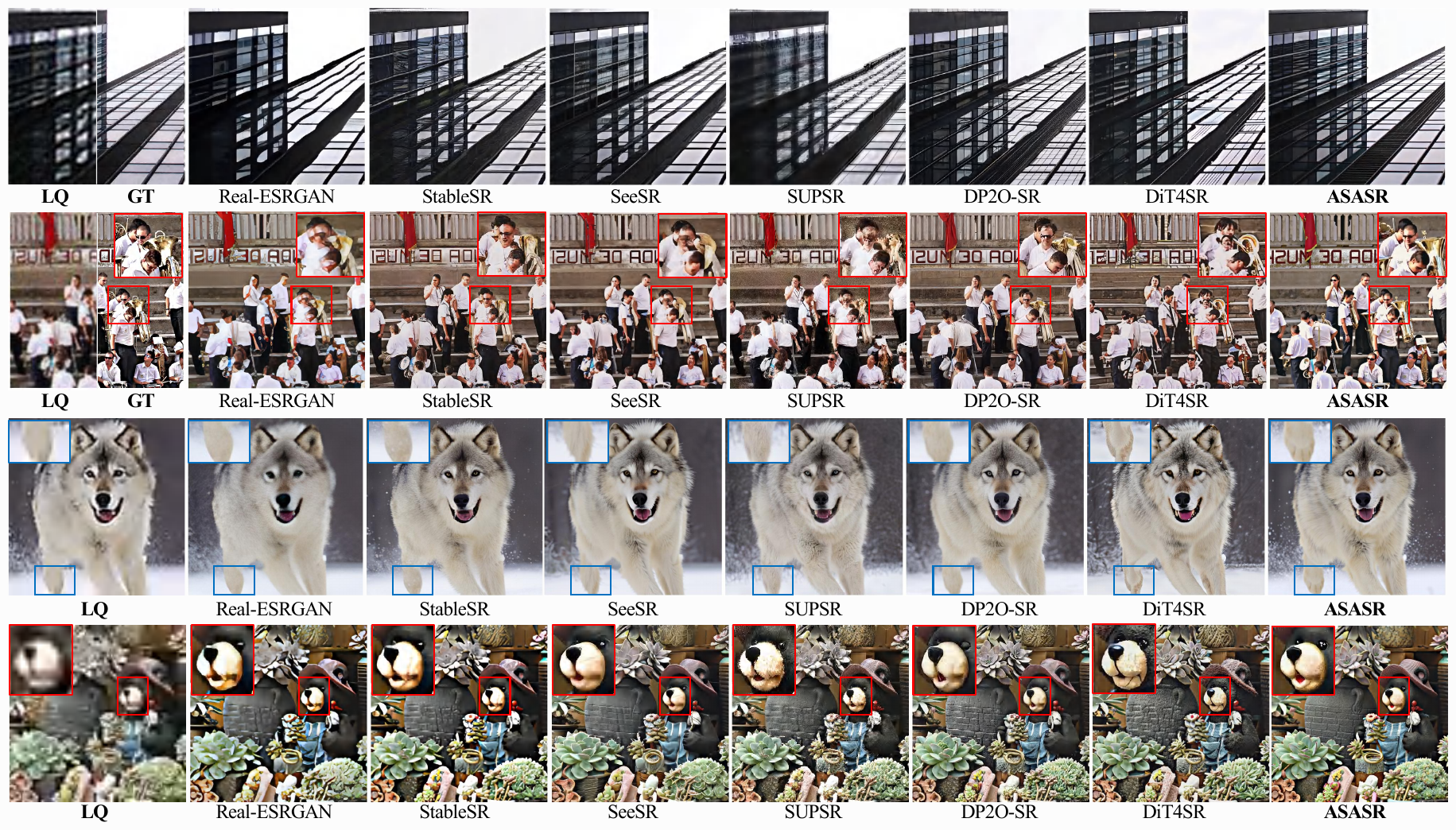
Presented at the ICML 2026 conference, ASASR is an innovative image super-resolution method that addresses the problem of visual hallucinations during upscaling. By leveraging the FLUX.1-dev architecture and mathematically grounded spectral characteristic alignment, the method achieves 4x upscaling with a high degree of detail fidelity.


What Happened
The ASASR (Adversarial Sobolev Alignment for Faithful Image Super-Resolution) method has been developed, based on the FLUX.1-dev architecture. The process involves using Dual-LoRA: a base SR-LoRA restores the general structure, while a specialized AS-DPO LoRA suppresses artifacts and hallucinations. The key technology is adversarial Sobolev alignment and the application of spectrally colored noise for accurate texture reproduction.
Context
Traditional generative upscaling methods often "invent" details, creating unnatural textures (the "smoothed skin" effect or blurred natural objects). ASASR overcomes this limitation by relating the generative process to the statistics of natural images at the spectral level through mathematical alignment of spectral characteristics of noise.
Why It Matters for the Industry
The method offers a new approach to training diffusion models by using adversarial generative models (AMG) to generate complex negative examples within the DPO (Direct Preference Optimization) framework. This paves the way for creating highly reliable restoration and upscaling pipelines that minimize visual distortions and allows for the integration of similar alignment methods into standard model training cycles.
Why It Matters for Users
Users gain the ability to increase image resolution by 4x without losing texture plausibility. Skin, fabric, and natural objects look natural and detailed rather than blurred or unnaturally smoothed. The availability of the method in the form of ready-to-use LoRA weights simplifies its implementation into existing FLUX.1-dev-based workflows.
What Is Not Yet Known / Limitations
For full-scale industrial implementation (production-ready), additional data regarding latency and inference costs are required.
Sources
Author
Look at AI, Editorial Staff