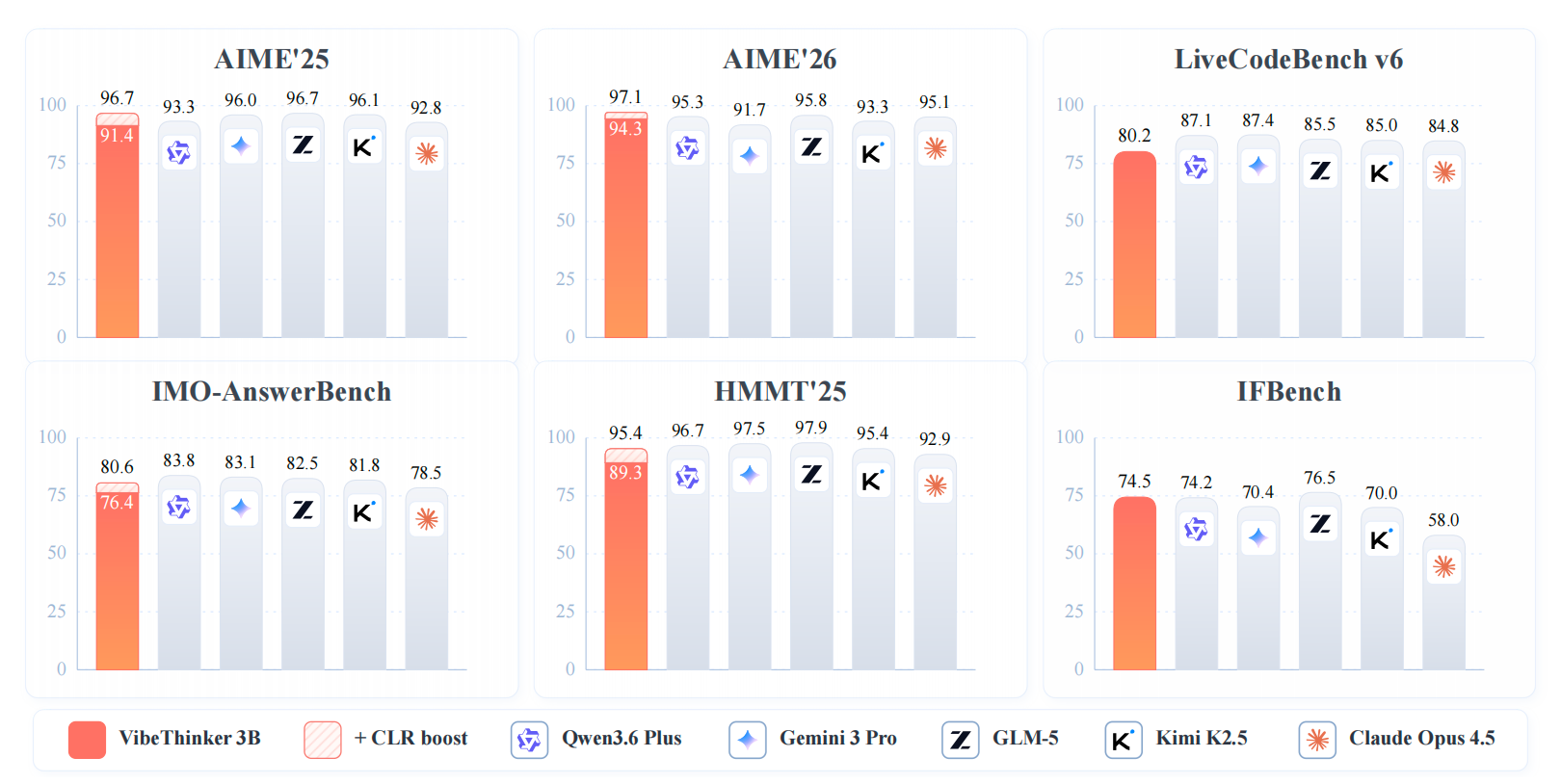
WeiboAI has introduced VibeThinker-3B — a compact 3-billion parameter language model capable of demonstrating reasoning levels comparable to flagship systems in specialized STEM tasks.


What Happened
Built on Qwen2.5-Coder-3B, the VibeThinker-3B model utilizes the Spectrum-to-Signal Principle (SSP) training method and the Claim-Level Reliability Assessment (CLR) testing strategy. This has allowed it to achieve outstanding results on Olympiad benchmarks: 97.1 on AIME26 and 95.4 on HMMT25.
Context
VibeThinker-3B is part of the growing trend toward extreme specialization of Small Language Models (SLMs). Instead of striving for universality, these models focus on tasks with verifiable outcomes, such as programming, mathematics, and other STEM disciplines.
Why It Matters for the Industry
The release of this model proves that high-quality reasoning can be achieved within ultra-small parameter counts. This radically reduces the cost and computational resource requirements (TCO), enabling the creation of high-precision specialized tools instead of relying on heavy and expensive cloud APIs.
Why It Matters for Users
For end users, this means the ability to run powerful "reasoning" AI agents locally on standard consumer hardware. This paves the way for integrating high-precision logic modules directly into workflows, such as IDEs or scientific software, without dependence on the internet or cloud providers.
What Is Not Yet Known / Limitations
The model is oriented toward verifiable tasks, making it ideal for coding and mathematics, but this may limit its effectiveness in creative or encyclopedic scenarios.
Sources
Author
Look at AI, Editorial Team