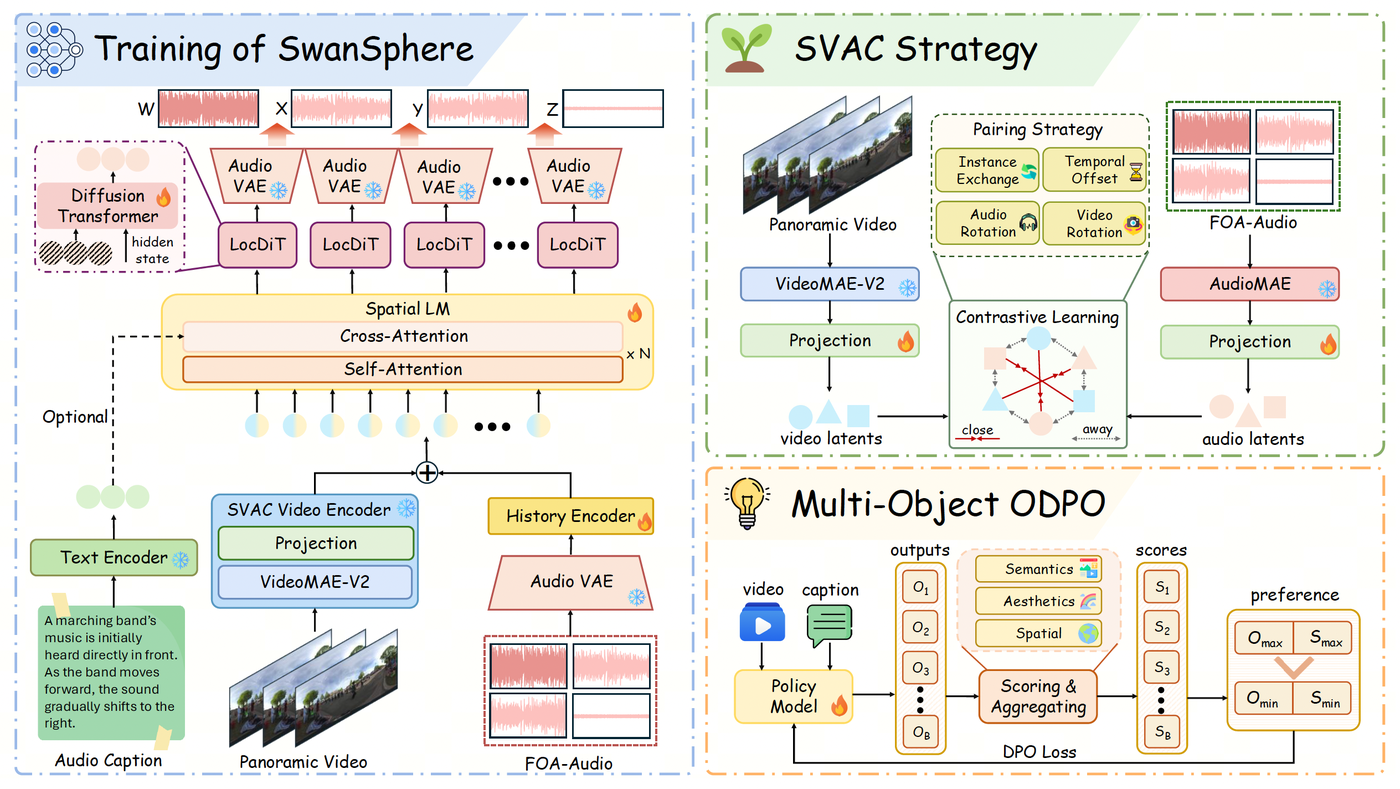
The SwanAIGC research group, a collaboration between specialists from ByteDance and Zhejiang University, has introduced SwanSphere—an innovative system for streaming spatial audio generation. The project, accepted to the ICML 2026 conference, utilizes a causal autoregressive diffusion transformer architecture to create high-quality volumetric sound in real-time based on text prompts or panoramic video sequences.

What Happened
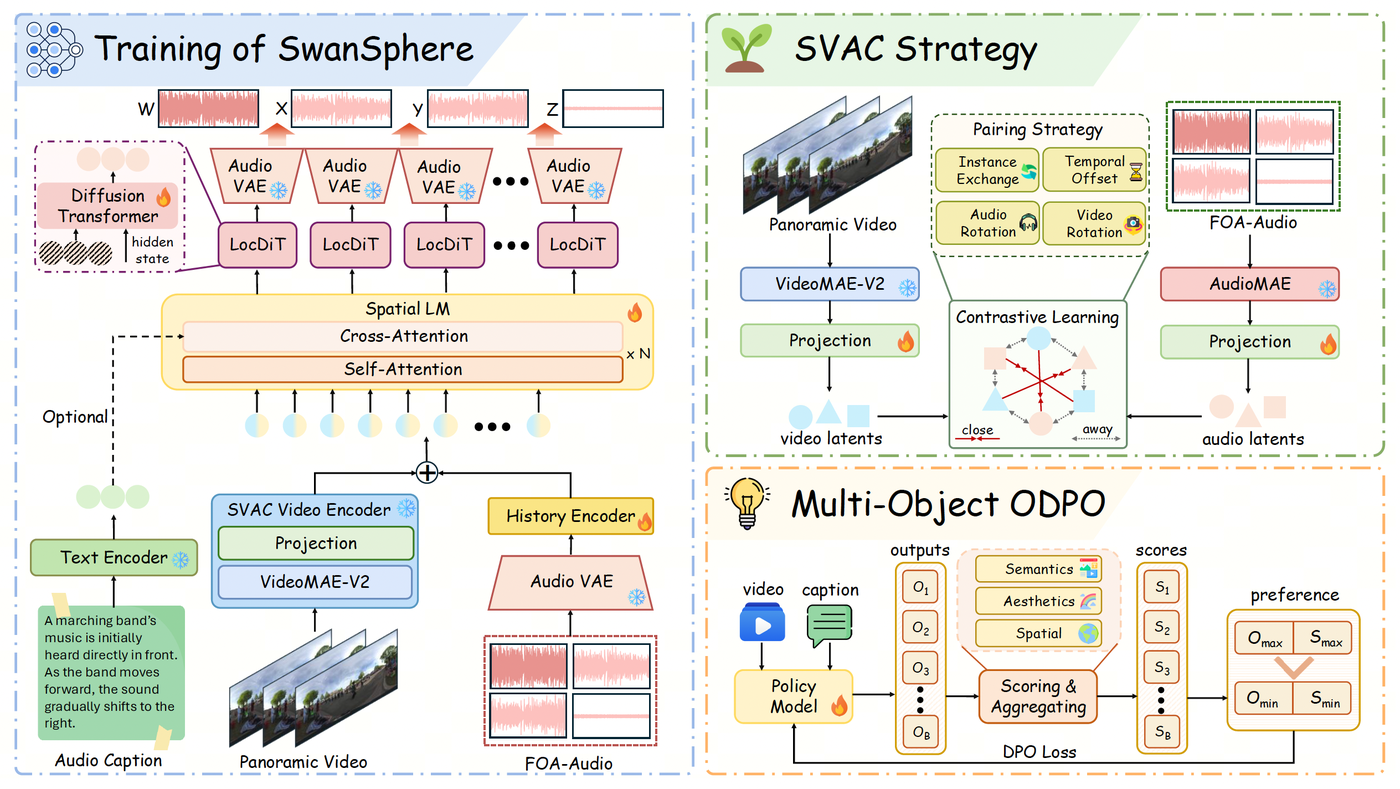
Developers presented SwanSphere, which addresses the task of synchronous audio and video generation. The system relies on a Causal Autoregressive Diffusion Transformer architecture and employs the SVAC (Spatial Video-Audio Contrastive) training strategy for precise audio-video synchronization. Additionally, to enhance the perceived quality of spatial sound, the Online Direct Preference Optimization (ODPO) method is applied.
Context
Traditionally, when generating volumetric sound, developers face a strict trade-off between high audio quality and inference latency. SwanSphere offers a new architectural approach, transforming complex spatial audio generation into an efficient streaming task, which is a significant step for multimodal generative AI.
Why It Matters for the Industry
For the industry, this means overcoming a fundamental latency barrier, opening possibilities for creating truly immersive VR/AR content with generative sound that works in real-time. The technology lays a new architectural foundation for multimodal research and could become a standard for foley sound generation in video content creation pipelines.
Why It Matters for Users
For end users, this represents a qualitative leap in digital content consumption: videos and virtual worlds will be able to sound volumetric and synchronized with the imagery, even if the sound is being created by a neural network "on the fly" from a text description or based on moving video footage.
What Is Not Yet Known / Limitations
At present, experts express skepticism regarding the technology's practical readiness for production deployment due to the lack of open-source code and detailed technical inference metrics, such as specific latency and throughput figures.
Sources
- SwanSphere: Towards Streaming Synchronized Spatial Audio Generation via Autoregressive Diffusion Transformer
- SwanAIGC Official Project Page
Author
Look at AI, Editorial Staff