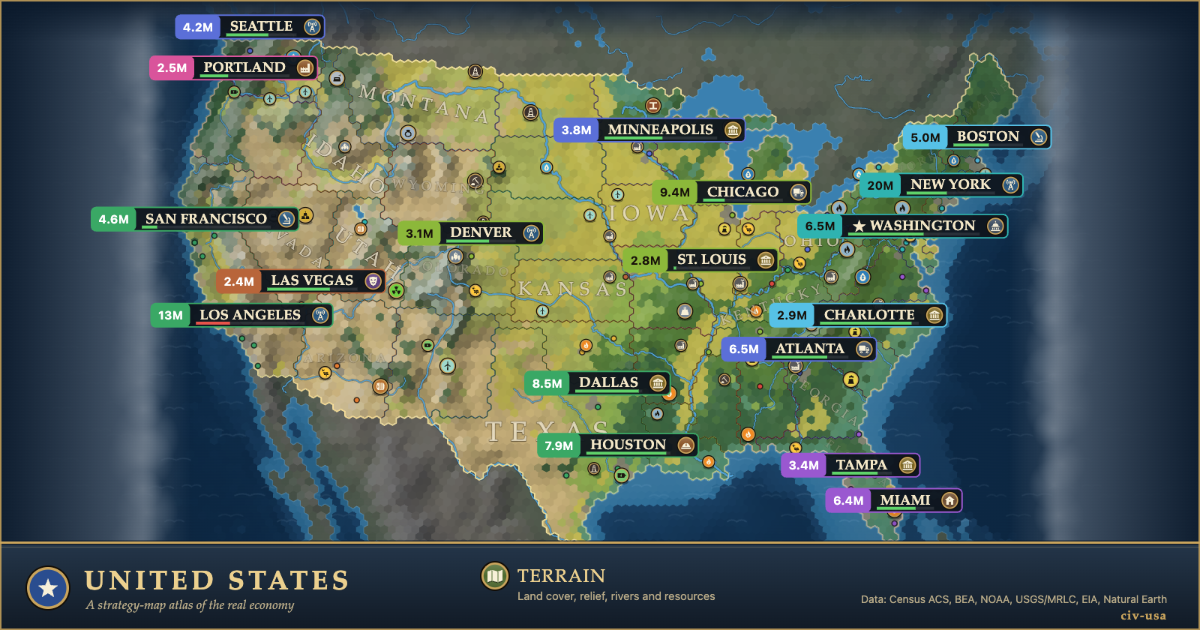
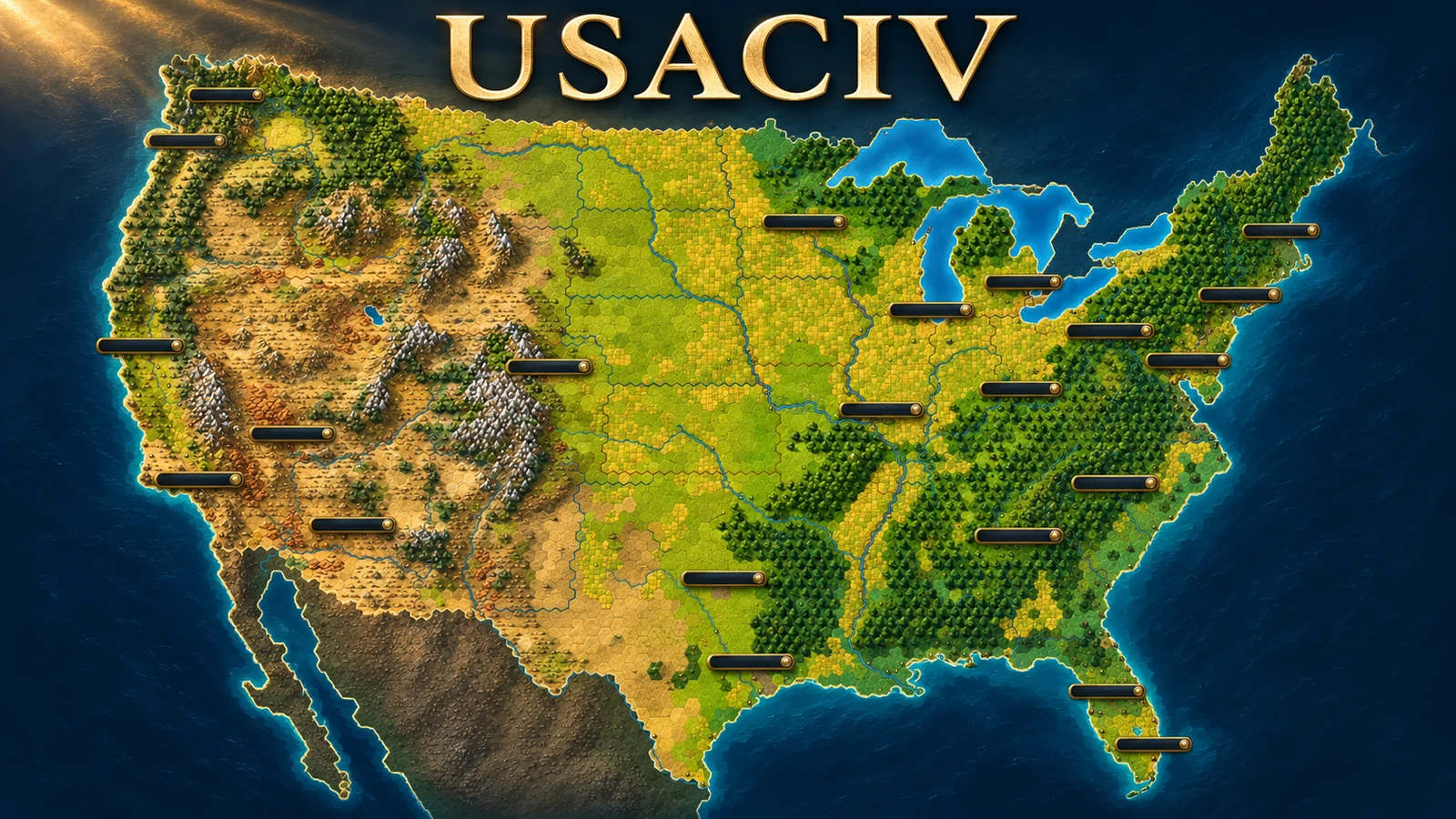
On November 26, 2026, Andrej Karpathy published usaciv, an interactive map of the United States in the style of a 4X strategy game like Civilization. The model Claude Opus 5.5 in Claude Code Desktop built it in a single autonomous session of approximately 7 hours, generating around 45,000 lines of code. The project is available in the browser without registration at karpathy.ai/usaciv, and the source code is available in the usaciv-source.zip archive under the MIT license.
What happened
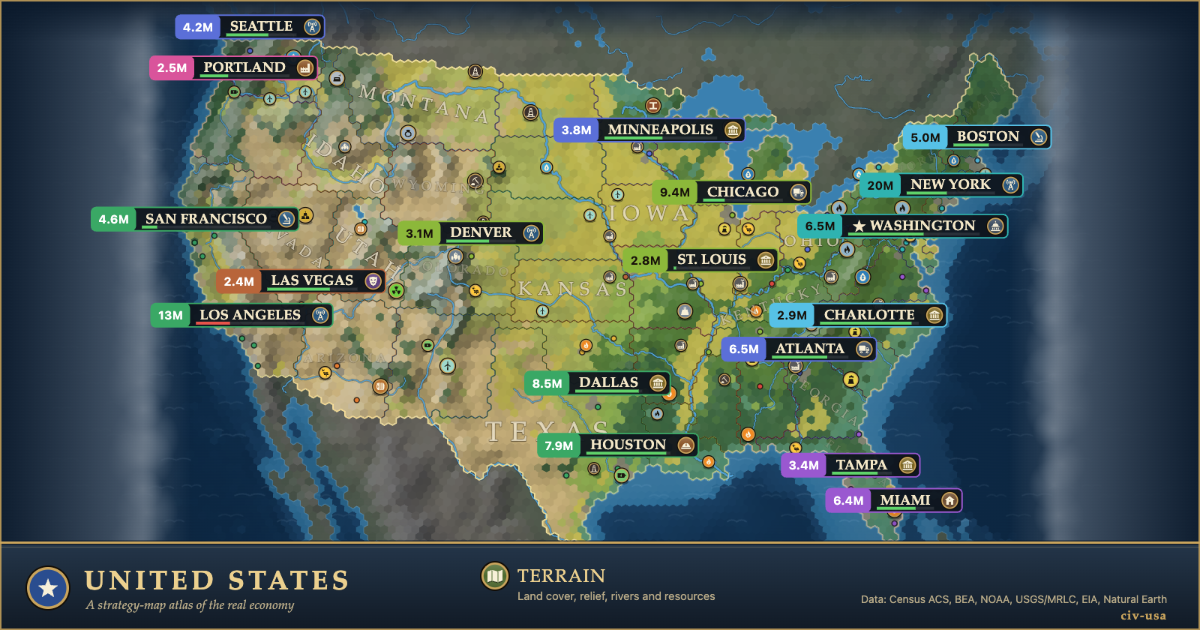
In usaciv, the US is laid out on a hexagonal grid with 25 km cells, onto which the AI itself downloaded and matched data from 31 government sources, including Census/ACS, BEA, BLS, EIA, NOAA, USGS, CDC, DoD, NPS, FAA, and FEMA. Cities received "districts" and specializations based on the real economy: San Jose is marked as a Tech City with a Campus district, while Detroit is a Motor City. The project features 19 thematic "lenses," 524 city profiles, 9 "advisors," and an Explorer tool that builds tables and charts for more than 3,100 counties. Karpathy clarified that the project took up about 50% of his weekly quota on a standard consumer Claude subscription and noted that the model "missed several states and territories."
Context
usaciv is not a scientific publication or a benchmark, but a demonstrative stress test of a frontier model's agentic mode: in a single session, the model had to complete the entire cycle from loading heterogeneous government datasets to a working web application. Such multi-hour autonomous sessions in Claude Code Desktop are becoming an increasingly prominent way to create analytical products, where the model itself finds sources, normalizes data to a unified schema, and designs the interface. Until now, there have been few public examples where a single agentic session produced a finished interactive application of this scale, making usaciv a public reference point for evaluating the capabilities of agentic code generation.
Why this matters for the industry
For developers of agentic pipelines, usaciv is public proof that a frontier model in agentic mode can produce a finished interactive product in a single session, not just a prototype. Karpathy explicitly states that the main problem is no longer generation, but verification: checking 45,000 lines of code and the consistency of 31 merged datasets takes more time than the generation itself, meaning the bottleneck has shifted from code creation to code verification. However, the project cannot be used directly in production: there is no API, SLA, or data on latency and load. Nevertheless, the MIT-licensed code provides a free reference pipeline for "31 datasets, unified schema, web application" and a lens UX pattern that can be adapted for custom data.
Why this matters for users
The map can be opened in a browser without registration and used as an analytical atlas of the US: switching lenses for income, education, and population, entering cities to view real employment metrics, and using the Explorer to build tables and scatter plots for 3,100 counties. For readers, this is a clear example of how "agentic" LLM sessions now provide not just demo scripts, but finished interactive products, and the MIT-licensed source code can be forked and reused for other data and geographies.
What is currently unknown / limitations
Open sources do not provide a session protocol, seed, or exact model version, nor a record of tools or a description of exactly how Claude selected and matched the 31 sources, so the run cannot be exactly reproduced. There are no benchmarks, data accuracy metrics, or comparisons with previous model versions, and the only evaluative evidence is the existence of the working artifact itself. Factual omissions are known: the model missed several states and territories, and the exact token cost for the session is not disclosed, making it premature to call usaciv a reproducible workflow.
Sources
- usaciv — the United States as a strategy game (official project page)
- Karpathy's USA Civ (usaciv): the real United States as a Civilization-style map — vibegamer.io
- Karpathy Had Claude Map the US Like Civilization — CellCog
Author
Look at AI, editorial team