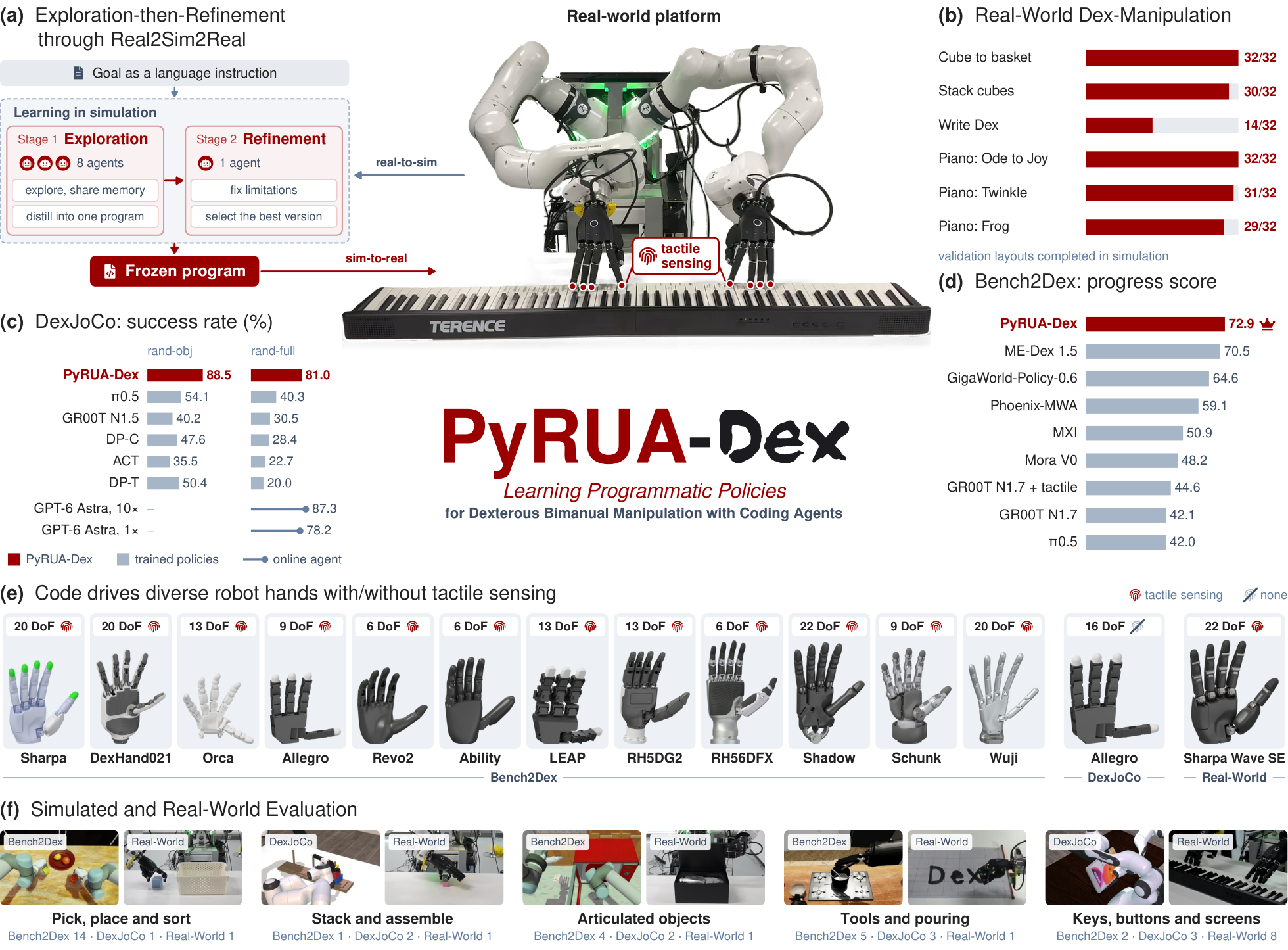
The DAGroup from Peking University, in collaboration with NUS, NVIDIA, Tongji University, and the University of Chicago, introduced PyRUA-Dex (arXiv:2611.33144, November 24, 2026) — a framework where coding agents based on GPT-6 Astra via Codex CLI learn bimanual manipulation by generating executable Python programs instead of neural policies and without a single human demonstration. The final program runs at the control frequency without a single LLM token.


What happened
PyRUA-Dex uses a two-stage pipeline. First, parallel coding agents in the simulator search for skills and ways to combine them; then, a distiller consolidates successful attempts into a skill library and a single base program, which is refined on random layouts. The final artifact is a "frozen" program consisting of 2,241 lines of Python across 22 files, which can be read and edited by hand. Reported results: SOTA on Bench2Dex — 72.9 points and 60.6% success rate versus 44.6% after the search stage, and 81.0% success rate on DexJoCo with full randomization versus 40.3% for the best trained policy. On a real platform with two hands having 22 degrees of freedom each (2x FR3 + Sharpa Wave), demonstration videos were shown, including playing the piano.
Context
The main bottleneck in dexterous manipulation is the shortage of high-quality demonstrations: retargeting from video is imprecise, teleoperation does not provide force feedback, and exoskeletons do not scale. The standard approach is training a neural policy on demonstrations, but PyRUA-Dex changes the format of the "policy" itself: instead of model weights, the final artifact is readable program code. LLM agents work only during the training stage in the simulator, while a static program is executed at runtime without calling the model. This is a new product pattern where retargeting a robot reduces to editing code rather than fine-tuning a model.
Why this matters for the industry
The approach addresses the shortage of demonstrations that limits the deployment of dexterous robots. Replacing weight training with the generation of readable code, executed without an LLM at the control frequency, promises cheap and interpretable retargeting of robots to new tasks. If the approach is confirmed on other platforms, it will reduce the cost of introducing robots into production and services and may make programmatic policies a standard tool for tasks with clear specifications where interpretability and manual editing are more important than general generalization ability. For R&D teams, the "agent writes robot program" pipeline becomes a reference for designing their own agentic pipelines.
Why this matters for users
Currently, this is a research result, not a ready-made tool: there is no code, no API, and no data on cost and latency. You can read the arXiv:2611.33144 paper, watch videos of real tasks and result tables on the project page, and also follow the dex branch of the DAGroup-PKU/PyRUA-Lean repository, where the authors promise to publish the harness. The key fact for evaluation: the policy is 2,241 lines of Python in 22 files, not a model, and it can be read and edited by hand.
What is currently unknown / limitations
The code and harness have not been published (status "coming soon" on the dex branch), so SOTA claims on Bench2Dex and DexJoCo are not verifiable. On Bench2Dex, the comparison is provided only with their own intermediate result (44.6% after the search stage), not with the best trained policies, leaving the SOTA claim unconfirmed. Results were obtained on a single platform, there is no independent reproduction, no assessment of policy generation cost, and no data on reliability outside of demonstrations.
Sources
- PyRUA-Dex: Learning Programmatic Policies for Dexterous Bimanual Manipulation with Coding Agents (arXiv:2611.33144)
- PyRUA-Dex — project page (Peking University DAGroup and co-authors)
- DAGroup-PKU/PyRUA-Lean, dex branch (README with results and code status)
Author
Look at AI, editorial team