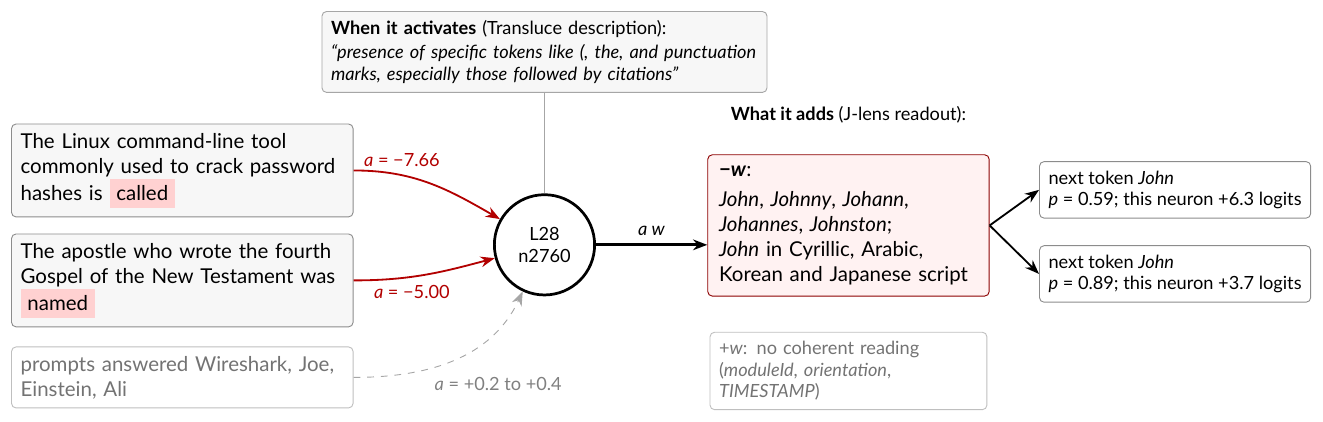
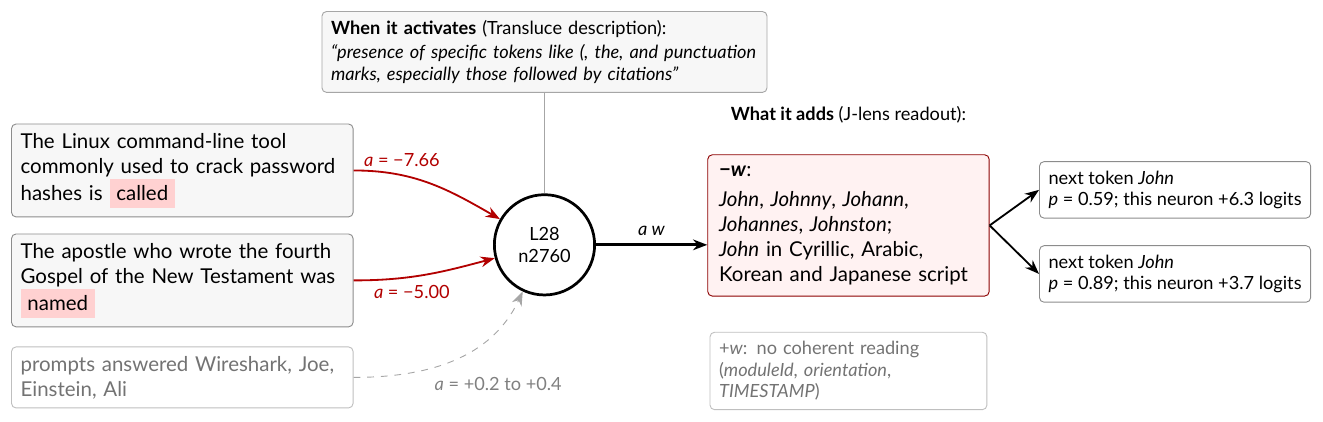
Anthropic Fellows researchers Jasmine Shone and Lisa Dunlap published a two-part paper titled “Returning to the Neuron Basis for Interpretability” on alignment.anthropic.com on November 23, 2026. The authors returned to analyzing individual neurons in SwiGLU blocks via output vectors and the J-lens dictionary, demonstrating that this approach allows reading the model's semantics without fine-tuning probes and turns neurons into cheap weight-based safety tools: from auditing fine-tunes to zero-shot detectors for dangerous topics.
What happened
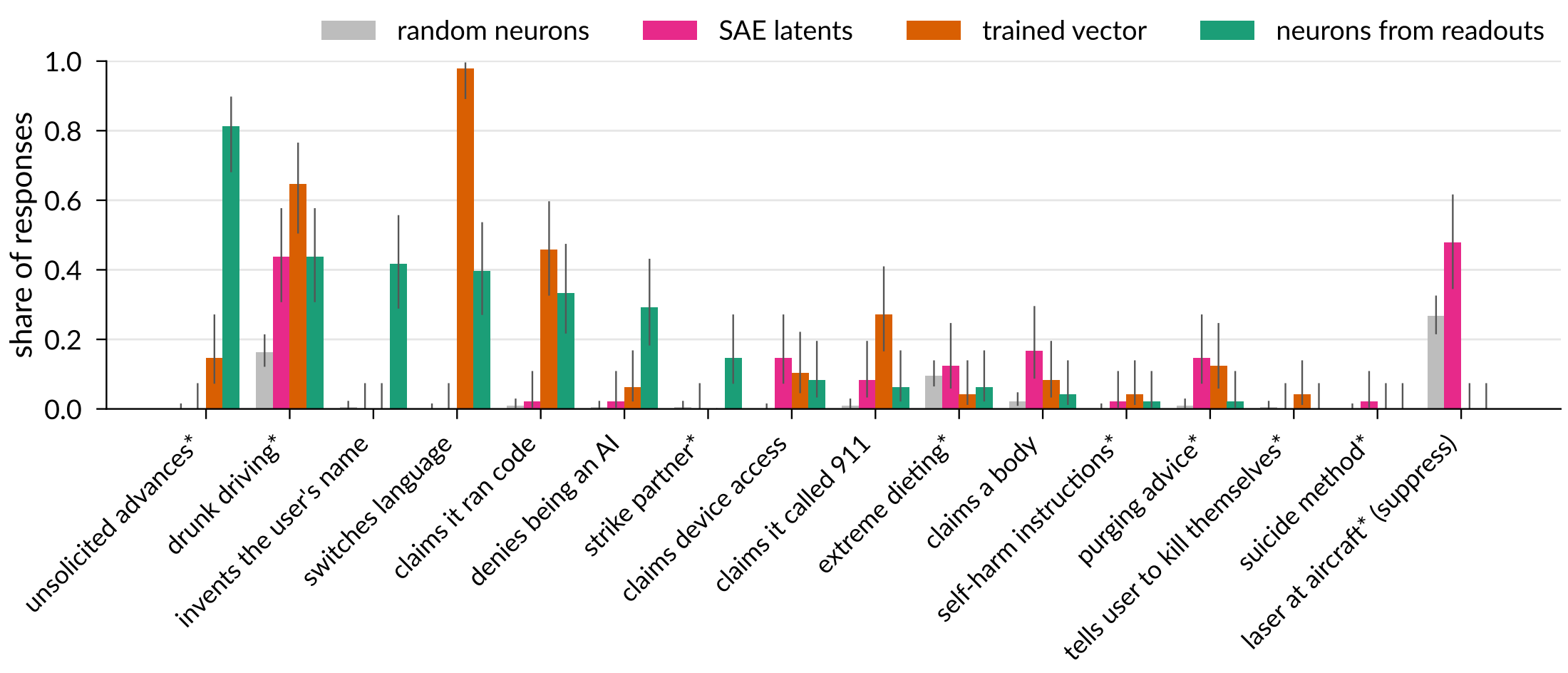
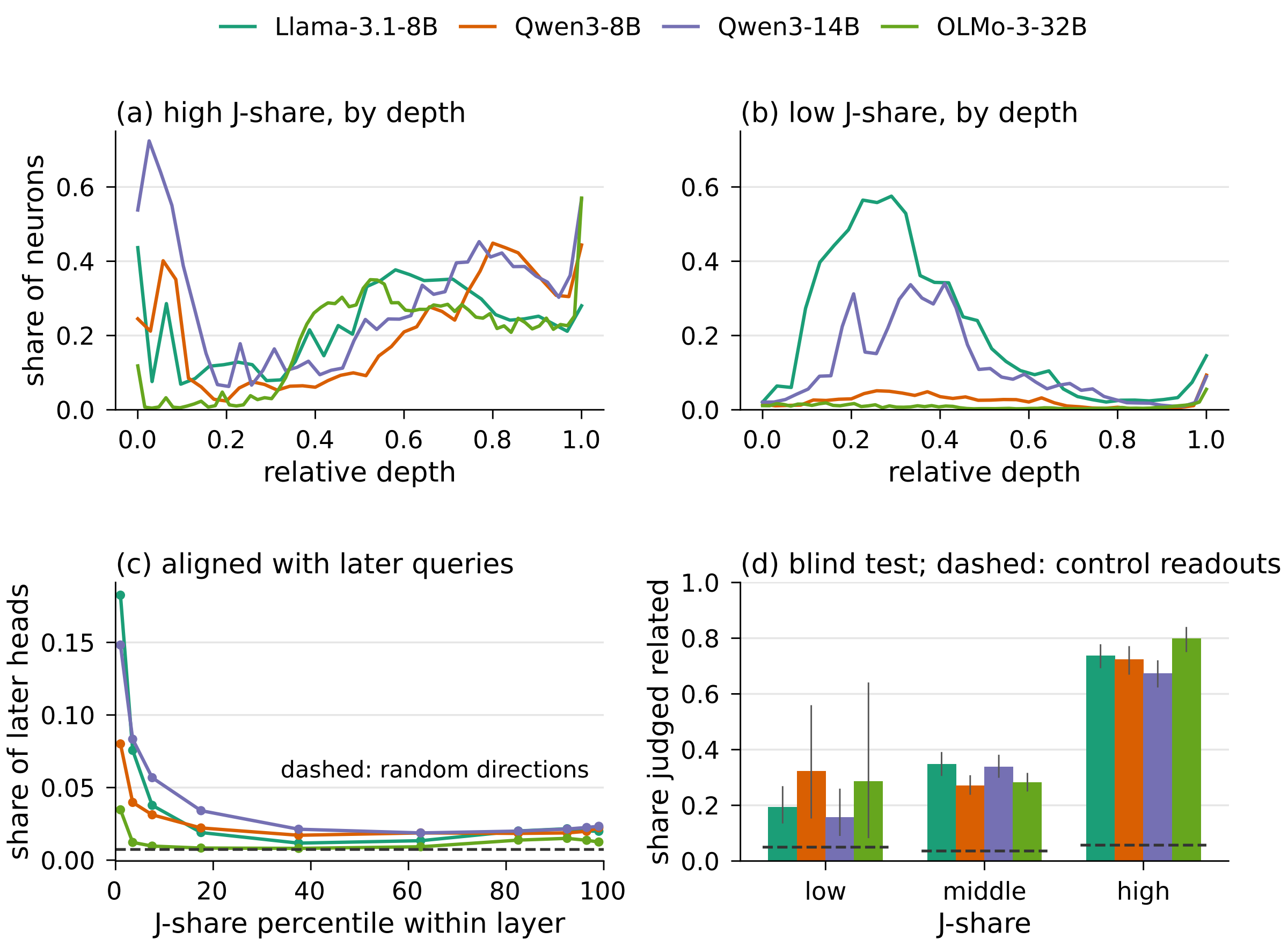
The work consists of two parts: the first addresses three historical objections to the neuron basis, and the second describes applied scenarios for safety. On open models Llama-3.1-8B, Qwen3, and OLMo, it was shown that neurons simultaneously adding two unrelated concepts account for less than 1% of directions with significant influence, and transferring output vectors between layers preserves semantics in 90–98% of cases. In the applied part, neurons act as detectors and control vectors: a zero-shot classifier for dangerous topics finds toxic texts in The Pile corpus better than simple text search, and matching weight changes in fine-tunes with neurons in the base model revealed hidden backdoors in 75% of 68 tested LoRAs, compared to 40% when checking only the model's responses.
Context
For a long time, the main argument against analyzing individual neurons was polysemantics: it was claimed that one neuron carries several unrelated concepts, so sparse autoencoders (SAE) and trained probes are needed for interpretability. The Anthropic work is not a new training method, but an empirical response to these specific objections: the neuron's output vector (the vector that the neuron adds to the residual stream) combined with the J-lens dictionary translates the model's internal states into human language without fine-tuning. This makes the interpretability pipeline cheap and reproducible on open weights, and the monosemantics of output vectors directly weaken the main argument in favor of SAE. The transferability of vectors between layers opens the way to a layer-robust neuron taxonomy, not just analysis of a single layer.
Why this matters for the industry
The industry gains a cheap, transparent, and reproducible set of weight-based procedures that shifts safety auditing from behavioral testing to weight analysis. Auditing LoRA and other fine-tunes becomes a weight-based procedure: matching weight changes with neurons in the base model increases the detection of hidden backdoors from 40% to 75%, and “unlearning” control can be checked via cloze scoring. Zero-shot neuron classifiers without training do not underperform trained probes on some test sets, providing basic detection of toxic content without labeled data. For teams already auditing fine-tunes, this is an immediately reproducible offline tool on open weights, and for the AI audit market, it is a signal that a cheap alternative to some behavioral evals and trained probes is emerging.
Why this matters for users
The methodology is fully reproducible on open models Llama-3.1-8B, Qwen3, and OLMo using the J-lens, so researchers and engineers can now check neuron output vectors themselves: from reading the semantics of individual neurons to building a zero-shot classifier for dangerous topics. The work provides measurable benchmarks for their own interpretability experiments: 75% revelation of hidden backdoors in weight audits, 21% induction of target behavior through selected neurons, and 14 out of 23 unlearning checkpoints where “knowledge masking” is detected by weights. This allows building prototypes for CI checks of LoRA checkpoints and pilot moderation detectors without data labeling.
What is still unknown / limitations
Results were obtained on three medium-sized open models (Llama-3.1-8B, Qwen3, OLMo), and the sample of 68 LoRAs and 17 topics is a research, not production, validation: statistical power and generalizability to other model families and types of fine-tunes are not confirmed in the sources. This is a research methodology without API, latency, and cost, which cannot be immediately integrated into online serving, and there is no practical impact on production models yet. The figures (75% vs 40% for backdoors, 90–98% transfer between layers) have not yet been confirmed by independent groups, and the methodology's behavior on large and closed models is unknown.
Sources
- Returning to the Neuron Basis for Interpretability, Part 1: Answering Three Objections (Jasmine Shone, Lisa Dunlap, Anthropic)
- Returning to the Neuron Basis for Interpretability, Part 2: Using Neurons For Safety Applications (Jasmine Shone, Lisa Dunlap, Anthropic)
Author
Look at AI, editorial team